Medical Billing
 Medical Coding
 Medical Audit
 Provider Credentialing
 Denial Management
 A/R Follow-up
 Private Practice
 Patient Help Desk
 Customized Reporting
 Out-of-Network Billing
 Internal Medicine
 Pediatrics
 Radiology
 Surgery
 Emergency Medicine
 Anesthesiology
 Cardiology
 Orthopedic
 Psychiatry
 Dentistry
 OB-GYN
 Family Medicine
The Centers for Medicare & Medicaid Services (CMS) CLFS 2026 update is not just a compliance change; it’s a direct shift in how laboratory revenue will be calculated for years to come. Because Medicare reimbursement is built on private payer data submitted by laboratories, even small reporting inaccuracies can lower payment rates across thousands of claims.
This makes CLFS more than a reporting requirement. For laboratories, providers, and organizations offering CMS billing services or laboratory billing services, it is a revenue-setting mechanism where the quality of your data today determines your reimbursement tomorrow.
What Is the Clinical Laboratory Fee Schedule (CLFS)?
The Clinical Laboratory Fee Schedule (CLFS) is Medicare’s payment system for most laboratory tests. Instead of fixed pricing, Medicare calculates reimbursements using private payer data submitted by laboratories, making payments reflect real market rates.
Under the Protecting Access to Medicare Act (PAMA), CMS uses the weighted median of private insurer payments to set national lab reimbursement rates. These rates are updated every three years, meaning accurate reporting directly impacts future laboratory revenue and reimbursement performance.
CLFS 2026 Updates and CMS Reporting Requirements for Laboratory Providers
Many providers rely on CMS credentialing services and medical billing services to ensure payer enrollment accuracy, proper reimbursement tracking, and compliant CLFS reporting.
The CLFS 2026 cycle introduces several important updates that directly affect how laboratories collect, validate, and report payment data. While the structure of CLFS remains consistent, the timelines and financial implications have been updated in ways that significantly influence provider planning and long-term reimbursement strategy.
1. New Data Collection Period (2025)
The data used for the 2026 reporting cycle must be collected between January 1 and June 30, 2025. This period is critical because it captures all eligible private payer payments that will later be used to calculate Medicare reimbursement rates. Any gaps or missing data during this window can directly affect the accuracy of future payment calculations, making early and consistent data tracking essential for laboratories.
2. 2026 Reporting Period Requirements
Once data is collected, laboratories must submit their reports during the official CMS reporting window from May 1 to July 31, 2026. This is the formal submission phase where all validated private payer data is reported to the Centers for Medicare & Medicaid Services (CMS). Accuracy at this stage is critical, as submitted data becomes the foundation for future CLFS payment rate calculations and cannot be easily corrected once finalized.
3. Payment Reduction Delay Explained
For the 2026 cycle, CMS has confirmed that there will be no payment reductions applied. This temporary pause provides financial stability for laboratories and allows additional time to strengthen reporting processes. However, this delay is not a permanent exemption. It reflects a transitional approach designed to give providers time to adjust to updated reporting requirements and improve data accuracy before payment reductions resume in future cycles.
4. Payment Reduction Caps Starting 2027
Beginning in 2027, CLFS payment reductions are expected to resume, with a maximum cap of 15% per year through 2029. While this cap is designed to prevent sudden reimbursement drops, it still represents a significant long-term revenue adjustment for laboratories. The impact of these reductions will depend heavily on the accuracy of data submitted in the 2026 cycle, making this reporting period a key financial checkpoint for providers.
CLFS Reporting Process: CMS Data Collection, Validation, and Submission Steps
The CLFS reporting process is a structured workflow that directly impacts how Medicare calculates future laboratory reimbursement. Each step must be handled with accuracy because CMS uses this data to set payment rates for the next cycle.
Step 1: Private Payer Data Collection for CLFS Reporting
Labs must first collect all applicable private payer payment data from the defined reporting period. This includes commercial insurance, Medicare Advantage, and other qualifying payers. The key requirement here is completeness; missing even a small portion of data can distort the final reimbursement calculation and reduce future CLFS rates.
Step 2: Data Validation and Accuracy Review Before CMS Submission
Once collected, the data must be reviewed for accuracy and eligibility. This includes confirming CMS reporting thresholds, verifying payer classifications, and validating payment amounts against source records. Errors at this stage directly impact the weighted median calculation used for Medicare reimbursement, making this the most critical control point in the process.
Step 3: CMS Submission Process for CLFS Reporting
After validation, the finalized data is submitted to the Centers for Medicare & Medicaid Services (CMS) within the official reporting window. This submission becomes the official dataset used to calculate future CLFS payment rates. Once reported, the data cannot be revised, which makes accuracy and internal review essential before submission.
Who Qualifies as a Private Payer Under CMS CLFS Reporting Rules
Accurate identification of private payers is critical in CLFS reporting because CMS uses this data to calculate future Medicare reimbursement rates. Any misclassification or omission can directly impact the weighted median and reduce payment accuracy for laboratory services.
- Types of Private Payers Included in CLFS Reporting
CLFS private payer data includes all non–fee-for-service Medicare payments that reflect market-based reimbursement. This primarily includes commercial insurance plans, which make up the largest portion of laboratory payments.
It also includes group health plans, typically employer-sponsored coverage, as well as Medicare Advantage plans, since they operate under managed care arrangements. In addition, Medicaid Managed Care organizations are included when payments are processed through managed care contracts rather than traditional Medicaid fee schedules.
- Common Private Payer Classification Errors in CLFS Data
The most common issue in CLFS reporting is incorrect payer mapping, where payers are mislabeled during data extraction or aggregation. This leads to inaccurate reporting of payment rates.
Another frequent problem is missing eligible payer data, especially when laboratories use multiple billing systems or clearinghouses. If all qualifying payments are not captured during the reporting period, the submitted data becomes incomplete, which can negatively impact future reimbursement calculations under the Centers for Medicare & Medicaid Services (CMS) CLFS methodology.
Financial Impact of CLFS 2026 on Laboratory Revenue and Medicare Reimbursement
CLFS has a direct and long-term effect on laboratory reimbursement because Medicare payment rates are built from the data laboratories submit. Unlike claim-level billing issues, this is not a short-term adjustment; it becomes the basis for how services are priced across an entire three-year cycle.
- How CMS CLFS Data Directly Impacts Medicare Payment Rates
The data submitted to the Centers for Medicare & Medicaid Services (CMS) is used to calculate the weighted median of private payer rates, which directly determines Medicare payment levels under CLFS. This means every reported payment amount contributes to the final reimbursement benchmark.
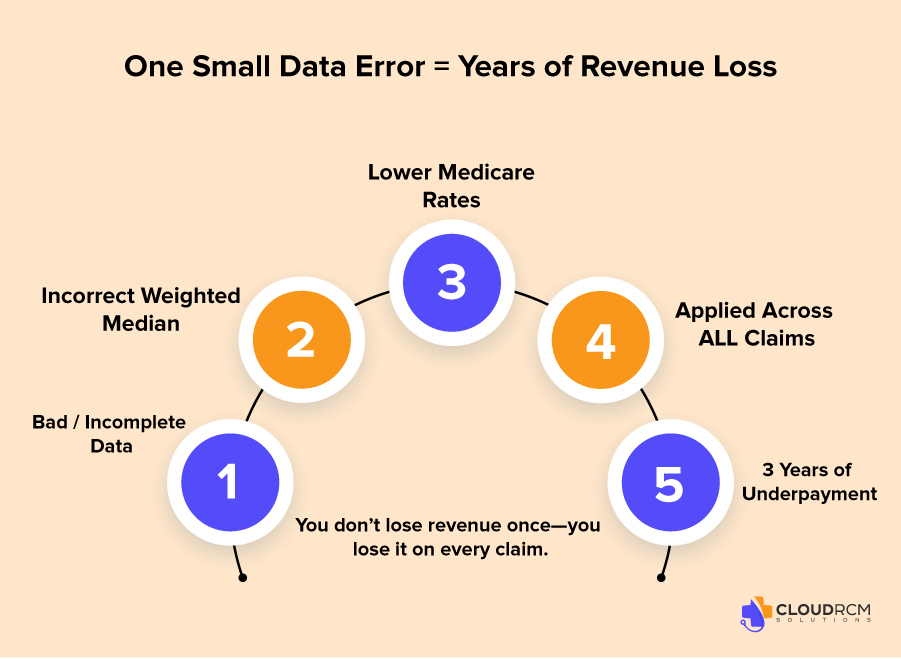
If data is incomplete, underreported, or incorrectly classified, the calculated median becomes lower than actual market rates. Once CMS finalizes these rates, they are applied nationally, directly affecting laboratory reimbursement for each covered test.
- Long-Term Revenue Impact of CLFS Reporting Errors
CLFS operates on a three-year rate-setting cycle, which means the impact of one reporting period extends well beyond a single year. Once rates are established, they remain in effect until the next update cycle, making reporting accuracy a long-term revenue driver rather than a one-time compliance task.
Any errors in data submission can create a compounding revenue loss effect. Even small inaccuracies in reported payer rates can reduce the overall median, and when applied across high-volume laboratory testing, this results in sustained underpayment over multiple years.
Common CLFS Reporting Mistakes That Reduce Laboratory Reimbursement
CLFS reporting errors are rarely caused by a single major failure. In most cases, they come from small but repeated gaps in data handling, validation, and timing. These issues directly affect how accurately Medicare calculates future reimbursement rates under the CLFS methodology used by the CMS.
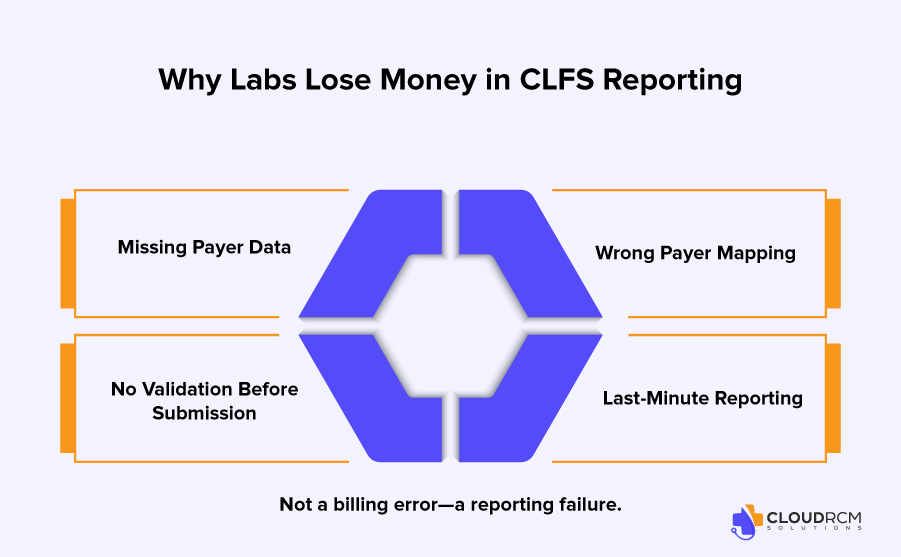
- Incomplete Data Submission
One of the most common issues is missing or partial payer data. This usually happens when all billing systems, clearinghouses, or service lines are not fully included during extraction. Even small gaps can distort the overall dataset, leading to lower calculated payment benchmarks.
- Incorrect Payer Classification
Misclassifying payers is another frequent error. When commercial, Medicare Advantage, or managed care payers are incorrectly labeled, the reported data does not accurately reflect real payment patterns. This directly impacts the weighted median used for CLFS rate calculation.
- Lack of Internal Validation
Many reporting issues occur because data is not properly reviewed before submission. Without internal checks for accuracy, eligibility, and consistency, errors remain in the final dataset. Once submitted to CMS, these issues cannot be corrected, making validation a critical control step.
- Last-Minute Reporting Approach
Delaying CLFS preparation until the reporting window often leads to rushed submissions and overlooked errors. When data collection, validation, and reporting are compressed into a short timeframe, the risk of inaccuracies increases significantly, which can negatively affect future reimbursement outcomes.
Best Practices for Accurate CLFS 2026 Reporting and CMS Compliance
Accurate CLFS reporting is built on preparation, not reaction. Since CMS uses submitted data to calculate future Medicare reimbursement rates, even small errors can impact long-term laboratory revenue under the CMS system.
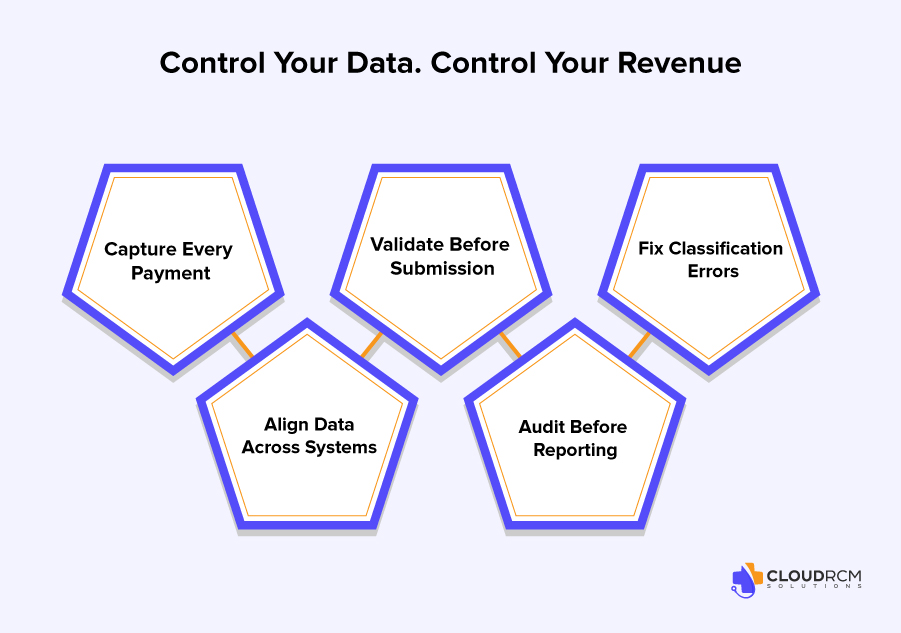
- Start early with data preparation by collecting and organizing payer data throughout the reporting period instead of waiting for the deadline. This helps reduce missing or incomplete records and improves overall accuracy.
- Conduct internal audits before submission to review payer classifications, payment accuracy, and data completeness so errors are identified and corrected in advance.
- Align billing, compliance, and finance teams to ensure all data is consistently captured, correctly mapped, and fully compliant with CMS reporting requirements.
- Use data analytics tools to detect gaps, inconsistencies, and unusual payment patterns, helping improve reporting accuracy and reduce the risk of submission errors.
CLFS success depends on how clean and validated your data is before submission, not how fast you submit it.
What Happens After CLFS 2026 Reporting and CMS Rate Calculation
Once laboratories complete the CLFS 2026 submission, the process moves from reporting to rate calculation and implementation. At this stage, the data submitted to the Centers for Medicare & Medicaid Services (CMS) becomes the foundation for future Medicare reimbursement, making this phase critical for long-term revenue planning.
- How CMS Calculates Medicare Rates Under CLFS Methodology
After the reporting window closes, CMS aggregates all submitted private payer data and calculates the weighted median for each laboratory test. This median becomes the benchmark for Medicare payment rates. In simple terms, the accuracy and completeness of submitted data directly determine how much Medicare will pay for each service in the next cycle.
- CLFS Implementation Timeline for 2027–2029
Once rates are finalized, CMS implements them starting in 2027. Under the current framework, any payment reductions are phased in gradually, with caps applied through 2029. This means reimbursement changes are not immediate but are spread over multiple years, making the impact dependent on both timing and the data quality of the 2026 reporting cycle.
- Understanding the Three-Year CLFS Reimbursement Cycle
CLFS operates on a three-year update cycle, meaning the data submitted in 2026 will influence Medicare reimbursement for several years beyond the reporting period. Once rates are set, they remain in effect until the next cycle, making each submission a long-term financial driver rather than a one-time compliance requirement.
Strategic Insight: How Laboratories Can Use CLFS Reporting as a Revenue Optimization Tool
CLFS is not just a compliance requirement; it is a reimbursement-setting system that directly impacts long-term laboratory revenue. The data submitted to the Centers for Medicare & Medicaid Services (CMS) is used to calculate future Medicare payment rates, meaning reporting accuracy directly affects how labs get paid for years.
Why CLFS Is More Than Compliance
CLFS goes beyond meeting reporting deadlines. It determines how Medicare values laboratory services based on submitted private payer data. This makes it a financial process, not just a regulatory one. Inaccurate or incomplete reporting can lower future reimbursement, even if compliance requirements are technically met.
How Smart Labs Use CLFS Strategically
Efficient labs treat CLFS as a revenue protection process. They continuously track payer data during the collection period, ensure proper payer classification, and perform internal validation before submission. This reduces errors and ensures the final data reflects true reimbursement levels, leading to more accurate Medicare rate calculations.
Positioning for Future Payment Stability
Since CLFS operates on a three-year cycle, each reporting period impacts reimbursement for multiple years. Labs that focus on clean data submission and structured reporting processes are better positioned to maintain stable payments, even when future reductions are introduced.
Cloud RCM Solutions: Supporting Accurate CLFS Reporting and Revenue Protection
Cloud RCM Solutions doesn’t just support CLFS reporting, we protect the revenue behind it. We help laboratories capture complete payer data, eliminate classification errors, and validate submissions before they reach CMS. Our structured workflows ensure your reported data reflects true market rates, not incomplete snapshots that reduce reimbursement.
We don’t just help you report; we help you report correctly, so your future payments stay accurate.
Conclusion
CLFS 2026 is not just another reporting cycle; it is a defining moment for your laboratory’s future reimbursement. The data you submit today will shape your payment rates for the next several years, making accuracy a direct driver of financial stability.
If your reporting process has gaps, your revenue will reflect it.
Partner with Cloud RCM Solutions to ensure your CLFS data is accurate, compliant, and optimized for maximum reimbursement. Don’t let reporting errors define your future payments – take control now.
FAQs
How does CLFS 2026 directly affect my lab revenue?
CLFS 2026 impacts revenue because Medicare payment rates are calculated from the data you submit. If your reported payer data is incomplete or inaccurate, future reimbursement rates can be set lower for multiple years.
What happens if we miss or delay CLFS reporting?
Missing the reporting window can result in non-compliance and exclusion of your data from CMS rate calculations. This can indirectly reduce future Medicare payments since your lab’s actual market rates are not fully represented.
Why is CMS using private payer data instead of fixed rates?
The Centers for Medicare & Medicaid Services uses private payer data to reflect real market pricing. This ensures Medicare rates are aligned with what commercial insurers actually pay for laboratory services.
What is the biggest mistake labs make during CLFS reporting?
The most common issue is incomplete data capture, especially missing payer payments across multiple systems. This leads to inaccurate weighted median calculations and reduced reimbursement rates.
Can CLFS reporting errors be corrected after submission?
No. Once data is submitted to CMS, it becomes part of the official rate calculation. That’s why internal validation before submission is critical.
How can labs reduce revenue risk during CLFS reporting?
Labs can reduce risk by maintaining continuous data tracking, validating payer classifications, and performing internal audits before submission, rather than relying on last-minute reporting.
Why should providers treat CLFS as a financial strategy, not just compliance?
Because CLFS determines Medicare reimbursement for multiple years, it directly affects long-term revenue. Treating it strategically helps ensure accurate payment rates and prevents silent revenue loss.