Medical Billing
 Medical Coding
 Medical Audit
 Provider Credentialing
 Denial Management
 A/R Follow-up
 Private Practice
 Patient Help Desk
 Customized Reporting
 Out-of-Network Billing
 Internal Medicine
 Pediatrics
 Radiology
 Surgery
 Emergency Medicine
 Anesthesiology
 Cardiology
 Orthopedic
 Psychiatry
 Dentistry
 OB-GYN
 Family Medicine
Laboratory testing drives critical patient care, quietly draining thousands in revenue every month, often without labs realizing where the leakage is happening. Studies show that up to 20% of lab claims are denied on first submission, often due to coding errors, missing documentation, or payer compliance gaps. Even minor mistakes in CPT or ICD‑10 coding can stall reimbursements, stretch A/R days, and disrupt cash flow.
With the rise of molecular, genetic, and high-complexity testing, 2026 has made laboratory billing more complicated than ever. Labs must navigate evolving payer rules, detailed documentation requirements, and frequent claim denials, all while maintaining accurate reporting and maximizing revenue. This guide breaks down the billing process, common pitfalls, and actionable strategies to optimize reimbursements and streamline your lab’s revenue cycle.
What Is Laboratory Billing?
Laboratory billing is the process of submitting, managing, and reconciling claims for diagnostic tests performed in clinical laboratories. It involves coding procedures with CPT and ICD-10 codes accurately, verifying patient insurance coverage, documenting medical necessity, and ensuring claims comply with payer and regulatory requirements. Effective lab billing maximizes reimbursements, minimizes denials, and maintains a smooth revenue cycle for healthcare providers.
Why Laboratory Billing Has Become More Complex in 2026
Laboratory billing in 2026 has grown increasingly complex due to a combination of regulatory changes, evolving payer policies, and the rapid advancement of diagnostic testing. Accurate CPT coding and ICD-10 documentation are no longer optional; minor mistakes can lead to denied claims, delayed reimbursements, and lost revenue. Laboratories are now expected to provide precise medical justification for each test, particularly for high-complexity and specialized procedures such as genetic panels, molecular diagnostics, and advanced biomarker tests.
Frequent updates to CPT and ICD-10 codes further increase the risk of errors, requiring billing teams to stay current and ensure every claim meets payer specifications. In addition, compliance standards from CLIA, CMS, and commercial insurers demand meticulous documentation, thorough audit readiness, and proper test justification. Payers are also scrutinizing the clinical necessity of tests more closely, making even small gaps in documentation a potential reason for denials.
The combination of these factors has transformed laboratory billing into a precision-driven process where accuracy, timeliness, and adherence to payer guidelines directly impact revenue cycle performance. Laboratories that fail to maintain up-to-date coding, proper documentation, and rigorous verification processes may face longer A/R cycles, higher denial rates, and operational inefficiencies. For labs aiming to optimize reimbursement in 2026, understanding the complexities of modern laboratory billing is critical to maintaining compliance, protecting revenue, and ensuring consistent cash flow.
End-to-End Laboratory Billing Process
Laboratory billing in 2026 has become increasingly complex, requiring accuracy at every stage to ensure timely payer reimbursement and maximize revenue. From test ordering to payment posting, each step in the laboratory revenue cycle management (RCM) workflow must be precise. Errors in coding, documentation, or eligibility verification can lead to delayed claims, high denial rates, and disrupted cash flow.
- Test Ordering & Patient Registration
The laboratory billing process starts with test ordering and accurate patient registration. Verifying insurance eligibility upfront is critical to ensure coverage, identify prior authorization requirements, and prevent denials. Correct patient demographics, provider NPI, and insurance information reduce front-end rejections and lay the foundation for smooth claim submission. Even minor mistakes at this stage, like incorrect plan details, can delay reimbursement cycles.
- Specimen Processing & Documentation Accuracy
Proper documentation for lab billing is essential to support claims and meet payer compliance requirements. Every test must include detailed information about the methodology, clinical purpose, and linkage to the patient’s ICD-10 diagnosis codes. Physician orders must clearly justify medical necessity, particularly for high-complexity tests such as molecular or genetic assays. Maintaining audit-ready records helps laboratories avoid denials and supports regulatory compliance during payer reviews.
- CPT & ICD-10 Coding for Lab Services
Accurate CPT coding for laboratories transforms clinical services into billable claims. Each test should be assigned the correct CPT code, while ICD-10 codes establish medical necessity. Appropriate use of modifiers clarifies repeated, distinct, or reference lab procedures. Validating codes against payer rules and NCCI edits reduces errors, minimizes claim denials, and ensures clean claim submission for faster revenue cycle optimization.
- Claim Submission & Payer Communication
Once coding is complete, electronic claim submission to payers accelerates processing and reduces manual errors. Adhering to payer-specific rules is crucial to avoid rejections. Some claims may require supporting documentation, such as physician orders or test rationale, to ensure full reimbursement. Incorrect documentation or code mismatches remain a leading cause of first-pass denials in laboratory billing in 2026.
- Payment Posting & Denial Management
The final stage of the laboratory billing cycle is payment posting and denial management. Payments should be reconciled against expected reimbursement to identify underpayments. Denials must be categorized and addressed promptly, using proper documentation and coding justification for appeals. Continuous A/R follow-up, KPI tracking, and denial trend analysis help laboratories identify recurring issues, reduce future denials, and optimize revenue cycle performance.
Implementing a precise, end-to-end laboratory billing workflow ensures labs in 2026 minimize errors, maintain regulatory compliance, accelerate payer reimbursements, and protect cash flow.
Laboratory Billing Codes Cheat Sheet (CPT & ICD-10)
Below is a quick-reference cheat sheet to help billing teams reduce coding errors and improve claim accuracy.
| Procedure/Test | CPT Code | Common ICD-10 Codes | Billing Insight |
| CBC | 85025 | R53.83, D64.9 | Ensure diagnosis supports necessity |
| CMP | 80053 | I10, E11.9 | Avoid unbundling components |
| Lipid Panel | 80061 | E78.5 | Watch frequency limits |
| HbA1c | 83036 | E11.9 | Must link to diabetes |
| TSH | 84443 | E03.9, R53.83 | General diagnosis may be denied |
| Urinalysis | 81003 | N39.0, R30.0 | Link symptoms clearly |
| Vitamin D | 82306 | E55.9 | High denial risk |
| Troponin | 84484 | I21.9, R07.9 | Must justify cardiac need |
| COVID PCR | 87635 | U07.1 | Follow payer updates |
| Glucose | 82947 | R73.9, E11.9 | Avoid duplication |
Key Modifiers in Laboratory Billing
| Modifier | Meaning | Usage |
| 91 | Repeat test | Same test repeated same day |
| 59 | Distinct service | Separate procedures |
| QW | CLIA waived | Required for waived tests |
| 90 | Reference lab | Sent to outside lab |
| 26 | Professional component | Interpretation only |
| TC | Technical component | Equipment/testing |
Common Reasons for Laboratory Claim Denials
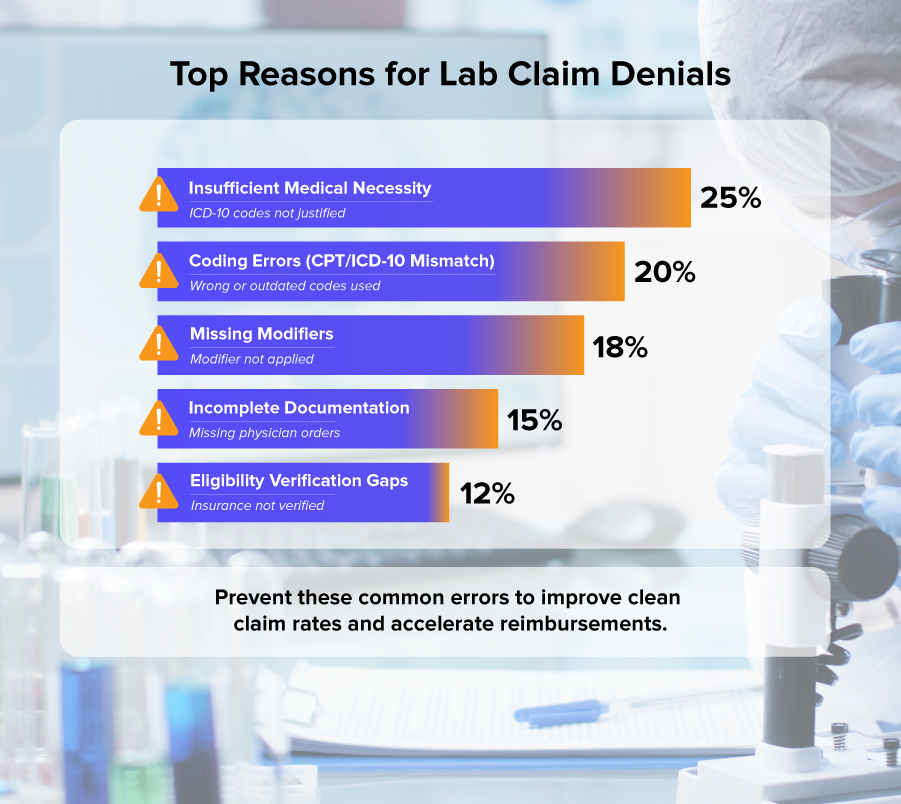
Laboratory claims are highly scrutinized by payers, making denial prevention a critical part of revenue cycle management. In many cases, denial rates for complex diagnostics can reach 18–25%, significantly impacting cash flow if not addressed proactively.
One of the most common reasons for denials is insufficient medical necessity, where diagnosis codes fail to clearly justify the test performed. Payers require specific and relevant ICD-10 codes, and vague documentation often leads to rejection. Coding errors also contribute significantly, particularly when outdated CPT codes or incorrect code combinations are used.
Eligibility verification gaps can result in claims being submitted for non-covered services, while incomplete documentation, such as missing physician orders or unclear clinical justification, further weakens claims. Addressing these issues at the source helps improve clean claim rates, reduce administrative rework, and ensure more consistent reimbursement.
How to Reduce Laboratory Billing Denials in 2026
Reducing laboratory claim denials requires a proactive, structured approach that addresses issues before claims are submitted. Since most denials originate from preventable errors, optimizing front-end and mid-cycle processes can significantly improve reimbursement outcomes.
- Strengthen medical necessity validation before billing
Ensure that every test ordered is supported by a specific and relevant ICD-10 diagnosis. Implementing pre-bill checks helps identify weak or missing clinical justification before submission, reducing avoidable denials and rework. - Implement pre-bill claim scrubbing processes
Automated or manual claim scrubbing helps detect coding errors, missing modifiers, and payer-specific rule violations before claims are sent. This improves clean claim rates and minimizes first-pass rejections. - Standardize documentation workflows
Consistent documentation practices across providers ensure that all required details, such as physician orders, test rationale, and supporting clinical notes, are captured accurately. This reduces variability and strengthens claim integrity. - Track and analyze denial trends regularly
Monitoring denial patterns helps identify recurring issues, whether related to coding, payer rules, or documentation gaps. Addressing root causes improves long-term billing performance and reduces revenue leakage. - Train staff on updated coding and payer requirements
Continuous training ensures billing teams stay aligned with CPT updates, ICD-10 changes, and payer-specific policies, reducing the likelihood of errors that lead to denials.
A proactive denial management strategy not only reduces rework but also improves cash flow predictability and overall revenue cycle efficiency.
Key KPIs in Laboratory Revenue Cycle Management
Tracking key performance indicators (KPIs) is essential for evaluating the financial health of laboratory billing operations. Without measurable benchmarks, it becomes difficult to identify inefficiencies or improve performance.
- Clean Claim Rate
This measures the percentage of claims accepted on the first submission without errors. A high clean claim rate indicates strong front-end processes, accurate coding, and efficient billing workflows, all of which contribute to faster reimbursements. - Denial Rate
The denial rate reflects the percentage of claims rejected by payers. Laboratories should aim to keep this rate as low as possible, as higher denial rates lead to increased administrative work and delayed revenue collection. - Days in Accounts Receivable (A/R)
This KPI tracks how long it takes to receive payment after claim submission. Lower A/R days indicate faster reimbursement cycles and better cash flow management. - First-Pass Acceptance Rate
This measures how many claims are approved without requiring corrections or resubmission. A high rate reflects strong billing accuracy and reduces operational inefficiencies. - Net Collection Rate
This shows how much of the expected revenue is actually collected. It highlights gaps in billing performance, including underpayments and uncollected balances.
Regularly monitoring these KPIs allows laboratories to identify bottlenecks, improve workflows, and maintain a more predictable and stable revenue cycle.
Why Accurate Coding is Critical in Laboratory Billing
Accurate coding is essential not only for reimbursement but also for maintaining compliance and operational efficiency. Because laboratory tests often involve specific coding rules and payer policies, even small inaccuracies can result in denied or underpaid claims.
Proper alignment between CPT and ICD-10 codes ensures that services are medically justified and correctly represented, improving first-pass acceptance rates. In addition, accurate coding prevents revenue leakage caused by missed or incorrect charges, while also supporting compliance with regulatory requirements.
By reducing errors and minimizing the need for claim corrections or appeals, strong coding practices improve workflow efficiency and help laboratories maintain a stable and predictable revenue cycle.
CMS & Compliance Updates Impacting Lab Billing in 2026
Regulatory and compliance requirements continue to shape laboratory billing practices in 2026. Payers, including CMS, are placing greater emphasis on detailed documentation to support medical necessity, making it essential for laboratories to maintain complete and accurate records for every test performed.
At the same time, reimbursement models are evolving, with a growing focus on value-based care and appropriate test utilization. This shift requires laboratories to align billing practices with updated payer guidelines to ensure consistent reimbursement.
Increased audit activity further highlights the need for compliance, as missing documentation or incorrect coding can lead to penalties or delayed payments. Staying current with CMS updates and integrating them into billing workflows is essential to reduce risk and maintain financial stability.
How Cloud RCM Solutions Supports Laboratory Billing Efficiency
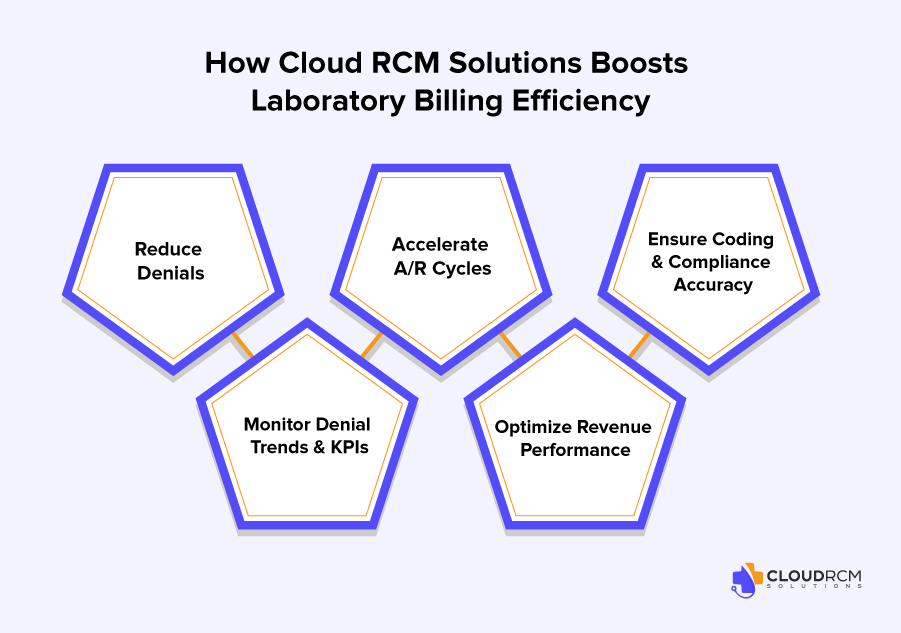
Managing laboratory billing internally can be overwhelming due to the complexity of coding, compliance, and denial management. This is where Cloud RCM Solutions provides strategic support to streamline the entire revenue cycle.
By identifying gaps in documentation, coding accuracy, and payer compliance, Cloud RCM Solutions helps laboratories reduce denial rates, improve clean claim submissions, and accelerate reimbursements. Their structured workflows and continuous monitoring ensure that billing processes remain consistent, compliant, and optimized for revenue performance.
Additionally, tracking key performance indicators such as denial trends, clean claim rates, and A/R days gives laboratories greater visibility into financial health. This allows for proactive improvements, better decision-making, and more predictable cash flow, critical for long-term growth and stability.
Conclusion
Laboratory billing in 2026 is complex, and even small inefficiencies can lead to significant revenue loss, delayed payments, and operational challenges. By implementing structured workflows, maintaining coding accuracy, and staying aligned with compliance requirements, laboratories can reduce denials and improve financial performance.
Stop revenue leakage before it impacts your bottom line. Partner with Cloud RCM Solutions to streamline billing, reduce denials, and achieve faster, more predictable reimbursements.
FAQs
What is laboratory billing and why is it complex in 2026?
Laboratory billing involves coding, submitting, and managing claims for diagnostic testing services. It has become more complex due to advanced testing procedures, stricter payer requirements, and frequent updates to coding and compliance standards.
Why do laboratory claims get denied frequently?
Common reasons include insufficient medical necessity, incorrect CPT or ICD-10 coding, missing modifiers, incomplete documentation, and lack of insurance verification. These issues can often be prevented with proper workflows and validation processes.
How can laboratories improve their clean claim rate?
Improving clean claim rates requires accurate coding, complete documentation, pre-bill claim scrubbing, and thorough insurance verification. Standardizing workflows also helps reduce variability and errors.
What are the most important KPIs for laboratory billing?
Key KPIs include clean claim rate, denial rate, days in A/R, first-pass acceptance rate, and net collection rate. These metrics provide insight into billing performance and overall revenue cycle efficiency.
How can outsourcing laboratory billing services help?
Outsourcing provides access to experienced billing professionals who specialize in coding accuracy, denial management, and compliance. This helps reduce errors, accelerate reimbursements, and improve overall financial performance.
What role does documentation play in laboratory billing?
Documentation is critical for establishing medical necessity and supporting claims. Incomplete or unclear documentation is one of the leading causes of denials and delayed payments.