Medical Billing
 Medical Coding
 Medical Audit
 Provider Credentialing
 Denial Management
 A/R Follow-up
 Private Practice
 Patient Help Desk
 Customized Reporting
 Out-of-Network Billing
 Internal Medicine
 Pediatrics
 Radiology
 Surgery
 Emergency Medicine
 Anesthesiology
 Cardiology
 Orthopedic
 Psychiatry
 Dentistry
 OB-GYN
 Family Medicine
Telehealth billing for mental health has become one of the most complex and high-impact areas of the healthcare revenue cycle in 2026. As virtual care continues to expand, providers must navigate evolving payer policies, documentation requirements, and reimbursement rules where even minor errors can result in claim denials or delayed payments.
Today, telehealth billing goes beyond simple claim submission. It requires accurate use of CPT codes, correct modifiers, and proper place-of-service (POS) reporting, along with strict compliance with frequently updated regulations. Mastering these elements is essential for protecting revenue, improving claim acceptance rates, and reducing financial leakage in mental health practices.
What is Telehealth Billing in Mental Health?
Telehealth billing is the process of submitting and managing insurance claims for virtual psychiatric, counseling, and therapy services delivered through video or digital platforms.
Unlike traditional billing, telehealth claims require additional precision, including:
- Correct CPT code selection
- Proper telehealth modifiers (e.g., 95 or GT based on payer rules)
- Accurate place-of-service (POS) coding
- Strong clinical documentation
- Compliance with payer-specific telehealth policies
Each insurance payer may have different rules, making consistency and accuracy essential for successful reimbursement.
Why Telehealth Mental Health Billing Is Challenging in 2026
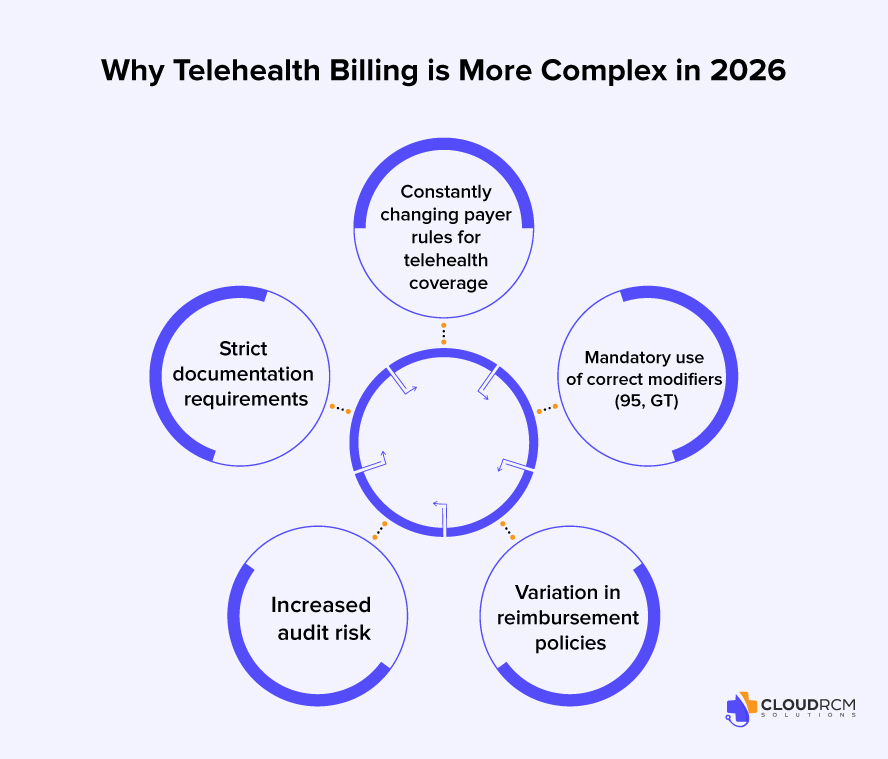
Telehealth billing complexity continues to increase due to evolving regulations and payer policies. Key challenges include:
- Frequent updates in CMS and insurance guidelines
- Varying telehealth coverage across payers
- Strict documentation requirements
- Higher audit and denial risk
- Time-sensitive coding rules for mental health services
Mental health practices also need to address broader telehealth revenue cycle challenges, including changing payer rules, documentation requirements, and claim processing issues.
Telehealth Billing for Mental Health: Key Rules in 2026
Telehealth billing for mental health in 2026 is governed by standardized coding, documentation, and payer-specific rules that determine whether a claim is accepted, denied, or reimbursed correctly. As virtual care continues to expand, insurers have become more precise in evaluating telehealth claims, making accuracy and compliance essential at every step.
Medicare telehealth claims require careful attention to current coding, coverage, and billing requirements. See our guide to Medicare telehealth billing for additional details.
Adherence to Payer-Specific Telehealth Policies
Telehealth coverage is not uniform across all insurers. Providers must follow specific guidelines related to:
- Eligible provider types
- Covered mental health services
- Required documentation formats
- Reimbursement conditions
Failure to align with payer policies often leads to avoidable denials.
Time-Based Coding Accuracy
Many mental health telehealth services are billed using time-based CPT codes. This means reimbursement is directly linked to session duration, making accurate time tracking and documentation essential for correct payment.
Where Most Billing Errors Occur
In practice, telehealth billing errors are usually not due to lack of services, but due to small technical mistakes such as:
- Using outdated or incorrect modifiers
- Inconsistent documentation across sessions
- Selecting the wrong POS code
- Missing payer-specific telehealth requirements
These issues can slow down reimbursements, trigger rework, or increase audit exposure, often requiring structured denial management strategies to resolve recurring claim issues.
Common Mental Health Telehealth CPT Codes
CPT coding is a key component of telehealth billing for mental health services. Accurate code selection ensures proper reimbursement and reduces the risk of claim denials.
The following CPT codes are most commonly used in mental health telehealth billing:
| CPT Code | Service Description | Typical Use in Telehealth Mental Health Billing |
| 90791 | Psychiatric Diagnostic Evaluation (No Medical Services) | Initial mental health assessment and treatment planning |
| 90832 | Psychotherapy, 30 Minutes | Short therapy sessions delivered via telehealth |
| 90834 | Psychotherapy, 45 Minutes | Standard individual therapy sessions (most commonly used) |
| 90837 | Psychotherapy, 60 Minutes | Extended therapy sessions for complex cases |
| 90846 | Family Psychotherapy (Without Patient Present) | Therapy involving family members only |
| 90847 | Family Psychotherapy (With Patient Present) | Family therapy sessions including the patient |
Key Coding Notes for Telehealth
- CPT codes remain the same for in-person and telehealth services
- Correct session duration documentation is essential for time-based codes
- Telehealth modifiers (e.g., 95 where required) must be applied correctly
- Payer-specific rules may affect reimbursement eligibility
- Documentation must clearly support medical necessity
Common Coding Issues (Explained)
Most telehealth claim denials can be traced back to a few common coding mistakes. In telehealth billing for mental health, even small coding errors can cause significant reimbursement issues. Most claim denials or payment delays don’t happen because services weren’t provided correctly, but because of technical billing errors.
1. Incorrect Time-Based Code Selection
Mental health therapy sessions are often billed based on time (30, 45, or 60 minutes). If the wrong CPT code is selected, for example, billing a 45-minute session as a 30-minute code, it can lead to underpayment or claim rejection.
2. Missing or Incorrect Telehealth Modifiers
Telehealth services require specific modifiers (such as 95 or GT, depending on the payer) to indicate that the service was delivered virtually. If these modifiers are missing or incorrectly applied, insurers may reject the claim or process it as a non-telehealth visit.
3. Mismatch Between Documentation and Billed CPT Code
Insurance companies closely review clinical notes. If the documentation shows a 30-minute session but a 60-minute CPT code is billed, it creates a mismatch that often triggers denials or audits.
4. Applying Outdated Payer Rules
Telehealth billing rules change frequently. Using outdated guidelines for modifiers, POS codes, or coverage policies can result in claim rejections, even if the service was valid and properly delivered.
Why These Issues Matter
These types of errors may seem small, but in practice, they can lead to:
- Delayed reimbursement cycles
- Increased claim rework and administrative workload
- Higher denial rates
- Potential audit risks for the practice
This is why accurate coding, updated payer knowledge, and consistent documentation are essential for maintaining smooth revenue flow in mental health telehealth billing.
How to Maximize Reimbursement in Telehealth Billing for Mental Health
Maximizing reimbursement in telehealth billing for mental health is not just about submitting claims; many practices rely on medical billing services to improve accuracy and improve the clean claim rate. It requires a structured approach that combines accurate coding, proper documentation, and alignment with payer-specific guidelines. Small improvements in billing practices can significantly strengthen reimbursement accuracy and improve overall revenue performance.
Practices that follow structured billing strategies can significantly improve cash flow and reduce rework.
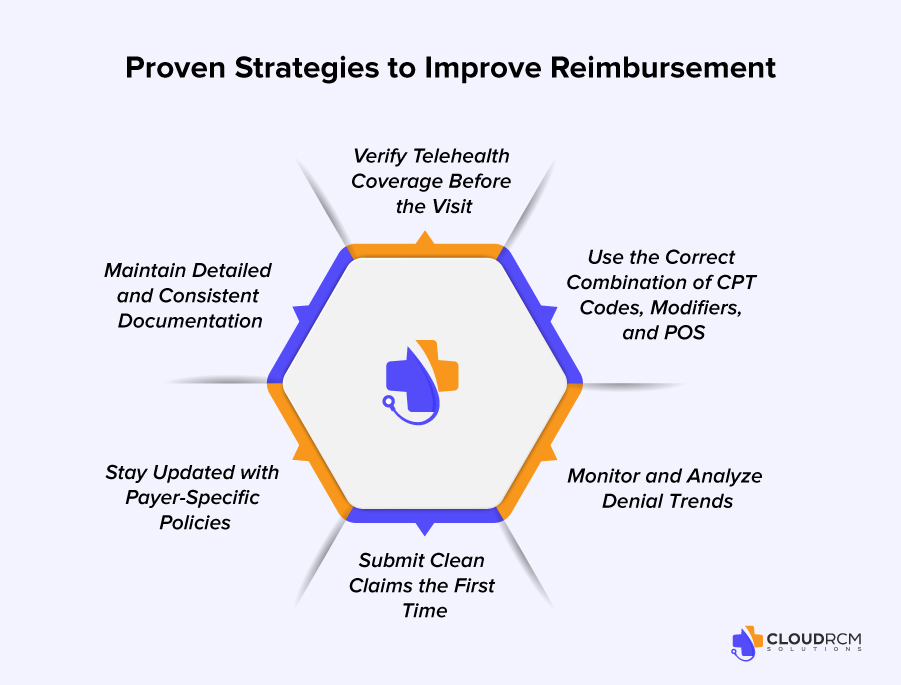
Verify Telehealth Coverage Before the Visit
Before providing services, confirm whether the patient’s insurance covers telehealth mental health visits. This also ensures providers are properly enrolled with payers through credentialing services, which is essential for claim approval.
Use the Correct Combination of CPT Codes, Modifiers, and POS
Accurate billing depends on using the correct CPT code, the appropriate telehealth modifier (such as 95 when required), and the correct place-of-service (POS) code. Even if one element is missing or incorrect, the claim may be denied or underpaid.
Maintain Detailed and Consistent Documentation
Clear documentation supports medical necessity and ensures that billed services match the clinical notes. Include:
- Session duration
- Type of therapy provided
- Patient condition and progress
- Treatment plan discussed
Consistent documentation reduces audit risk and speeds up claim approval.
Stay Updated with Payer-Specific Policies
Telehealth billing rules are not the same across all insurers. Regularly reviewing payer updates helps ensure compliance with:
- Covered telehealth services
- Modifier requirements
- Documentation standards
- Reimbursement changes
Monitor and Analyze Denial Trends
Tracking denied claims can reveal patterns such as:
- Frequent modifier errors
- Documentation gaps
- Incorrect coding practices
Addressing these patterns proactively helps improve clean claim rates over time.
Submit Clean Claims the First Time
A “clean claim” is one that is complete, accurate, and free of errors. Submitting clean claims reduces rework, shortens payment cycles, and improves cash flow.
Key Outcomes of Optimized Telehealth Billing
When these strategies are applied consistently, mental health practices can achieve:
- Faster reimbursement turnaround
- Reduced claim denial rates
- Improved revenue cycle efficiency
- Better compliance with billing regulations
Role of Medical Billing Services in Telehealth Mental Health Billing
Managing telehealth billing for mental health requires more than just basic claim submission. It involves staying up to date with changing payer policies, ensuring accurate coding, maintaining compliant documentation, and proactively handling denials. For many practices, managing all of these elements internally can be both time-consuming and error-prone.
This is where professional Medical Billing Services play an important role in supporting efficient and compliant revenue cycle operations.
How Medical Billing Services Support Telehealth Practices
Accurate Coding and Claim Submission
Billing teams ensure that CPT codes, modifiers, and POS codes are applied correctly based on the latest telehealth billing guidelines, reducing the risk of claim rejections.
Continuous Compliance Monitoring
With evolving regulations from organizations like the Centers for Medicare & Medicaid Services, billing services help practices stay compliant by adapting to updated rules and documentation requirements.
Denial Management and Resolution
Experienced billing teams identify the root causes of denials, correct errors, and resubmit claims efficiently to recover lost revenue.
Payer Policy Management
Medical billing professionals track payer-specific telehealth policies, ensuring that each claim aligns with current coverage rules and reimbursement criteria.
Revenue Cycle Optimization
By streamlining billing workflows and reducing errors, practices can improve cash flow, shorten reimbursement cycles, and reduce administrative burden.
A Strategic Approach to Telehealth Billing
At CloudRCM Solutions, telehealth billing for mental health is managed with a focus on accuracy, compliance, and revenue optimization. By combining industry expertise with updated billing practices, the goal is to help providers minimize denials, maintain compliance, and ensure consistent reimbursement for virtual care services.
Rather than treating billing as a routine administrative task, a structured and proactive approach allows practices to focus more on patient care while maintaining financial stability.
As telehealth continues to evolve, billing complexity will only increase. Practices that adopt structured billing processes and stay aligned with regulatory standards are better positioned to:
- Reduce claim denials
- Improve reimbursement accuracy
- Maintain compliance with federal and payer guidelines
- Scale telehealth services confidently
Conclusion
Telehealth billing for mental health in 2026 demands accuracy, compliance, and up-to-date knowledge of payer rules. Even small errors in coding or documentation can lead to claim denials and delayed payments.
As regulations evolve, managing billing in-house becomes more complex and time-consuming. A structured and compliant billing approach is essential to maintain steady revenue and reduce risk.
CloudRCM Solutions helps mental health providers simplify telehealth billing, reduce denials, and improve reimbursement accuracy to streamline the revenue cycle.
FAQ’s
Which modifiers are used for telehealth mental health billing?
Common modifiers include 95 and GT, which indicate that the service was delivered via telehealth. However, the exact modifier requirements may vary depending on the insurance payer and their billing policies.
Why do telehealth mental health claims get denied?
Claims are often denied due to incorrect coding, missing modifiers, or incomplete documentation. Not following payer-specific telehealth guidelines can also result in claim rejections or delays.
How can providers reduce telehealth billing denials?
Providers can improve clean claim rate by verifying insurance coverage before visits, using accurate CPT codes and modifiers, and maintaining clear, detailed documentation for each session.
Does insurance cover telehealth billing in 2026?
Most insurance providers, including the Centers for Medicare & Medicaid Services, continue to cover telehealth services. However, coverage rules and reimbursement rates may vary by payer.
What is the difference between in-person and telehealth billing?
While CPT codes are often the same, telehealth billing requires additional modifiers and specific POS codes. Documentation requirements are also more detailed for virtual services.
What documentation is required for telehealth mental health billing?
Documentation should include session duration, type of service, patient condition, and clinical justification for telehealth. Proper documentation is essential to support claims and avoid denials.