Medical Billing
 Medical Coding
 Medical Audit
 Provider Credentialing
 Denial Management
 A/R Follow-up
 Private Practice
 Patient Help Desk
 Customized Reporting
 Out-of-Network Billing
 Internal Medicine
 Pediatrics
 Radiology
 Surgery
 Emergency Medicine
 Anesthesiology
 Cardiology
 Orthopedic
 Psychiatry
 Dentistry
 OB-GYN
 Family Medicine
Payer contract negotiations play a crucial role in shaping a medical practice’s financial stability. Independent practices, especially in primary care, behavioral health, urgent care, and physical therapy, face a growing challenge in managing fair reimbursement. Whether in Florida, Texas, or Pennsylvania, these small and mid-sized providers depend on payer contracts that directly affect their day-to-day revenue.
But here’s the reality: old or poorly written contracts can underpay by 5–10% compared to local benchmarks. These gaps cost single providers a loss of their revenue, tens of thousands of dollars every year, especially for high-volume services like office visits, therapy sessions, or diagnostic procedures.
According to the 2025 MGMA Performance Survey, 58% of practice leaders review their payer contracts annually but nearly 20% admit they never check them. That leaves many regional practices stuck in unprofitable agreements that no longer support their operations or staff.
Why Data is the Key to Fair Reimbursement?
In today’s payer environment, from Texas to New Jersey and California to Georgia, small healthcare practices are learning that data is their most valuable tool in payer negotiations.. Payers often use complex data models to define what they’ll pay. If practices don’t bring their own data to the table, they’re left reacting instead of negotiating.
Data gives these practices real leverage by helping them:
- Identify underpaid CPT codes and low reimbursement trends.
- Track denial rates and payer-specific turnaround times.
- Compare contracted rates to Medicare or FAIR Health benchmarks.
- Support negotiation requests with evidence-based insights rather than emotion.
As one revenue strategist puts it: “Payers respond better to numbers, not narratives.”
When providers show solid comparative data, they’re not asking for more; they’re asking to be paid fairly for the care they already provide.
Six-Part Approach for Better Payer Negotiation Results
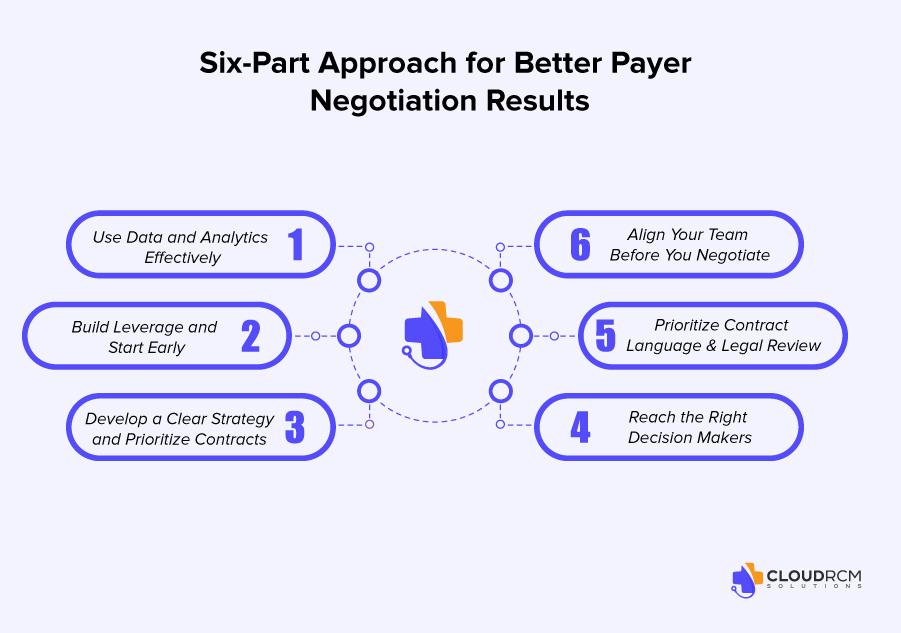
Strong payer contracts come from structure, not chance. Here’s a proven six-part strategy used by RCM professionals to help small practices secure fair and profitable contracts.
1. Use Data and Analytics Effectively
Preparation using detailed data is very important for successful negotiations. Practices should collect information about reimbursement rates, denial frequency, and CPT utilization. Analyze which services are undervalued and how each payer performs compared to others.
- Use visual dashboards for a quick comparison.
- Monitor payer behavior (delays, downcoding, denials).
- Identify high-volume CPTs where even small rate increases can boost revenue.
2. Build Leverage and Start Early
Start preparing at least 9–12 months before the contract renewal date. This gives time to assess financial performance, review payer trends, and gather evidence.
- Early preparation prevents rushed negotiations.
- Benchmark rates and outcomes using MGMA or FAIR Health data.
- Document how your practice contributes to patient satisfaction and compliance.
3. Develop a Clear Strategy and Prioritize Contracts
Not all payers are equal. Focus on the ones that matter most. Good negotiations start with setting clear goals, like:
- Identify top contracts that drive 80% of your revenue by total volume, revenue, and denial rate.
- Tailor your negotiation goals to your specialty (e.g., urgent care volume, therapy session rates).
Iden - Focus on achievable goals like targeting a 5% rate increase, removing low-pay clauses, or improving appeal rights.
4. Align Your Team Before You Negotiate
Payer negotiations succeed when leadership and finance teams work toward shared outcomes.. Providers, billing teams, and administrators operate with shared insights; the practice speaks with one strong voice.
- Schedule pre-negotiation meetings to review revenue goals, payer trends, and cost benchmarks
- Make sure everyone understands the practice’s cost structures for better patient care and financial sustainability.
5. Prioritize Contract Language and Legal Review
Don’t just negotiate rates; review the fine print. Vague clauses on recoupment, downcoding, or audit rights can lead to post-payment losses.
- Pay close attention to language around denials, audits, and payment disputes. Seek clarification on ambiguous terms.
- Get everything in writing, even verbal promises.
- Have contracts legally reviewed before signing.
6. Reach the Right Decision Makers
Negotiating with the wrong contact can waste months.
- Request to speak with payer representatives who have the authority to approve rate changes.
- Maintain professional relationships; negotiations are long-term, not one-time events.
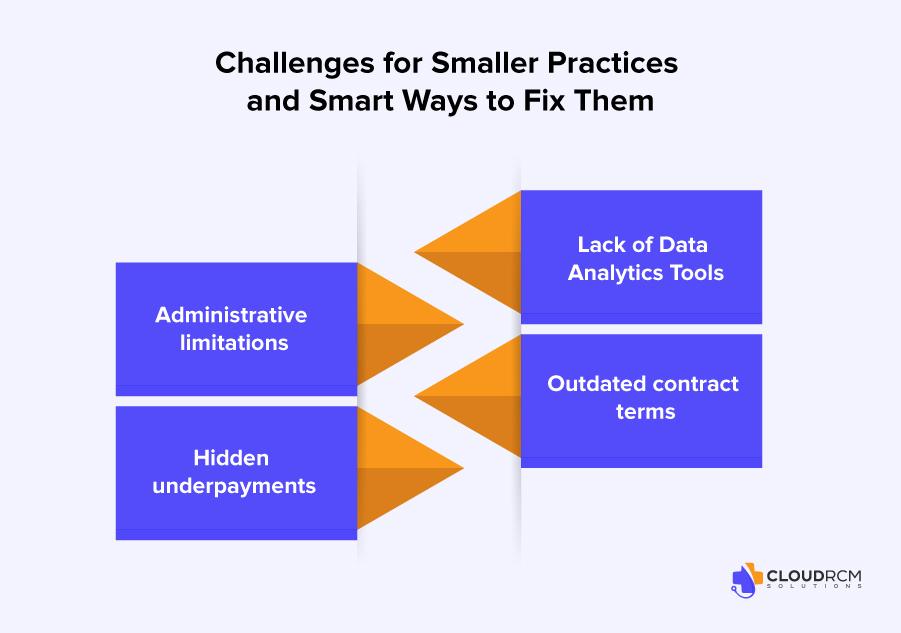
Challenges for Smaller Practices and Smart Ways to Fix Them
Smaller practices often struggle to negotiate effectively because of resource and data gaps. Among the most frequent pain points are:
- Administrative limitations that prevent consistent payer monitoring..
- Lack of data analytics tools for contract modeling and comparison.
- Fear of losing network participation keeps them tied to Outdated contract terms
- Hidden underpayments due to insufficient payment reconciliation.
These challenges don’t mean small practices can’t compete; they simply need the right data insights and negotiation strategy. With accurate payer analytics, benchmarking, and the right RCM partner, independent providers can transform these obstacles into opportunities, building stronger payer relationships, fairer reimbursement rates, and long-term financial stability.
How Data and Technology Drive Smarter Negotiations
In today’s healthcare landscape, technology plays a vital role in contract strategy. With advanced RCM analytics and AI-based modeling, small and mid-sized practices can view reimbursement data in real time and prepare negotiation reports that mirror payer logic.
Before entering any payer negotiation, practices should monitor key performance metrics such as:
- Average reimbursement per payer and CPT.
- Denial categories (CO-50, CO-197, CO-29).
- Payer scorecards showing claim turnaround times.
- Underpayment trends and historical discrepancies.
Market comparison using FAIR Health and CMS benchmarks.
When practices use these insights proactively, they negotiate from a position of knowledge, not pressure.
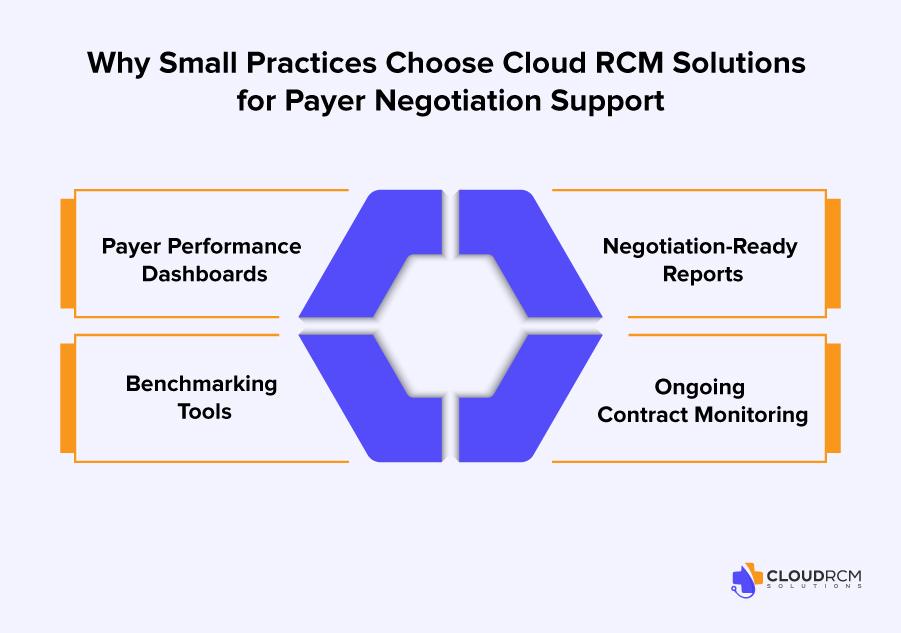
Why Small Practices Choose Cloud RCM Solutions for Payer Negotiation Support
At Cloud RCM Solutions, we help small and mid-sized practices use their data to take control of payer negotiations.
We provide:
- Payer performance dashboards that reveal underpayments and trends.
- Benchmarking tools for fair rate comparison.
- Negotiation-ready reports backed by real-time analytics.
- Ongoing contract monitoring to ensure new rates are accurately implemented.
Our focus is to help practices:
- Strengthen their negotiation position.
- Recover lost revenue from outdated or weak contracts.
- Simplify complex billing workflows through automation and analytics.
Instead of chasing payers, we help you present the data that gets their attention.
Conclusion
Fair reimbursement doesn’t come from chance; it comes from insight. In the world of medical billing and revenue cycle management, data is no longer just a report; it’s a negotiation asset.
Small practices that track payer performance, denial patterns, and reimbursement benchmarks can approach negotiations strategically and achieve stronger contract terms.
With Cloud RCM Solutions, providers gain access to analytics, benchmarking, and contract management support that helps them recover lost revenue and strengthen financial outcomes.
FAQ’s
How can data analytics be used to improve healthcare outcomes?
Data analytics helps healthcare practices identify trends in patient care, streamline workflows, and measure the effectiveness of treatments. By tracking metrics like denial patterns, reimbursement rates, and service utilization, practices can uncover inefficiencies and redirect resources to where they make the most impact. Data-driven insights also allow providers to monitor performance, reduce claim errors, and enhance the overall quality of care through informed decision-making.
What are the approaches for Better Payer Negotiation Results?
Better payer negotiation results come from a structured, data-driven approach. Practices should analyze reimbursement trends, start negotiations early, set clear financial goals, align internal teams, review contract terms carefully, and connect with authorized payer representatives. Using data and preparation not pressure, helps small practices secure fair and profitable contracts.
How can healthcare organizations leverage data to ensure and improve the quality of care and patient experience in the organization?
Healthcare organizations can use data to understand both operational and clinical performance. Through payer analytics, claim turnaround data, and patient satisfaction trends, providers gain visibility into care delivery and payment efficiency. By comparing outcomes with benchmarks such as FAIR Health or CMS data, they can improve patient access, reduce delays, and maintain consistent, high-quality service, leading to a better overall patient experience.
How Payers Can Leverage Data in Contract Negotiations?
Payers rely heavily on data modeling to determine reimbursement rates and coverage terms. They use analytics to assess provider performance, cost efficiency, and patient outcomes. Understanding this, practices can mirror payer logic by presenting their own data, such as denial trends, turnaround times, and benchmarking comparisons, to justify fairer rates. When both sides use transparent, evidence-based data, contract discussions become more balanced and outcome-focused
Why do small practices struggle to negotiate fair reimbursement rates?
Smaller practices often face challenges like limited administrative capacity, a lack of data analytics tools, and outdated fee schedules. Many avoid renegotiations due to fear of losing network participation or experiencing payer pushback. These factors make it difficult to prove value or track underpayments. However, by using analytics, benchmarking, and proactive payer monitoring, small practices can close these gaps and negotiate more effectively for fair, competitive rates.