Medical Billing
 Medical Coding
 Medical Audit
 Provider Credentialing
 Denial Management
 A/R Follow-up
 Private Practice
 Patient Help Desk
 Customized Reporting
 Out-of-Network Billing
 Internal Medicine
 Pediatrics
 Radiology
 Surgery
 Emergency Medicine
 Anesthesiology
 Cardiology
 Orthopedic
 Psychiatry
 Dentistry
 OB-GYN
 Family Medicine
Healthcare credentialing has evolved from paper-based applications and manual verification processes into a digital ecosystem powered by online payer portals, regulatory databases, and credentialing platforms. While these technologies were designed to improve efficiency, many healthcare organizations now face a new challenge: managing multiple disconnected credentialing portals. Credentialing specialists often navigate numerous systems to submit enrollments, verify provider information, track applications, and maintain compliance, creating administrative complexity that can slow provider onboarding and increase operational costs.
In this guide, we’ll explore how fragmented credentialing systems impact healthcare organizations, why credentialing delays affect revenue cycle performance, and how provider credentialing software can help streamline workflows, improve compliance, and accelerate provider enrollment.
What Are Credentialing Portals?
Credentialing portals are digital platforms used by healthcare organizations, insurance payers, and regulatory agencies to verify provider qualifications, manage enrollment applications, and maintain compliance records. These portals support critical functions such as provider enrollment, document submission, license verification, credential monitoring, and application tracking.
While credentialing portals play an essential role in healthcare operations, most organizations must manage multiple systems simultaneously. Medicare, Medicaid, commercial insurance companies, licensing boards, and regulatory databases often operate independently, requiring credentialing teams to maintain provider information across numerous platforms.
The Rise of Digital Credentialing in Healthcare
Healthcare organizations adopted digital credentialing systems to improve efficiency, reduce paperwork, support growing provider networks, and meet increasingly complex regulatory requirements. Electronic credentialing platforms helped standardize processes and improve visibility compared to traditional paper-based workflows.
However, as more payers and regulatory agencies launched their own credentialing portals, many healthcare organizations found themselves managing a growing number of disconnected systems. Instead of creating a truly centralized process, digital credentialing often introduced new administrative burdens that continue to affect provider enrollment and compliance management.
The Real Cost of Too Many Credentialing Portals
At first glance, digital credentialing appears more efficient than manual processes. However, fragmented credentialing environments can create significant operational challenges.
Each time staff members must log into different portals, re-enter provider information, upload documents, or verify credentials across multiple systems, productivity declines. Small inefficiencies quickly compound, creating delays that impact provider onboarding, compliance management, and revenue generation.
Common challenges include:
- Duplicate data entry
- Delayed provider enrollment
- Increased administrative workload
- Compliance risks
- Reduced visibility into application status
- Revenue cycle disruptions
For healthcare organizations managing multiple providers or locations, these challenges can become increasingly difficult to control.
Common Issues Caused by Fragmented Credentialing Systems
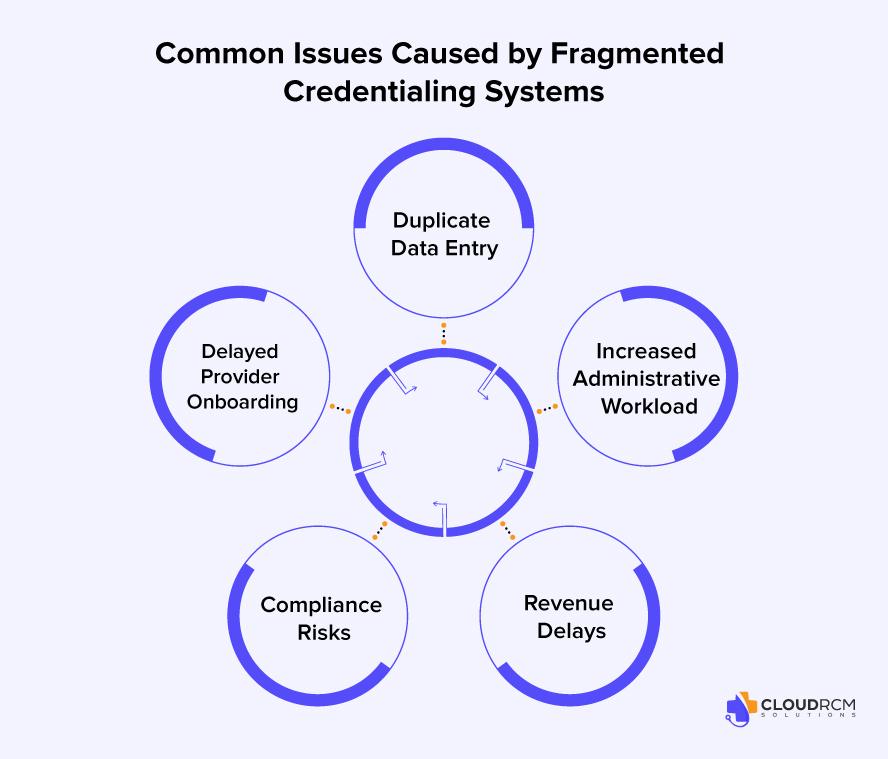
Healthcare organizations that rely on multiple credentialing portals often experience:
1. Duplicate Data Entry
Provider information frequently needs to be entered into several systems individually. This repetition increases the likelihood of errors and consumes valuable administrative time.
2. Delayed Provider Onboarding
When credentialing applications move slowly between systems, providers may wait weeks or months before being fully enrolled with payers.
3. Increased Administrative Workload
Credentialing specialists spend a significant portion of their day logging into different portals, uploading documents, and tracking application statuses.
4. Compliance Risks
When provider data is stored across multiple systems, it becomes harder to maintain consistent records and monitor expiration dates for licenses or certifications.
5. Revenue Delays
Credentialing delays prevent providers from billing insurance companies, which can significantly impact healthcare revenue cycles.
Why Credentialing Delays Hurt Revenue Cycle Performance
Credentialing is one of the earliest and most important stages of the revenue cycle. Before providers can bill insurance companies and receive contracted reimbursement rates, they must complete payer credentialing and enrollment requirements.
When credentialing is delayed, organizations may experience:
- Delayed claim submission
- Lost reimbursement opportunities
- Increased accounts receivable balances
- Cash flow disruptions
- Reduced provider productivity
- Higher administrative costs
Even highly efficient billing teams cannot submit reimbursable claims if providers have not completed credentialing and payer enrollment. For this reason, credentialing should be viewed as a critical revenue cycle management function rather than a purely administrative responsibility.
The Critical Role of CAQH, PECOS, and Provider Enrollment
Modern credentialing extends beyond payer applications. Healthcare organizations must also manage provider information across multiple industry-standard systems and databases.
Credentialing teams commonly work with:
- CAQH provider profiles
- Medicare PECOS enrollment
- State licensing boards
- NPI verification systems
- Commercial payer portals
- Medicaid enrollment platforms
- Sanction and exclusion databases
Maintaining consistent provider information across these systems is essential. Even minor discrepancies can lead to enrollment delays, application rejections, or compliance concerns.
Types of Credentialing Systems Used in Healthcare
One of the primary reasons credentialing workflows become complex is that healthcare organizations must manage multiple systems that serve different functions. Most credentialing workflows involve three distinct categories of platforms:
| Credentialing System Type | Primary Purpose | Common Examples | Key Challenge |
|---|---|---|---|
| Payer Credentialing Portals | Provider enrollment and payer participation | Medicare, Medicaid, commercial insurance carriers, managed care organizations | Provider data must be submitted separately to each payer because systems rarely communicate with one another. |
| Regulatory Verification Portals | Verification of provider qualifications and compliance requirements | State licensing boards, sanction databases, exclusion monitoring systems, certification registries | Credentialing teams must monitor multiple databases to maintain compliance and provider eligibility. |
| Internal Credentialing Platforms | Management of credentialing workflows and provider records | Document management systems, credential verification tools, provider enrollment trackers, compliance monitoring platforms | Data often becomes siloed across systems, making workflows harder to manage and track. |
Because these systems operate independently, credentialing specialists frequently switch between platforms to verify credentials, submit applications, upload documentation, and track enrollment progress. This fragmented approach increases administrative workload, creates opportunities for errors, and often contributes to provider enrollment delays.
Why Multiple Credentialing Portals Slow Down Operations
A typical credentialing workflow may require staff to:
- Verify provider credentials in one system
- Update CAQH information
- Perform sanction screenings
- Upload documents into internal software
- Submit enrollment applications to multiple payers
- Track application statuses separately
This constant switching between systems creates what many organizations refer to as portal fatigue. Credentialing specialists spend significant time managing technology rather than focusing on strategic enrollment and compliance activities.
Key Benefits of Provider Credentialing Software
Modern provider credentialing software helps healthcare organizations streamline enrollment workflows, improve compliance, and reduce administrative burden.
| Benefit | How It Helps Healthcare Organizations |
|---|---|
| Centralized Provider Data | Creates a single source of truth for provider information, credentials, and supporting documentation, reducing duplicate data entry across multiple systems. |
| Automated Workflow Management | Automates task assignments, reminders, and application tracking to help ensure credentialing milestones are completed on time. |
| Real-Time Enrollment Visibility | Provides dashboards and reporting tools that allow administrators to monitor enrollment status, identify bottlenecks, and track progress more efficiently. |
| Compliance Monitoring | Automatically tracks licenses, certifications, contracts, and recredentialing deadlines to support ongoing regulatory compliance. |
| Faster Provider Onboarding | Streamlines enrollment processes and documentation management, helping providers become credentialed and reimbursement-ready sooner. |
| Reduced Administrative Workload | Minimizes manual processes and repetitive tasks, allowing credentialing teams to focus on higher-value activities. |
| Improved Revenue Cycle Performance | Accelerates provider enrollment and reduces credentialing-related billing delays, helping organizations improve cash flow and reimbursement timelines. |
| Enhanced Scalability | Supports growing provider networks, multiple locations, and expanding healthcare organizations without significantly increasing administrative overhead. |
By centralizing provider data and automating credentialing workflows, healthcare organizations can improve operational efficiency, strengthen compliance, and reduce delays that impact provider enrollment and revenue cycle performance.
Signs Your Credentialing Process Needs Improvement
Healthcare organizations may benefit from workflow modernization if they regularly experience:
- Frequent enrollment delays
- Missed recredentialing deadlines
- High administrative workloads
- Excessive manual data entry
- Difficulty tracking applications
- Credentialing-related claim holds
- Revenue delays caused by enrollment issues
These challenges often indicate that existing credentialing processes are no longer scalable.
Best Practices for Managing Credentialing Portals
Healthcare organizations can improve credentialing efficiency by:
- Standardizing credentialing workflows
- Centralizing provider information
- Automating task management and reminders
- Maintaining accurate CAQH and enrollment records
- Monitoring credential expiration dates proactively
- Investing in modern credentialing technology
- Conducting regular credentialing audits
These strategies help reduce administrative complexity while improving compliance and enrollment performance.
The Future of Healthcare Credentialing
As healthcare organizations expand and regulatory requirements continue to evolve, credentialing processes will become increasingly data-driven and automated. Organizations that continue relying on fragmented systems and manual workflows may face growing operational challenges, while those that adopt modern credentialing technology will be better positioned to improve efficiency, accelerate provider onboarding, and strengthen revenue cycle performance.
FAQ’s
What is a credentialing portal?
A credentialing portal is a digital platform used to verify provider qualifications, manage enrollment applications, and maintain compliance records for healthcare organizations and insurance payers.
Why do multiple credentialing portals create delays?
Multiple portals require credentialing teams to enter provider information into separate systems, increasing administrative workload, duplicate data entry, and application tracking challenges.
How do credentialing delays affect revenue?
Credentialing delays prevent providers from billing insurance companies until enrollment is completed, which can delay reimbursements and negatively impact cash flow.
What is provider credentialing software?
Provider credentialing software is a centralized platform that automates credential verification, enrollment tracking, compliance monitoring, and workflow management.
Can credentialing software replace payer portals?
No. Payer portals remain necessary for enrollment and verification. However, credentialing software can centralize provider data and streamline the management of multiple credentialing systems.