Medical Billing
 Medical Coding
 Medical Audit
 Provider Credentialing
 Denial Management
 A/R Follow-up
 Private Practice
 Patient Help Desk
 Customized Reporting
 Out-of-Network Billing
 Internal Medicine
 Pediatrics
 Radiology
 Surgery
 Emergency Medicine
 Anesthesiology
 Cardiology
 Orthopedic
 Psychiatry
 Dentistry
 OB-GYN
 Family Medicine
Healthcare organizations rely on provider credentialing to verify that physicians and other licensed professionals meet regulatory, payer, and organizational requirements before treating patients and submitting claims. However, credentialing is more than an administrative onboarding task. It is a critical compliance function that directly affects reimbursement, patient safety, accreditation, and legal risk.
In this guide, you’ll learn the key provider credentialing compliance requirements, the credentialing process, common compliance risks, and best practices to streamline provider enrollment and protect revenue.
What Is Provider Credentialing Compliance?
Provider credentialing compliance is the process of ensuring healthcare professionals meet all federal, state, payer, and organizational requirements before they are authorized to provide services and bill insurance companies.
Credentialing compliance requires organizations to:
- Verify provider qualifications through primary sources.
- Confirm active licenses and certifications.
- Screen for sanctions and federal exclusions.
- Maintain accurate provider records.
- Complete payer enrollment requirements.
- Monitor providers continuously after credentialing.
- Re-credential providers according to accreditation standards.
Credentialing compliance is essential for hospitals, physician groups, behavioral health organizations, ambulatory surgery centers, federally qualified health centers (FQHCs), and private practices participating in Medicare, Medicaid, and commercial insurance networks.
Why Credentialing Compliance Matters
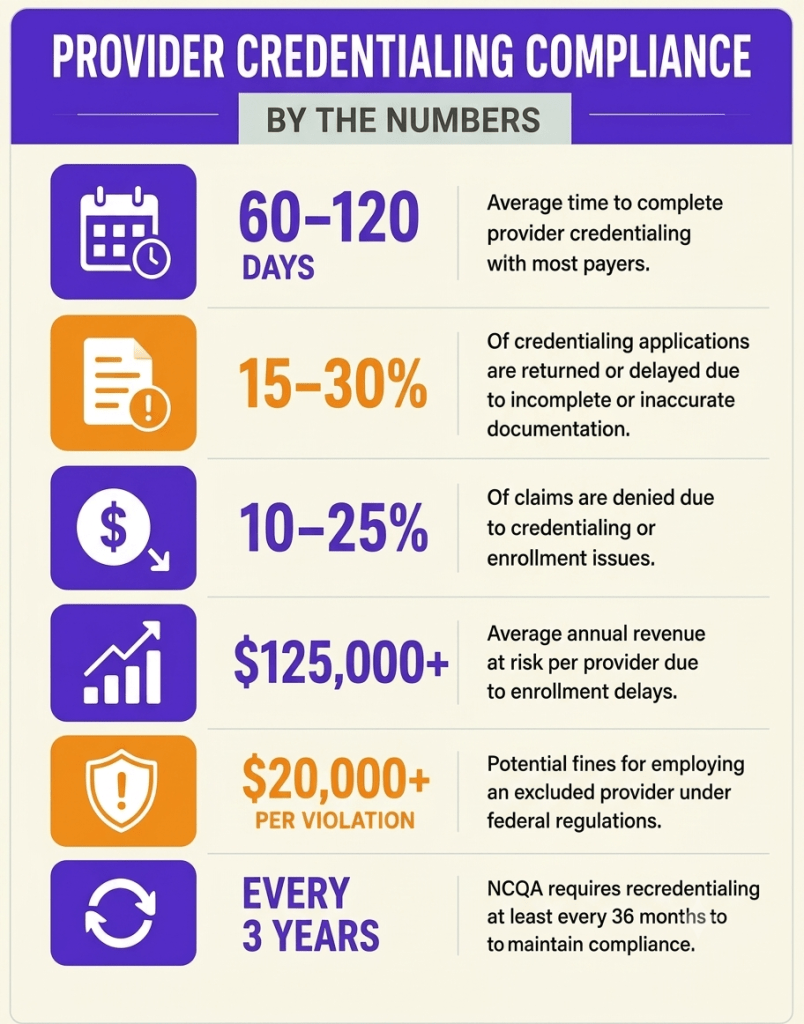
Many providers associate credentialing only with joining insurance networks. In reality, compliance impacts nearly every aspect of healthcare operations.
A strong credentialing program helps organizations:
| Benefit | Impact |
|---|---|
| Reduce claim denials | Prevent billing interruptions caused by incomplete enrollment |
| Improve cash flow | Activate provider billing faster |
| Meet CMS and payer requirements | Reduce audit risks |
| Protect patient safety | Verify provider qualifications before patient care |
| Support accreditation | Meet standards required by hospitals and health plans |
| Minimize legal exposure | Reduce risks related to false claims and excluded providers |
Poor credentialing practices often lead to delayed reimbursements, denied claims, payer audits, and unnecessary administrative costs.
Credentialing vs. Enrollment vs. Privileging
Although these terms are frequently used interchangeably, they represent different processes.
| Process | Purpose |
| Credentialing | Verifies education, licenses, training, certifications, malpractice history, and work history |
| Provider Enrollment | Registers providers with Medicare, Medicaid, and commercial insurance plans so claims can be reimbursed |
| Privileging | Determines which clinical procedures a provider may perform within a hospital or healthcare facility |
| Contracting | Establishes reimbursement agreements between providers and insurance companies |
Understanding these distinctions helps organizations avoid delays during provider onboarding.
Regulatory Requirements Every Credentialing Team Should Know
Credentialing compliance is governed by multiple federal regulations, accreditation organizations, and payer policies.
CMS Requirements
Healthcare organizations participating in Medicare or Medicaid must maintain accurate provider enrollment records and promptly report changes through the appropriate enrollment systems.
CMS also requires organizations to maintain documentation supporting provider eligibility and qualifications.
National Committee for Quality Assurance (NCQA)
Many commercial insurance companies follow NCQA credentialing standards.
These standards emphasize:
- Primary source verification
- Credentialing committee review
- Recredentialing every three years
- Ongoing monitoring of provider sanctions
Organizations delegated to perform credentialing on behalf of health plans must consistently meet these requirements.
The Joint Commission
Hospitals accredited by The Joint Commission must conduct comprehensive credentialing and privileging reviews before granting clinical privileges.
Unlike payer enrollment, privileging focuses on clinical competence within a healthcare facility.
Primary Source Verification (PSV): The Foundation of Credentialing
Primary Source Verification is the most important component of provider credentialing.
Instead of relying on copies provided by applicants, credentialing specialists verify information directly with the original issuing organization.
Typical PSV includes:
| Credential | Verification Source |
| Medical license | State licensing board |
| DEA registration | DEA registry |
| Board certification | Specialty certification board |
| Medical education | Medical school |
| Residency or fellowship | Training institution |
| National Provider Identifier (NPI) | NPI Registry |
Primary Source Verification reduces fraud, improves documentation accuracy, and satisfies payer and accreditation requirements.
Required Credentialing Documentation
Collecting complete documentation at the beginning of the process significantly reduces credentialing delays.
Standard Provider Credentialing Checklist
| Required Document | Purpose |
| Current CV | Employment and education history |
| State medical license | Practice authorization |
| DEA registration | Prescribing authority |
| Board certifications | Specialty qualifications |
| Malpractice insurance | Liability protection |
| Government-issued identification | Identity verification |
| NPI confirmation | Billing identification |
| Professional references | Clinical competency review |
| Work history | Experience verification |
Organizations should review these documents before submitting enrollment applications to insurance carriers.
Exclusion Screening and Background Checks
Credentialing does not end with license verification.
Organizations should also screen providers against federal exclusion databases before participation in government healthcare programs.
Common screening activities include:
- Federal exclusion screening
- State sanction monitoring
- Criminal background checks (when required)
- License disciplinary history
- Professional malpractice review
These checks help organizations identify providers who may be prohibited from participating in federally funded healthcare programs.
Continuous Monitoring Is Better Than Annual Reviews
Credentialing should never be treated as a one-time event.
Providers may experience:
- License suspensions
- Board disciplinary actions
- Malpractice settlements
- DEA registration changes
- Sanctions
- Certification expirations
Continuous monitoring allows credentialing teams to identify issues before they affect reimbursement or regulatory compliance.
Many organizations establish automated alerts for:
- License expiration
- DEA renewal
- Board certification renewal
- Malpractice insurance expiration
- Provider enrollment updates
Recredentialing Requirements
Most healthcare organizations must periodically recredential providers to confirm continued eligibility.
Typical recredentialing activities include:
- Updated Primary Source Verification
- License confirmation
- Malpractice claims review
- Sanction screening
- Updated work history
- Continuing education review
- Professional references when applicable
Organizations should begin recredentialing several months before expiration deadlines to prevent disruptions in payer participation.
Revenue Cycle Impact of Credentialing Delays
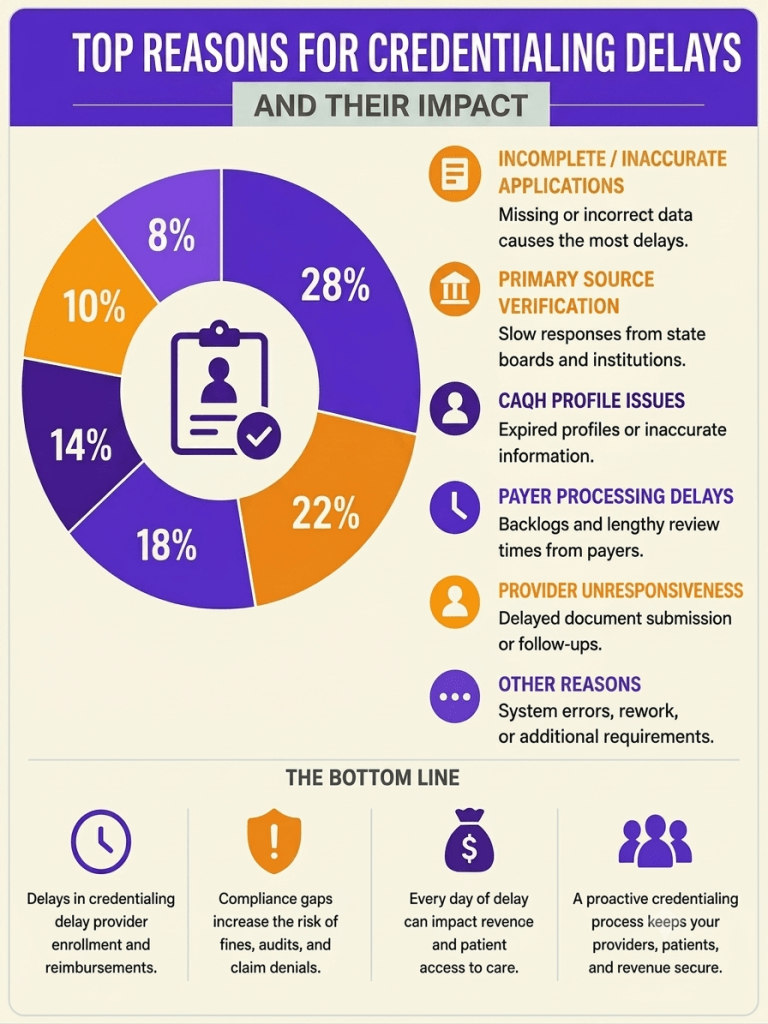
Credentialing has a direct effect on practice revenue.
When enrollment is incomplete, providers may treat patients without the ability to bill participating insurance plans.
Common financial consequences include:
| Credentialing Issue | Revenue Impact |
| Delayed payer enrollment | Delayed reimbursement |
| Missing documentation | Returned applications |
| Expired license | Claim denials |
| Incorrect provider information | Payment delays |
| Failed recredentialing | Network termination |
Credentialing should therefore be viewed as a revenue cycle management strategy rather than simply an administrative process.
Common Credentialing Compliance Mistakes
Healthcare organizations frequently encounter avoidable credentialing problems.
The most common include:
- Waiting until a provider’s start date to begin credentialing.
- Submitting incomplete applications.
- Allowing CAQH profiles to expire.
- Failing to monitor license renewals.
- Missing malpractice insurance updates.
- Inconsistent provider information across enrollment systems.
- Delayed responses to payer requests.
- Inadequate documentation retention.
Implementing standardized workflows and credentialing checklists helps reduce these issues.
Credentialing Compliance Best Practices
Organizations seeking to improve efficiency should adopt a proactive credentialing strategy.
Recommended best practices include:
- Start credentialing immediately after provider recruitment.
- Use standardized document checklists.
- Verify credentials through primary sources only.
- Monitor licenses and sanctions continuously.
- Maintain complete electronic credentialing files.
- Conduct regular internal credentialing audits.
- Track payer enrollment timelines.
- Review provider records before renewal deadlines.
- Coordinate credentialing with billing and revenue cycle teams.
- Educate providers about documentation requirements and renewal responsibilities.
These practices reduce administrative burden while improving payer approval rates.
Credentialing Compliance Workflow
A structured workflow improves accuracy and accountability.
| Step | Primary Objective |
| Provider application | Collect required documentation |
| Document review | Identify missing information |
| Primary Source Verification | Confirm qualifications |
| Exclusion screening | Verify eligibility |
| Credentialing committee review | Approve provider participation |
| Payer enrollment | Submit insurance applications |
| Provider activation | Begin billing services |
| Continuous monitoring | Track ongoing compliance |
| Recredentialing | Maintain participation |
Organizations that standardize each stage experience fewer delays and stronger regulatory compliance.
Final Thoughts
Provider credentialing compliance is essential for protecting patients, maintaining regulatory compliance, and ensuring financial stability. A proactive approach to Medicare & Medicaid credentialing and commercial payer credentialing helps reduce claim denials, accelerate provider enrollment, and support consistent reimbursement.
Rather than treating credentialing as a one-time administrative requirement, healthcare organizations should integrate it into their broader compliance and revenue cycle strategy. A proactive approach helps minimize risk, improves provider onboarding, and creates a stronger foundation for sustainable reimbursement and quality patient care.