Medical Billing
 Medical Coding
 Medical Audit
 Provider Credentialing
 Denial Management
 A/R Follow-up
 Private Practice
 Patient Help Desk
 Customized Reporting
 Out-of-Network Billing
 Internal Medicine
 Pediatrics
 Radiology
 Surgery
 Emergency Medicine
 Anesthesiology
 Cardiology
 Orthopedic
 Psychiatry
 Dentistry
 OB-GYN
 Family Medicine
In today’s healthcare environment, a practice’s financial health depends on how effectively it manages its medical billing AR Aging. With complex payer rules tightening and commercial insurance denials rising under strict CMS guidelines, even well-run medical practices often see hard-earned revenue stuck in legacy revenue cycle management (RCM) bottlenecks.
Take a multi-specialty group we recently partnered with that was struggling with mounting administrative rejections and a 40% rise in claims over 90 days. In just four months, CloudRCM Solutions reduced its overall days in AR by 55% and recovered over $1.2 million in lost revenue through AI-driven analytics and an expert, HIPAA-compliant denial management strategy.
The truth is, most providers don’t even know where the leak starts. Claims vanish after submission, denials pile up, and staff get overwhelmed deciding which claims to chase first.
What is AR Aging in Medical Billing?
Accounts receivable (AR) aging in medical billing is the contractual measurement of time elapsed between a medical claim’s initial submission date and its final payment resolution. It relies on automated clearinghouse data to categorize outstanding insurance and patient balances into strict 30-day cohorts to evaluate billing efficiency, cash flow health, and timely filing risk.
Your AR aging report is a diagnostic mirror reflecting your practice’s operational performance. Outlined below is what each cohort reveals about your revenue cycle:
- 0–30 Days (Clean Claim Window): This represents active, newly submitted claims. Delays here point directly to frontend eligibility errors, charge entry mistakes, or clearinghouse validation failures.
- 31–60 Days (The Vulnerability Phase): The critical transition period involving complex payer medical necessity reviews, requests for medical records, or unworked initial denials.
- 61–90 Days (The High-Risk Zone): Payer timely filing deadlines approach, appeal windows narrow, and administrative collection costs begin to surpass the claim’s net relative value.
- 91+ Days (The Bad Debt Threshold): Industry data confirms that once a medical claim crosses the 90-day mark, the probability of successful collection drops by over 70%. Precise, programmatic intervention is required before these balances turn into permanent write-offs.
What Causes High Accounts Receivable in Healthcare?
High accounts receivable in healthcare is primarily caused by structural frontend errors, including missing prior authorizations, incomplete clinical documentation, and payer credentialing delays. These issues compound when internal billing teams rely on manual follow-up processes, leading to unworked denials and missed timely filing deadlines.
When small inefficiencies compound across multiple specialties, practices lose control of their revenue cycle management through five common culprits:
- Authorization Gaps: Expired or missing prior authorizations triggering hard, unappealable denials.
- Incomplete Clinical Documentation: Mismatched ICD-10 codes, missing CPT modifiers, or insufficient clinical charts leading to immediate rejections.
- Payer Credentialing Lapses: Providers rendering care before being fully enrolled in an insurance panel, resulting in immediate out-of-network denials.
- Manual Follow-Up Overload: Billing teams sorting through static spreadsheets without predictive workflows or priority routing.
- Unstructured Write-Off Policies: Lack of a clear governance model distinguishing true contractual adjustments from clear bad debt leaks.
The Growing Impact Across Medical Specialties
While AR challenges impact the entire healthcare sector, specific operational bottlenecks vary deeply by clinical discipline and affect your broader MACRA/MIPS operational tracking:
| Medical Specialty | Primary Driver of High AR Days | Revenue Cycle Impact |
| Orthopedics & Pain Management | Complex anatomical modifiers & prior authorization mismatches | High initial denial rates on surgical claims |
| Cardiology & Interventional | Bundled procedure coding conflicts & medical necessity validation | Delayed reimbursement on high-ticket technical fees |
| Behavioral & Mental Health | Frequent payer policy shifts & session unit/time discrepancies | High volume of low-dollar localized claim rejections |
| Multi-Specialty Health Systems | Fragmented cross-specialty coding rules & diverse fee schedules | Compounded administrative overhead & high days in AR |
How Do AI Analytics Improve Medical AR Recovery?
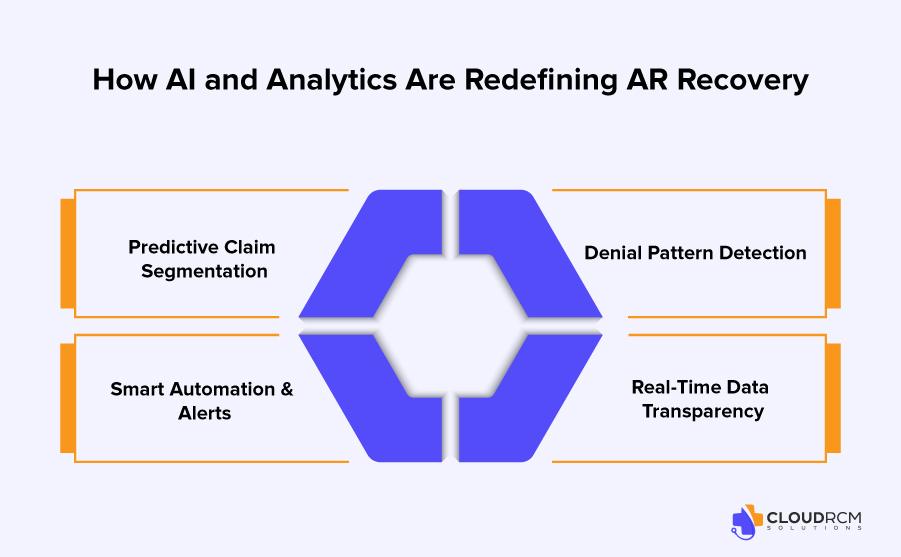
AI analytics improve medical AR recovery by deploying machine learning algorithms to automate claim segmentation, detect historical denial patterns, and prioritize high-value claims. This technology eliminates manual tracking by continuously scoring outstanding claims based on their legal collection probability and remaining timely filing windows.
In today’s medical billing services landscape, manual AR tracking just doesn’t cut it. Instead of replacing certified human coders, cloud-based automation empowers teams to scale their efficiency through four core mechanisms:
1. Predictive Claim Segmentation
Our platform scans legacy medical billing ar aging reports to assign an algorithmic recovery probability score to every outstanding claim. Your team focuses their human efforts on the high-yield collections first, rather than chasing low-dollar accounts blindly.
2. Denial Pattern Detection
Machine learning models analyze historical clearinghouse data and payer remittance codes to isolate root causes. By predicting denial trends before submission, the system maximizes your clean claim rate at the backend.
3. Automated Timely Filing Alerts
Intelligent workflows flag high-risk claims approaching strict payer appeal windows, preventing automatic losses caused by administrative oversight.
4. Real-Time Data Transparency
Custom dashboards track Net Collection Rate (NCR), days in AR, and denial volumes by provider, location, and insurance payer, providing executive leadership with actionable business intelligence.
The CloudRCM Method: Human Expertise Guided by AI
Technology alone cannot fix an unmonitored revenue cycle. The optimal outcome requires a seamless co-sourcing partnership between machine intelligence and certified billing professionals.
- System-Agnostic Integration: CloudRCM overlays natively with your existing EHR/PM software (Epic, Athenahealth, eClinicalWorks, NextGen) without disrupting ongoing clinical operations.
- Targeted Denial Resolution Routing:
- Coding Errors: Instantly routed to certified AAPC/AHIMA coders.
- Eligibility & Coordination of Benefits (COB): Verified via automated real-time payer clearinghouse integrations.
- Authorization Discrepancies: Re-examined against historical prior-approval logs for immediate appeal dispatch.
- Performance Accountability: Providers gain on-demand access to transparent performance dashboards, turning back-office billing into a completely trackable, measurable operation.
Proven Results: Measurable Impact Within Weeks
CloudRCM’s combination of analytics, automation, and billing expertise delivers measurable outcomes for our clients across multiple specialties:
| Key Revenue Cycle Metric | Pre-CloudRCM Baseline | Post-CloudRCM Integration | Total Financial Optimization |
| Average Days in AR | 68 days | 32 days | ↓ 53% Acceleration |
| AR Aging Balance > 90 Days | 28% | 10% | ↓ 64% Write-off Reduction |
| First-Pass Denial Rate | 18% | 7% | ↓ 61% Cleaner Submissions |
| Clean Claim Acceptance Rate (CCAR) | 82% | 97% | ↑ 15% Operational Lift |
| Net Collection Rate (NCR) | Baseline | 2× Increase | +100% Cash Flow Velocity |
These results reflect what happens when AI precision meets expert billing strategy faster recovery, fewer denials, and a healthier revenue cycle.
In-House vs. Outsourced RCM: Empowering Your Internal Billing Team
Choosing to optimize your revenue cycle does not mean replacing your trusted administrative team. Even highly competent in-house billing groups face operational limits amid evolving federal regulatory mandates, changing payer policies, and rising claim volumes.
We do not replace your internal billers; we equip them with scalable infrastructure.
By pairing specialty-specific billing knowledge with automated workflows, CloudRCM converts traditional billing offices from a reactive state of claim chasing into a proactive framework of revenue retention. The result is accelerated reimbursements, fewer compliance audits, and predictable revenue.
The Critical Risk of Delay
Every single day a medical claim remains unaddressed past its date of service, its collection value drops significantly. Managing your AR aging report retroactively at the close of a quarter is no longer a sustainable option in the US healthcare landscape.
Market-leading practices leverage real-time metrics to catch frontend registration mistakes before they degrade into bad debt write-offs. If your practice is managing high employee turnover, resource constraints, or growing denial backlogs, CloudRCM Solutions provides the infrastructure needed to stabilize your current cash flow while building a predictive framework for tomorrow.
Schedule a Complimentary AR Health & Compliance Audit
Do not allow your aging 90-day bucket to turn into uncollectible bad debt. Contact CloudRCM Solutions today for a comprehensive, data-driven AR assessment and discover how our revenue cycle experts can maximize your net collections with zero operational disruption.
FAQ’S
What is Accounts Receivable (AR)?
AR is the money your practice is waiting to receive from insurance companies or patients for services you’ve already provided.
Why is AR aging important?
It shows how long your payments have been pending. The older the claim, the harder it becomes to collect.
What causes claims to get stuck in AR?
Missing authorizations, wrong codes, or incomplete documents often cause delays and denials.
How can CloudRCM help reduce my AR?
We use AI tools and expert billers to find problem claims, fix them fast, and recover more payments.
Should I outsource my AR follow-up?
Yes, if your staff is overloaded. Outsourcing helps you recover payments faster without adding extra workload.