Medical Billing
 Medical Coding
 Medical Audit
 Provider Credentialing
 Denial Management
 A/R Follow-up
 Private Practice
 Patient Help Desk
 Customized Reporting
 Out-of-Network Billing
 Internal Medicine
 Pediatrics
 Radiology
 Surgery
 Emergency Medicine
 Anesthesiology
 Cardiology
 Orthopedic
 Psychiatry
 Dentistry
 OB-GYN
 Family Medicine
Sleep medicine is a growing clinical market, but more patients do not always mean more collected revenue. Recent research estimates that 83.7 million U.S. adults had obstructive sleep apnea in 2024, creating substantial demand for diagnosis and treatment. Yet sleep centers, pulmonology and neurology practices, and sleep physicians face complex reimbursement requirements involving prior authorization, medical necessity, specialized coding, documentation, and payer policies.
In this guide, we cover HST and PSG coding, CPAP/DME billing, common denials, A/R challenges and reimbursement strategies with practical ways to improve documentation, reduce billing errors and protect more of your practice’s revenue.
What Are Sleep Medicine Billing Services?
Sleep medicine billing services are specialized revenue cycle solutions for providers and organizations that diagnose and treat sleep disorders. The billing process may include sleep studies, physician evaluations, home sleep testing, polysomnography, CPAP-related services, and ongoing patient management.
Typical sleep medicine billing services include:
- Insurance eligibility and benefits verification
- Prior authorization management
- Medical coding and charge capture
- Sleep study claim submission
- Payment posting and reconciliation
- Denial management and appeals
- A/R follow-up and recovery
- Provider credentialing and enrollment
- CPAP and DME billing support
- Revenue-cycle reporting and analytics
Who Needs Sleep Medicine Billing Services?
Sleep medicine billing support is valuable for organizations that diagnose, treat, and manage sleep disorders across different care settings. Sleep centers and sleep laboratories performing PSG, HST, and PAP titration need billing workflows that align testing documentation with payer requirements.
Pulmonology and neurology practices also benefit from specialized billing expertise when managing obstructive sleep apnea, hypersomnia, narcolepsy, parasomnias, and other sleep-related conditions. ENT practices treating sleep-disordered breathing face their own coding, documentation, and coverage considerations.
For multi-specialty groups and growing healthcare organizations, centralized sleep medicine billing can bring greater consistency to coding, claims, denials, A/R follow-up, and revenue reporting across providers and locations.
Why Sleep Medicine Billing Is More Complex Than Most Medical Specialties
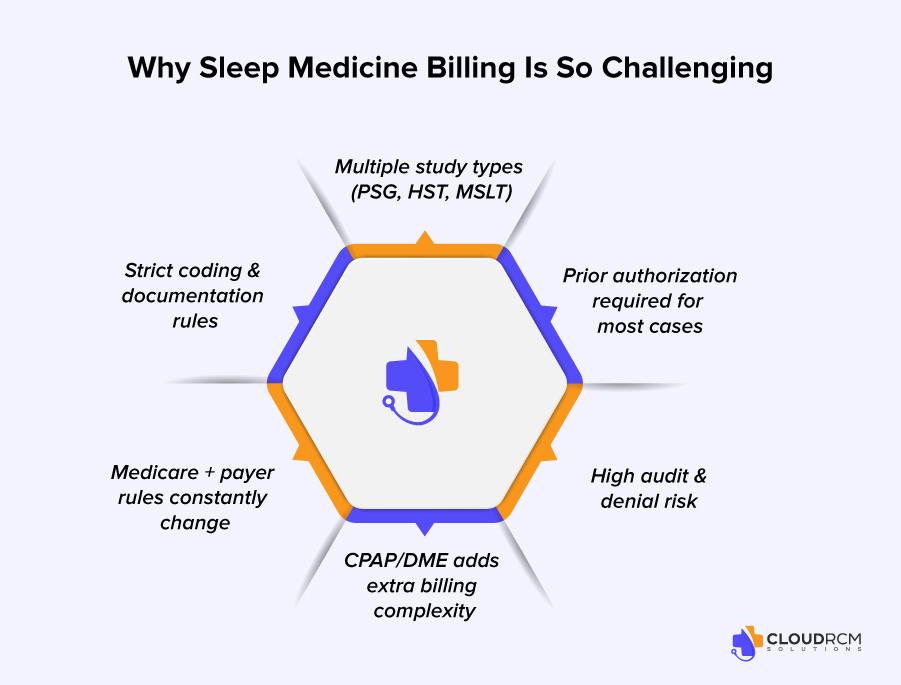
Sleep medicine combines diagnostic testing, physician evaluation, clinical documentation, payer coverage rules, and in some cases PAP/DME requirements. Each part of the workflow can create a reimbursement issue if it is not properly coordinated.
- Polysomnography (PSG)
Facility-based polysomnography provides comprehensive sleep monitoring but can involve extensive documentation and authorization requirements. Claims should be supported by the physician’s order, clinical assessment, testing rationale, and appropriate study documentation.
- Home Sleep Testing (HST)
Home sleep testing is commonly used for patients with suspected obstructive sleep apnea. Although HST can simplify testing, billing still depends on payer requirements, patient eligibility, device requirements, documentation, and appropriate coding.
- Multiple Sleep Latency Testing (MSLT)
MSLT is used to evaluate excessive daytime sleepiness and conditions such as narcolepsy. Because of its specialized clinical purpose, accurate documentation and coding are particularly important.
- CPAP and DME
Sleep medicine may continue beyond diagnosis into CPAP therapy and related DME. This introduces additional documentation, qualification, coverage, and ongoing compliance requirements.
- Medical Necessity Reviews
Payers routinely review sleep study claims to determine whether testing was medically necessary. Clinical documentation must clearly support symptoms, diagnoses, treatment plans, and testing rationale.
- Medicare and Commercial Payer Rules
Coverage requirements vary significantly among payers. Billing teams must remain current on LCD requirements, authorization policies, modifier usage, and documentation expectations to avoid denials and compliance risks.
Where Sleep Medicine Practices Lose Revenue
Revenue leakage can occur before the patient completes a sleep study and continue after the claim has been paid.
Before the Study
Common front-end problems include:
- Incomplete eligibility verification
- Missing authorization
- Incorrect payer information
- Missing referral or order
- Failure to confirm coverage requirements
During the Service
Revenue can be affected by:
- Missing charges
- Incomplete documentation
- Incorrect service reporting
- Coding inconsistencies
- Unclear clinical support
After the Study
Post-service problems may include:
- Incorrect CPT or ICD-10 coding
- Claim edits
- Modifier issues
- Timely filing problems
- Payer-specific submission errors
After Payment
Even paid claims can contain revenue leakage through:
- Underpayments
- Incorrect contractual adjustments
- Unresolved denials
- Aging A/R
- Payment posting discrepancies
A strong sleep medicine RCM process monitors each stage rather than focusing only on claim submission.
The Financial Reality of Sleep Medicine in 2026
Sleep medicine has a large and growing clinical need, with recent research estimating that 83.7 million U.S. adults were living with obstructive sleep apnea in 2024. For providers, however, demand does not automatically translate into collected revenue.
Sleep centers must navigate prior authorization, medical-necessity documentation, HST/PSG coverage requirements, coding accuracy, and payer-specific rules. CMS coverage guidance also ties sleep testing and PAP therapy to specific clinical, documentation, and coverage requirements.
In 2026, stronger sleep medicine revenue-cycle performance increasingly depends on accurate front-end verification, compliant coding, denial prevention, and disciplined A/R follow-up not simply higher testing volume.
Top Revenue Challenges Facing Sleep Centers
Growing patient demand does not eliminate revenue cycle challenges. In fact, higher patient volumes can expose inefficiencies in billing workflows and increase the financial impact of denials, delays, and documentation issues. Many sleep centers lose substantial revenue each year due to preventable administrative and billing-related problems.
- Prior Authorization Delays
Prior authorization remains one of the most common challenges in sleep medicine. Many commercial payers require authorization before approving sleep studies, particularly facility-based polysomnography.
Authorization delays can result in postponed testing, claim denials, patient dissatisfaction, and increased administrative workload.
- Documentation Deficiencies
Incomplete documentation frequently leads to reimbursement issues. Missing physician orders, insufficient clinical history, and inadequate medical necessity support can result in claim denials and audit findings.
- Coding Errors
Sleep medicine coding requires specialized knowledge of CPT, HCPCS, ICD-10, and payer-specific billing requirements. Coding inaccuracies can lead to underpayments, denials, or compliance concerns.
- Staffing Challenges
Many sleep centers struggle to maintain experienced billing and authorization teams. Staffing shortages often create delays in claim processing, denial management, and accounts receivable follow-up.
- Payer-Specific Requirements
Coverage policies vary significantly between Medicare and commercial insurers. Failure to comply with payer-specific rules can create reimbursement challenges and increase denial rates.
- Denial Management Backlogs
Without proactive denial management, unpaid claims can accumulate quickly, leading to aging A/R and cash flow disruptions. Practices can also explore strategies for automating A/R recovery to address older balances more efficiently.
Common Sleep Medicine CPT & Diagnosis Codes
Accurate coding is essential to sleep medicine reimbursement. Frequently encountered procedure codes may include:
| Code | Common Use |
|---|---|
| 95805 | Multiple Sleep Latency Test |
| 95806 | Sleep study with unattended monitoring |
| 95810 | Diagnostic polysomnography |
| 95811 | Polysomnography with PAP titration |
| 95782 | Pediatric polysomnography |
| 95783 | Pediatric PSG with PAP titration |
| G0398 | Home sleep test |
| G0399 | Home sleep test |
| G0400 | Home sleep test |
Common sleep-related ICD-10-CM diagnoses may include:
- G47.33 — Obstructive sleep apnea
- G47.30 — Sleep apnea, unspecified
- G47.10 — Hypersomnia
- G47.411 — Narcolepsy with cataplexy
- G47.52 — REM sleep behavior disorder
- G47.61 — Periodic limb movement disorder
Code selection should always be based on the current coding guidelines, documentation, and payer requirements applicable to the service.
Medical Necessity Documentation for Sleep Studies
Medical necessity is one of the most important factors in sleep study reimbursement. A payer must be able to understand why the service was ordered and how it relates to the patient’s clinical condition.
Documentation should appropriately support:
- Patient symptoms and clinical history
- Physician evaluation
- Suspected or documented sleep disorder
- Reason for ordering the study
- Type of sleep study performed
- Physician order
- Treatment or follow-up plan
- Medical necessity for repeat testing when applicable
Examples of relevant symptoms may include excessive daytime sleepiness, loud snoring, witnessed apneas, fatigue, and other sleep-related breathing concerns.
Better documentation gives the claim stronger support and can reduce preventable reimbursement issues.
HST vs PSG Billing Considerations
Home sleep testing and polysomnography serve different clinical purposes and may have different payer requirements.
| Category | HST | PSG |
| Location | Patient’s home | Sleep laboratory/facility |
| Monitoring | Limited | Comprehensive |
| Common use | Suspected uncomplicated OSA | Complex or broader sleep evaluation |
| Cost | Generally lower | Generally higher |
| Authorization | Payer-dependent | Payer-dependent |
| Documentation | Medical necessity and eligibility | More extensive clinical and study documentation |
Providers should not select a testing method based solely on reimbursement. The appropriate study should be supported by the patient’s clinical needs and applicable payer policies.
Common Sleep Study Denials and How to Prevent Them
Sleep study denials can significantly impact cash flow and increase administrative workload. Fortunately, many denials are preventable.
| Common Denial Reason | Prevention Strategy |
| Missing Authorization | Verify before scheduling |
| Insufficient Medical Necessity | Strengthen documentation |
| Incorrect CPT Coding | Conduct coding audits |
| Missing Physician Order | Maintain complete records |
| Diagnosis Mismatch | Verify ICD-10 accuracy |
| Modifier Errors | Review billing guidelines |
| Timely Filing Violations | Submit claims promptly |
Organizations that proactively monitor denial trends are often able to recover lost revenue while reducing future denial rates.
Conclusion
Sleep medicine practices face growing reimbursement challenges from prior authorizations, documentation requirements, coding complexities, payer rules, and DME compliance. Specialized billing support can help reduce denials, improve cash flow, strengthen compliance, and protect earned revenue.
Ready to improve collections and reduce denials? Contact Cloud Rcm Solutions today to learn how our specialized Sleep Medicine Billing Services can help your practice achieve stronger financial performance.
FAQ’s
Does Medicare cover sleep studies?
Yes. Medicare covers medically necessary sleep studies when documentation and coverage requirements are met.
What are the most common sleep study CPT codes?
Common codes include 95810, 95811, 95805, 95806, G0398, G0399, and G0400.
Why are sleep study claims denied?
Claims are commonly denied due to missing authorizations, insufficient medical necessity documentation, coding errors, diagnosis mismatches, and modifier-related issues.
Does sleep testing require prior authorization?
Many commercial payers require prior authorization before approving sleep studies, particularly facility-based polysomnography.
What documentation is required for CPAP reimbursement?
Requirements often include sleep study results, physician evaluations, treatment recommendations, and ongoing compliance documentation.