Medical Billing
 Medical Coding
 Medical Audit
 Provider Credentialing
 Denial Management
 A/R Follow-up
 Private Practice
 Patient Help Desk
 Customized Reporting
 Out-of-Network Billing
 Internal Medicine
 Pediatrics
 Radiology
 Surgery
 Emergency Medicine
 Anesthesiology
 Cardiology
 Orthopedic
 Psychiatry
 Dentistry
 OB-GYN
 Family Medicine
Submitting a Louisiana Medicaid application doesn’t automatically mean your practice can bill for services. Many healthcare providers mistakenly believe they’re ready to see Medicaid patients after completing state enrollment, only to discover they still need credentialing with one or more Healthy Louisiana Managed Care Organizations (MCOs). That misunderstanding can delay reimbursements, create claim denials, disrupt patient scheduling, and slow practice growth.
Whether you’re opening a new practice, hiring additional providers, expanding into Louisiana, or enrolling with Medicaid for the first time, understanding the complete enrollment process is essential to getting paid accurately and on time.
Louisiana Medicaid Provider Enrollment Overview
| Feature | Details |
| State Agency | Louisiana Department of Health (LDH) |
| Enrollment Portal | Louisiana Medicaid Provider Enrollment Portal |
| Medicaid Model | Fee-for-Service + Healthy Louisiana Managed Care |
| Number of Active MCOs (2026) | Five |
| Average Enrollment Timeline | 60–120 Days |
| CAQH Required | For most participating MCOs |
| NPI Required | Yes |
| Taxonomy Verification | Yes |
| Revalidation | Required periodically |
What Is Louisiana Medicaid Provider Enrollment?
Louisiana Medicaid provider enrollment is the official process healthcare professionals and organizations complete before billing Louisiana Medicaid for covered medical services. Enrollment confirms that a provider meets state and federal participation requirements, satisfies screening standards, and is eligible to receive reimbursement for treating Medicaid beneficiaries.
Unlike many commercial insurance plans, Louisiana Medicaid operates through a dual enrollment model. State approval alone does not automatically authorize billing every Medicaid patient. Providers must also establish participation with the managed care organizations that administer benefits across the Healthy Louisiana program.
This distinction is one of the most misunderstood aspects of Medicaid credentialing. Many providers assume that completing the state application finishes the process, only to discover later that individual health plans have not yet approved their participation. As the uploaded guide notes, completing one layer does not replace the other, and both are needed before claims process successfully.
Why Provider Enrollment Matters
Provider enrollment is more than an administrative requirement. It directly affects a practice’s financial stability and patient access.
Without active enrollment, providers may experience:
- Claim denials due to inactive enrollment
- Delayed reimbursements
- Limited access to Medicaid patients
- Interrupted revenue cycles
- Compliance risks during audits
- Reduced referral opportunities
For growing practices, enrollment delays can postpone revenue generation for weeks or even months. Completing enrollment accurately the first time helps minimize disruptions and accelerates participation in Louisiana Medicaid networks.
Understanding Louisiana’s Two-Layer Enrollment System
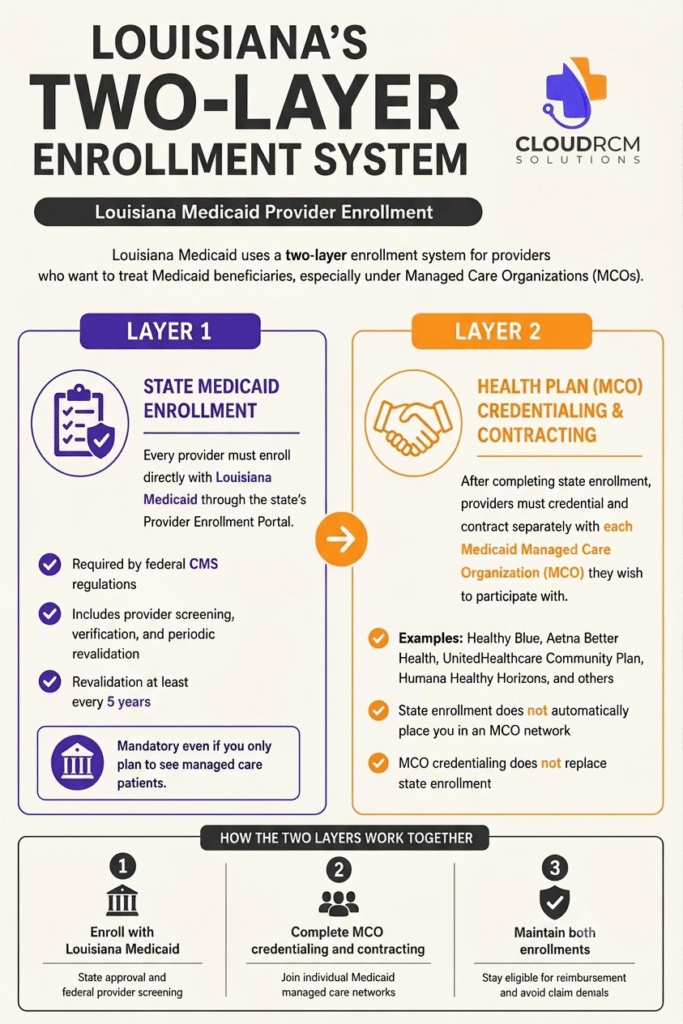
One of the biggest reasons providers experience credentialing delays is misunderstanding how Louisiana structures Medicaid participation.
The process consists of two independent approvals.
Step 1: State Medicaid Enrollment
Providers begin by submitting an application through the Louisiana Medicaid Provider Enrollment Portal. During this stage, the state verifies information such as:
- Professional licenses
- National Provider Identifier (NPI)
- Taxonomy codes
- Ownership disclosures
- Federal screening requirements
- Provider eligibility
Once approved, the provider becomes enrolled with Louisiana Medicaid at the state level.
Step 2: Healthy Louisiana MCO Credentialing
After state enrollment, providers must separately credential with each Healthy Louisiana Managed Care Organization they wish to join.
Each payer performs its own credentialing review, including:
- License verification
- Board certification (when applicable)
- Professional liability coverage
- Work history
- Sanction screening
- CAQH profile review
Only after both state enrollment and payer credentialing are complete can providers bill participating Medicaid health plans.
Who Must Complete Louisiana Medicaid Enrollment?
Enrollment requirements extend beyond physicians who submit claims directly.
Many provider types must enroll, including:
- Physicians
- Nurse Practitioners
- Physician Assistants
- Behavioral Health Providers
- Mental Health Professionals
- Physical Therapists
- Occupational Therapists
- Speech-Language Pathologists
- Home Health Agencies
- Durable Medical Equipment (DME) Suppliers
- Rural Health Clinics
- Federally Qualified Health Centers (FQHCs)
- Hospitals
- Ambulatory Surgery Centers
- Independent Laboratories
- Imaging Centers
The source also explains that ordering, prescribing, and referring (OPR) providers may need active enrollment even if they do not bill Medicaid directly, because their identifiers appear on claims for Medicaid beneficiaries.
Documents Required Before You Apply
Preparing documentation before beginning the application can significantly reduce processing delays.
Most providers should have the following available:
- National Provider Identifier (NPI)
- Tax Identification Number (TIN)
- IRS documentation
- Signed W-9
- State professional license
- Professional liability insurance certificate
- Electronic Funds Transfer (EFT) information
- Ownership disclosure documents
- Practice address information
- Taxonomy codes
- Group NPI (if applicable)
The uploaded guide identifies these items as part of the required enrollment packet and recommends assembling them before starting the online application.
How Long Does Louisiana Medicaid Enrollment Take?
Although every provider’s timeline differs, most credentialing projects follow a similar progression.
| Stage | Typical Timeline |
| State Enrollment Review | 30–45 Business Days |
| MCO Credentialing | 30–60 Days |
| Total Process | Approximately 60–120 Days |
Several factors can extend these timelines, including incomplete applications, missing documentation, incorrect taxonomy codes, expired licenses, or delayed responses to requests for additional information.
Practices that monitor application status regularly and respond quickly to payer requests often experience faster approvals.
Common Reasons Applications Are Delayed
Credentialing delays rarely occur because of one major mistake. Instead, they often result from small inconsistencies throughout the application.
Common issues include:
- Incorrect NPI information
- Taxonomy mismatches
- Incomplete ownership disclosures
- Missing signatures
- Expired malpractice insurance
- Outdated CAQH information
- Missing supporting documents
- Unanswered payer requests
- Duplicate provider records
- Incorrect practice addresses
Many of these problems can be prevented through careful document review before submission.
The Importance of CAQH and Accurate Provider Data
While the Louisiana Medicaid application focuses on state enrollment, managed care organizations frequently rely on CAQH ProView during credentialing.
An incomplete or outdated CAQH profile can delay participation with multiple payers simultaneously.
Providers should regularly verify:
- Practice locations
- Hospital affiliations
- Professional licenses
- DEA registration (if applicable)
- Board certifications
- Work history
- Liability insurance
- Supporting documentation
Keeping provider information consistent across CAQH, NPPES, and state enrollment records helps reduce manual reviews and credentialing delays. The source highlights CAQH attestation and alignment between NPI, taxonomy, and enrollment data as important prerequisites before applying.
Healthy Louisiana Managed Care Organizations (MCOs)
After receiving approval from the Louisiana Medicaid Provider Enrollment Portal, providers must complete credentialing with the Healthy Louisiana Managed Care Organizations (MCOs) they plan to serve. These health plans administer the majority of Medicaid benefits across the state, and each maintains its own provider network, credentialing policies, and contracting requirements.
As of 2026, Healthy Louisiana includes five active MCOs, following the exit of UnitedHealthcare Community Plan of Louisiana earlier in the year. Providers should confirm participation requirements with each payer before accepting patients. The uploaded source identifies the five current organizations and notes the program change.
The five participating plans are:
- Aetna Better Health of Louisiana
- AmeriHealth Caritas Louisiana
- Healthy Blue
- Humana Healthy Horizons in Louisiana
- Louisiana Healthcare Connections
Because patient assignments vary by region and health plan, many practices credential with multiple MCOs to expand patient access and reduce referral limitations.
Louisiana Medicaid Revalidation Requirements
Enrollment is not permanent. Providers must periodically revalidate their Medicaid enrollment to maintain participation and continue receiving reimbursements.
Revalidation allows Louisiana Medicaid to confirm that provider information, licensing, ownership, and compliance records remain current. Failing to complete revalidation by the required deadline may result in deactivation from the Medicaid program and payment interruptions.
The uploaded guide explains that Louisiana generally requires revalidation at least every five years, while certain provider categories follow different schedules. It also describes the 2026 off-cycle revalidation initiative affecting selected provider groups.
Practices should maintain an internal credentialing calendar to monitor:
- Medicaid revalidation deadlines
- State license renewals
- DEA registration expirations
- Malpractice insurance renewals
- CAQH attestations
- Board certification updates
Proactive monitoring helps prevent avoidable credentialing lapses.
Best Practices for a Successful Enrollment
Successful Medicaid enrollment depends on preparation, accuracy, and consistent follow-up. Healthcare organizations can improve approval timelines by following several proven practices:
1. Verify Provider Information
Ensure all provider information matches across:
- Louisiana Medicaid application
- NPPES records
- CAQH profile
- State licensing board
- IRS documentation
Even small discrepancies may trigger manual reviews.
2. Submit Complete Documentation
Incomplete applications remain one of the leading causes of enrollment delays. Before submission, verify that every required document is current, signed where necessary, and uploaded in the correct format.
3. Respond Promptly
Credentialing specialists and Medicaid reviewers often request additional information during the review process. Responding quickly helps keep applications moving and reduces unnecessary delays.
4. Maintain Current Records
Provider information changes frequently. Office relocations, ownership updates, new service locations, or additional specialties should be reported promptly to avoid billing disruptions.
Final Thoughts
Louisiana Medicaid provider enrollment is more than completing an online application; it’s the foundation for participating in one of the state’s largest healthcare programs. Because enrollment involves both state approval and Healthy Louisiana MCO credentialing, providers who understand the full process are better positioned to avoid delays, minimize claim denials, and establish a reliable revenue cycle.
Ready to get credentialed? Schedule a free consultation with CloudRCM Solutions today.
FAQ’s
Is CAQH required?
Most Healthy Louisiana managed care organizations rely on CAQH during credentialing. Maintaining an accurate and regularly attested CAQH profile can help reduce credentialing delays.
Is Louisiana Medicaid enrollment the same as MCO credentialing?
No. State enrollment authorizes participation in Louisiana Medicaid, while separate credentialing is required with each Healthy Louisiana Managed Care Organization you intend to bill.
Can I bill Medicaid immediately after submitting my application?
No. Providers should wait until enrollment and any required MCO credentialing are approved before billing, unless an applicable effective date or retroactive billing policy specifically allows otherwise. The uploaded guide notes that billing depends on the written effective date rather than simply seeing an approved application status.