Medical Billing
 Medical Coding
 Medical Audit
 Provider Credentialing
 Denial Management
 A/R Follow-up
 Private Practice
 Patient Help Desk
 Customized Reporting
 Out-of-Network Billing
 Internal Medicine
 Pediatrics
 Radiology
 Surgery
 Emergency Medicine
 Anesthesiology
 Cardiology
 Orthopedic
 Psychiatry
 Dentistry
 OB-GYN
 Family Medicine
Independent cardiology practices continue to play a vital role in delivering specialized cardiovascular care, but today’s healthcare environment is becoming increasingly challenging. Rising operating costs, staffing shortages, stricter payer policies, prior authorization requirements, and declining reimbursements are placing significant pressure on practice profitability. Even with growing patient demand, many cardiology groups struggle with claim denials, delayed payments, and hidden revenue leakage that impacts long-term financial stability.
This guide covers the key challenges facing cardiology practices in 2026 and shares practical strategies to improve revenue cycle performance, reduce denials, and strengthen cash flow.
The State of Independent Cardiology Practices in 2026
Cardiovascular disease remains one of the leading healthcare challenges in the United States, driving continued demand for diagnostic testing, preventive care, and advanced cardiovascular treatments. At the same time, independent cardiology practices are operating in an increasingly complex healthcare environment, making efficient Cardiology Revenue Cycle Management Services more important than ever for maintaining financial stability and optimizing reimbursements.
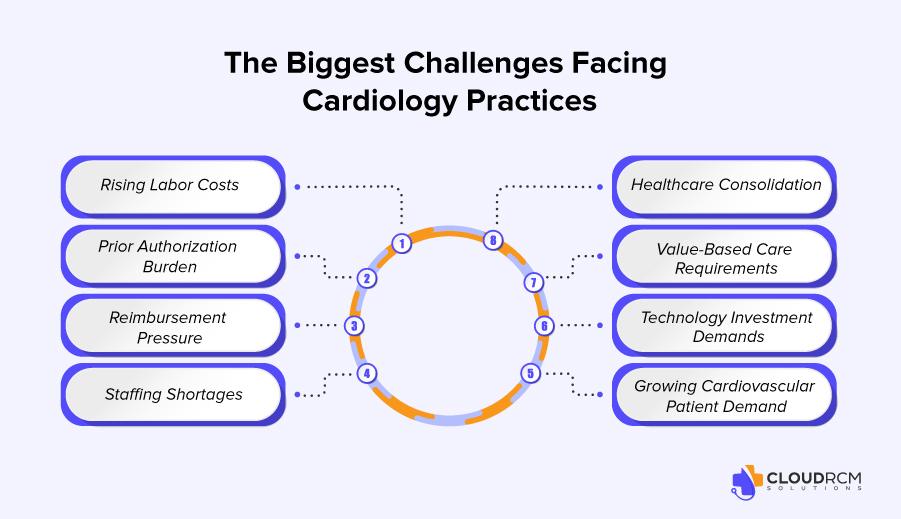
Several factors continue to reshape the specialty:
- Rising staffing and labor costs
- Increasing prior authorization requirements
- Greater payer scrutiny of high-cost procedures
- Ongoing reimbursement pressure
- Expansion of value-based care models
- Healthcare consolidation and acquisition activity
- Growing investment in healthcare technology and automation
While these trends create operational challenges, they also present opportunities for practices that adapt strategically.
Independent groups still maintain several competitive advantages, including greater agility, stronger physician autonomy, faster decision-making, and more personalized patient care. The challenge is building a sustainable business model capable of supporting those advantages in an increasingly competitive marketplace.
Key Trends Shaping Cardiology Practices in 2026
In 2026, independent cardiology practices face growing administrative burdens, tighter reimbursement policies, and increased payer scrutiny while adapting to value-based care models. At the same time, AI-powered automation, predictive analytics, and integrated practice management systems are improving operational efficiency. Combined with rising patient demand driven by an aging population and increasing cardiovascular disease, these trends make strong revenue cycle management and financial optimization more important than ever.
Where Cardiology Practices Are Losing Revenue Without Realizing It
Revenue loss rarely occurs because providers fail to deliver quality care. More often, it stems from operational inefficiencies hidden throughout the revenue cycle.
A missed modifier on an echocardiogram, an authorization delay for advanced cardiac imaging, an underpaid claim for a catheterization procedure, or an unresolved denial may seem insignificant individually. Across hundreds or thousands of claims each year, however, these small issues can translate into substantial revenue loss.
Common sources of hidden revenue leakage include:
- Coding inaccuracies
- Missing modifiers
- Prior authorization failures
- Insurance eligibility verification errors
- Documentation deficiencies
- Underpaid claims
- Denial management backlogs
- Delayed accounts receivable follow-up
- Missed charge capture opportunities
Many practices do not recognize these problems until they begin experiencing declining collections, increasing denial rates, aging receivables, or inconsistent cash flow.
Revenue Cycle Breakdown: Where Financial Problems Typically Occur
Revenue leakage can occur at virtually every stage of the patient journey.
| Revenue Cycle Stage | Common Breakdown | Financial Impact |
| Patient Scheduling | Incorrect demographics | Claim delays |
| Insurance Verification | Eligibility errors | Claim denials |
| Prior Authorization | Missing approvals | Lost reimbursement |
| Clinical Documentation | Incomplete records | Coding issues |
| Coding & Charge Capture | Incorrect CPT/ICD-10 selection | Underpayments |
| Claim Submission | Scrubbing errors | Claim rejections |
| Denial Management | Delayed appeals | Revenue loss |
| Accounts Receivable | Poor follow-up | Cash flow disruption |
Understanding where breakdowns occur allows practices to address root causes rather than continually reacting to symptoms.
Common Warning Signs of Revenue Leakage
| If You’re Seeing This… | It Could Indicate… |
| Increasing denials for cardiac procedures | Documentation or coding issues |
| Delays in scheduling diagnostic testing | Authorization bottlenecks |
| Growing A/R balances | Ineffective claim follow-up |
| Frequent payer underpayments | Contract or reimbursement gaps |
| Rising staff workload | Inefficient revenue cycle workflows |
| Stable patient volume but declining collections | Hidden revenue leakage |
| More time spent on appeals | Preventable denial trends |
If several of these challenges sound familiar, your practice may have opportunities to improve reimbursement performance and strengthen cash flow.
Prior Authorization Is Becoming a Growth Barrier
Few operational challenges generate more frustration for cardiology practices than prior authorization requirements.
Services that frequently require authorization include:
- Advanced cardiac imaging
- Echocardiography
- Stress testing
- Cardiac catheterization
- Electrophysiology procedures
- Ablation services
- Cardiac device implantation
When authorization workflows are inefficient, patient care can be delayed, schedules become disrupted, reimbursements are postponed, and staff workloads increase.
Over time, these challenges can negatively affect both patient satisfaction and financial performance.
Why Strong Revenue Cycle Management Matters More Than Ever
Revenue Cycle Management (RCM) has evolved beyond traditional billing. For independent cardiology practices, it is now a strategic function that directly influences profitability, operational efficiency, and long-term sustainability.
A high-performing RCM program focuses on:
- Insurance eligibility verification
- Accurate charge capture
- Clean claim submission
- Denial prevention
- Accounts receivable optimization
- Financial reporting and analytics
Practices that invest in strong revenue cycle processes are often better positioned to reduce reimbursement delays, improve collections, and strengthen cash flow.
High-Risk Cardiology Billing Areas That Demand Special Attention
Certain cardiology procedures require precise coding, complete documentation, and strict payer compliance. Even minor billing errors can lead to claim denials, delayed payments, or lost revenue.
| Service | Key Billing Challenge | Why It Matters |
|---|---|---|
| Echocardiography | Accurate CPT coding, modifiers, and documentation | Prevents underpayments and claim denials. |
| Stress Testing | Multiple billable components and medical necessity | Ensures proper reimbursement and payer compliance. |
| Nuclear Cardiology | Prior authorization and complex coding | Reduces payer audits and reimbursement delays. |
| Cardiac Catheterization | Detailed procedure coding and bundled services | Prevents coding errors and revenue leakage. |
| Electrophysiology (EP) | Frequently updated coding requirements | Improves claim accuracy for EP studies and ablations. |
| Device Implantation | Coding for pacemakers, ICDs, and CRT devices | Supports accurate reimbursement and regulatory compliance. |
New Revenue Opportunities for Independent Cardiology Practices
While reducing revenue leakage is critical, sustainable growth also requires identifying new reimbursement opportunities.
Many cardiology practices are expanding beyond traditional office visits and procedural services by implementing chronic care and remote monitoring programs that support both patient outcomes and practice revenue.
1. Remote Patient Monitoring (RPM)
Remote Patient Monitoring allows providers to track patient health data between visits using connected medical devices.
For cardiology practices, RPM can support:
- Hypertension management
- Heart failure monitoring
- Arrhythmia management
- Post-procedure follow-up
RPM programs help improve patient engagement while creating recurring reimbursement opportunities.
2. Chronic Care Management (CCM)
Patients with multiple chronic conditions often require ongoing care coordination outside traditional office visits.
CCM programs allow practices to provide continuous support while generating additional revenue through properly documented non-face-to-face care management services.
Benefits include:
- Improved patient outcomes
- Reduced hospitalizations
- Better care coordination
- Predictable recurring revenue
3. Principal Care Management (PCM)
PCM focuses on patients with a single high-risk chronic condition, making it particularly relevant for many cardiology populations.
These programs help providers deliver more proactive care while strengthening reimbursement opportunities.
For independent cardiology practices, RPM, CCM, and PCM programs are increasingly becoming valuable components of long-term growth strategies.
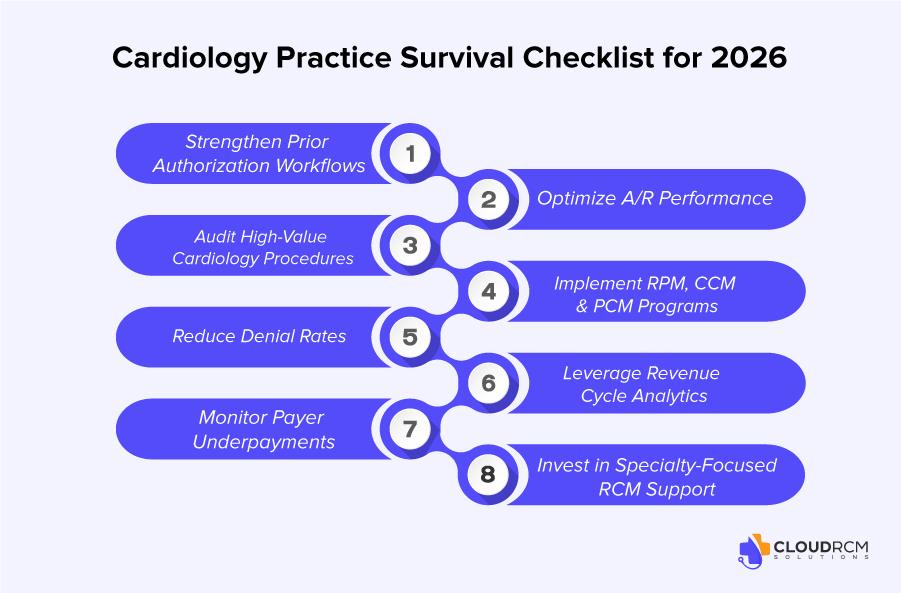
Partner with a Trusted Cardiology Revenue Cycle Management Team
Increasing payer scrutiny, complex cardiovascular coding, and reimbursement challenges can reduce your practice’s revenue. CloudRCM Solutions provides specialized Cardiology Revenue Cycle Management Services to improve coding accuracy, reduce claim denials, accelerate reimbursements, and optimize your entire revenue cycle.
Schedule a free revenue assessment today to discover how CloudRCM can increase reimbursements, improve cash flow, and give your providers more time to focus on exceptional patient care.
FAQ’s
Why are independent cardiology practices struggling financially in 2026?
Many practices face increasing administrative costs, staffing shortages, reimbursement pressure, prior authorization requirements, and growing compliance obligations, all of which affect profitability.
What are the biggest sources of revenue leakage in cardiology practices?
Common causes include coding errors, missing modifiers, authorization failures, underpaid claims, denial backlogs, eligibility verification mistakes, and poor A/R follow-up.
What is a healthy denial rate for a cardiology practice?
Most high-performing practices aim for a denial rate below 5%.
How can cardiology practices improve cash flow?
Improving eligibility verification, obtaining authorizations, reducing denials, accelerating claim submission, and strengthening A/R follow-up can significantly improve cash flow.
What cardiology services face the highest billing scrutiny?
Echocardiography, stress testing, nuclear cardiology, cardiac catheterization, electrophysiology procedures, device implantation, and remote monitoring services frequently receive increased payer scrutiny.
Are RPM and CCM programs worth implementing?
Yes. RPM and CCM programs can improve patient outcomes while creating additional recurring reimbursement opportunities when properly documented and managed.
Why should cardiology practices outsource revenue cycle management?
Specialized RCM partners can improve coding accuracy, reduce denials, strengthen collections, enhance compliance, and reduce administrative burden, allowing providers to focus more on patient care.