Medical Billing
 Medical Coding
 Medical Audit
 Provider Credentialing
 Denial Management
 A/R Follow-up
 Private Practice
 Patient Help Desk
 Customized Reporting
 Out-of-Network Billing
 Internal Medicine
 Pediatrics
 Radiology
 Surgery
 Emergency Medicine
 Anesthesiology
 Cardiology
 Orthopedic
 Psychiatry
 Dentistry
 OB-GYN
 Family Medicine
A patientwalks in expecting a routine visit and walks out weeks later, shocked by a medical bill they never saw coming. This is one of the most common reasons patients lose trust in healthcare practices, and in most cases, it happens because no one clearly explained their out-of-network benefits in advance.
How to explain out-of-network benefits to patients is not just a billing task; it is a critical communication skill that directly impacts patient satisfaction, trust, and your revenue cycle. When patients don’t fully understand their insurance coverage, even small gaps in communication can turn into frustration, disputes, and delayed payments.
Most confusion happens because:
- Patients assume insurance will cover most or all of the visit cost
- Out-of-network charges are not clearly explained before treatment
- Financial responsibility is discussed too late in the process
- Insurance terminology creates misunderstanding and fear
When providers take a few minutes to clearly explain out-of-network benefits upfront, patients feel informed instead of surprised. They understand what their insurance covers, what they will pay, and why the difference exists. This simple step not only improves transparency but also reduces billing conflicts and strengthens patient trust.
What Does Out-of-Network Mean in Medical Billing?
Out-of-network in medical billing refers to a healthcare provider who does not have a contracted agreement with a patient’s insurance company. This means the provider has not negotiated discounted rates with the insurer, and therefore, the insurance plan may cover less of the service cost compared to in-network providers.
When patients visit an out-of-network provider, their insurance still may contribute to the bill, but the coverage is usually limited based on the plan’s out-of-network benefits. As a result, patients often pay a higher portion of the total cost.
In simple terms:
- In-network providers = Lower negotiated rates + higher insurance coverage
- Out-of-network providers = No contract + higher patient responsibility
Understanding this difference is the first step in learning how to explain out-of-network benefits to patients clearly and effectively.
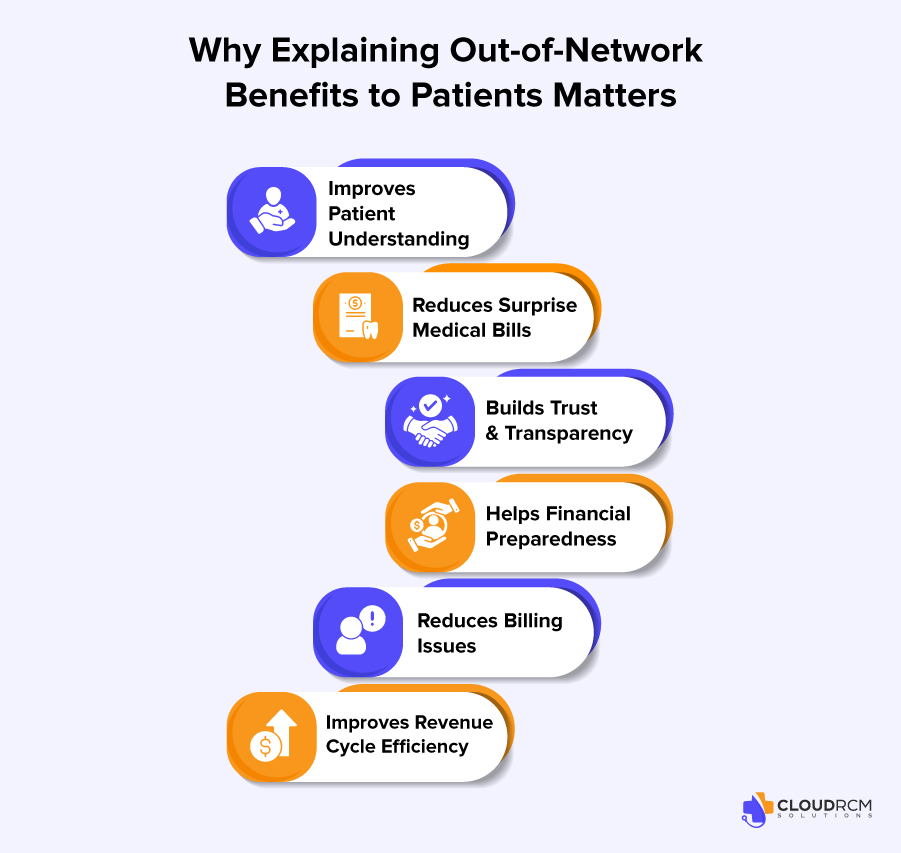
Why Explaining Out-of-Network Benefits to Patients Is Important
Explaining out-of-network benefits is not just an administrative task; it directly impacts patient trust, satisfaction, and the financial performance of a healthcare practice. When patients are not properly informed, they may feel surprised or misled when they receive their medical bill.
Clear communication helps prevent confusion and builds transparency between the provider and the patient.
- Reduces unexpected medical billing disputes and complaints
- Improves patient trust and long-term relationships
- Helps patients prepare financially before receiving care
- Minimizes claim confusion and reimbursement delays
- Supports better front desk and billing workflow efficiency
When providers take time to clearly explain out-of-network benefits to patients, it creates a smoother billing experience and reduces the chances of dissatisfaction or payment resistance.
In-Network vs Out-of-Network Providers: Key Differences Patients Must Understand
Many patients become confused about why their medical bill changes depending on where they receive care, especially when it comes to insurance coverage. This confusion usually comes from not fully understanding the difference between in-network and out-of-network providers, which can directly impact their out-of-pocket costs.
The main difference is simple: it depends on whether the provider has a contract with the patient’s insurance company. In-network providers have agreed-upon rates with insurance companies, while out-of-network providers do not have these agreements, which affects how much insurance will cover.
- In-Network Providers:
- Have a formal contract with insurance companies
- Follow pre-negotiated, discounted rates
- Result in lower out-of-pocket costs for patients
- Insurance typically covers a larger portion of the bill
- Out-of-Network Providers:
- Do not have a contract with the insurance company
- Charge standard (often higher) rates for services
- Insurance may only cover part of the cost or reimburse partially
- Patients may be responsible for the remaining balance (balance billing)
When healthcare staff clearly explain this difference in simple terms, patients are better able to understand their financial responsibility before receiving care. This not only reduces confusion and frustration but also improves transparency and trust between the patient and the provider.
Step-by-Step Guide on How to Explain Out-of-Network Benefits to Patients
Explaining out-of-network benefits to patients becomes much easier when it follows a clear and structured process. Patients are often unfamiliar with insurance rules, so the goal is to simplify the information, set correct expectations, and reduce confusion before treatment begins. A step-by-step approach ensures consistency across staff members and improves both patient understanding and financial transparency.
Step 1: Explain What Out-of-Network Means
The first step is to define “out-of-network” in simple terms. Patients should be told that the provider does not have a contracted agreement with their insurance company. Because of this, the insurance plan may not fully cover the services, and the patient may be responsible for a larger portion of the cost. Keeping this explanation short, direct, and jargon-free helps patients quickly understand the situation without feeling overwhelmed.
Step 2: Explain the Cost Difference Clearly
Once patients understand the definition, the next step is to explain how costs differ. In-network providers have pre-negotiated rates with insurance companies, which usually result in lower out-of-pocket expenses for patients. In contrast, out-of-network providers charge standard rates that are not discounted by insurance, which often leads to higher patient responsibility. This step helps patients understand why their bill may be higher.
Step 3: Break Down Patient Financial Responsibility
After explaining cost differences, it is important to clarify what the patient will actually pay. This includes deductible requirements, coinsurance percentages, and the possibility of balance billing. Patients should understand that insurance may only cover a portion of the allowed amount, and they may still be responsible for the remaining balance. This step is essential for preventing surprise billing issues later.
Step 4: Explain the Payment and Claims Process
Next, patients should be guided through how payment works for out-of-network services. In many cases, patients may need to pay at the time of service. Afterward, they are provided with a superbill, which they can submit to their insurance company for potential reimbursement. Explaining this process in advance helps patients understand the flow of payment and reduces confusion after the visit.
Step 5: Advise Patients to Verify Insurance Coverage
Patients should always be encouraged to contact their insurance provider before receiving care. They should confirm whether out-of-network services are covered, what their deductible and coinsurance amounts are, and whether pre-authorization is required. This step helps patients avoid unexpected financial responsibility and makes the billing process smoother for everyone involved.
Step 6: Provide Support and Encourage Questions
Finally, the conversation should end with reassurance and support. Patients should feel comfortable asking questions about their coverage, bills, or claims. Letting them know that assistance is available if they face confusion builds trust and improves their overall experience with the practice.
By following these structured steps on how to explain out-of-network benefits to patients, healthcare providers can improve communication, reduce billing disputes, and ensure patients feel informed and confident about their financial responsibilities before receiving care.
What Patients Pay in Out-of-Network Billing (Deductible, Coinsurance & Balance Billing Explained)
When patients visit an out-of-network provider, their final bill is usually made up of several different components. Unlike in-network care, where costs are negotiated and predictable, out-of-network billing can vary based on the insurance plan, coverage limits, and provider charges. Understanding these cost components is essential when learning how to explain out-of-network benefits to patients clearly.
In most cases, patients are responsible for more than just a single bill amount. Instead, their total payment is broken into three main parts: deductible, coinsurance, and balance billing.
The deductible is the amount a patient must pay out-of-pocket before their insurance starts covering any portion of the services. For out-of-network care, this deductible is often higher than in-network deductibles, which means patients may need to spend more before receiving insurance support.
After the deductible is met, coinsurance comes into effect. This is a percentage of the cost that the patient shares with the insurance company. For example, the insurance may cover 60%, while the patient is responsible for the remaining 40%. The exact percentage depends on the patient’s insurance plan and out-of-network benefits.
The third component is balance billing, which often causes the most confusion for patients. This happens when the provider charges more than what the insurance company considers the “allowed amount.” In this case, insurance pays only up to its approved rate, and the patient is billed for the remaining difference. This can significantly increase the total cost of care if the provider’s charges are higher than the insurance reimbursement rate.
- Deductible: Amount paid before insurance begins coverage
- Coinsurance: Percentage shared between patient and insurance
- Balance Billing: Difference between provider charges and insurance allowed amount
When patients understand these three components, they are better prepared for their financial responsibility and less likely to be surprised by their medical bills. Clear explanation of these terms is a key part of effectively explaining out-of-network benefits to patients and building trust in the billing process.
Real-Life Example of Out-of-Network vs In-Network Costs
One of the easiest ways to understand how out-of-network billing works is through a real-life example. Patients often struggle with insurance terminology, but numbers make the difference much clearer. When explaining how to explain out-of-network benefits to patients, using a simple cost comparison helps them immediately see why their bill may be higher.
Let’s assume a patient is receiving a medical service that costs $1,000.
In an in-network setting, the provider has a contract with the insurance company, which reduces the cost to a negotiated rate. For example, the allowed amount may be reduced to $600. The insurance company may then cover a large portion of that amount, such as 80%, which equals $480, leaving the patient responsible for only $120 out-of-pocket.
However, in an out-of-network setting, the situation changes. The provider may charge the full $1,000, and the insurance company may only recognize a lower “allowed amount,” such as $500. If the insurance covers 60% of that allowed amount, it would pay $300, leaving the remaining $200 as patient responsibility. On top of that, the provider may also bill the patient for the difference between their charge and the insurance allowed amount (balance billing), which in this case could be an additional $500.
- In-Network Example:
- Total cost: $1,000 → Adjusted: $600
- Insurance pays: $480
- Patient pays: $120
- Out-of-Network Example:
- Provider charges: $1,000
- Insurance allowed: $500
- Insurance pays: $300
- Patient pays: $200 + possible balance billing ($500)
This comparison clearly shows why out-of-network care often results in higher patient costs, even when insurance is involved. When healthcare staff use simple examples like this, it becomes much easier to explain out-of-network benefits to patients and help them understand their financial responsibility before receiving care.
How to Help Patients Understand Out-of-Network Insurance Claims
Understanding out-of-network insurance claims is often confusing for patients because the process is very different from in-network billing. In in-network care, the provider usually submits the claim directly to the insurance company. However, in out-of-network situations, patients are often more involved in the process, which can create uncertainty if it is not properly explained.
When learning how to explain out-of-network benefits to patients, it is important to simplify the claims process so they know exactly what to expect after their visit.
The first thing patients should understand is that they may need to pay the full amount at the time of service. Since the provider is not contracted with the insurance company, payment is often collected upfront instead of waiting for insurance processing. This step alone helps set realistic expectations and avoids confusion at checkout.
After payment, the provider usually gives the patient a superbill. A superbill is a detailed document that includes all necessary medical codes, service descriptions, and charges. Patients use this document to file a claim with their insurance company so they can request reimbursement. Explaining the purpose of a superbill clearly is important because many patients are not familiar with this term.
Once the claim is submitted, the insurance company reviews it and determines how much they will reimburse based on the patient’s out-of-network benefits. This process can take several weeks, and reimbursement amounts vary depending on the insurance plan, deductible status, and allowable charges.
- Patients may need to pay upfront for services
- A superbill is provided for insurance claim submission
- Patients must file the claim themselves or through assistance
- Insurance reviews and reimburses based on plan rules
- Processing time can take several weeks
Helping patients understand this process step-by-step reduces confusion and improves satisfaction. When providers clearly explain out-of-network claims, patients are more confident in managing their reimbursement and less likely to feel overwhelmed after receiving care.
Common Mistakes When Explaining Out-of-Network Benefits to Patients
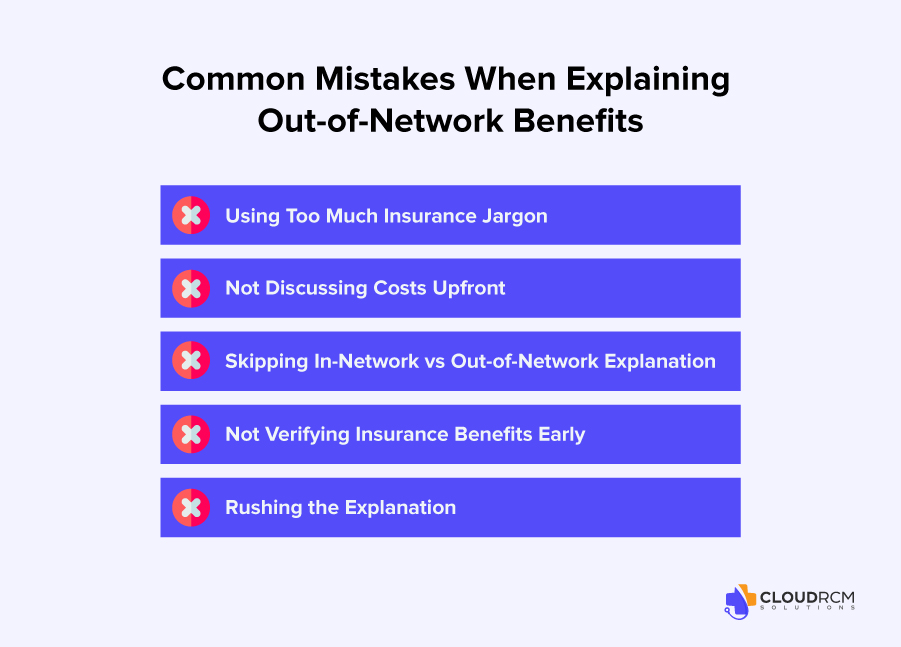
Even though explaining out-of-network benefits seems straightforward, many healthcare staff unintentionally make mistakes that lead to patient confusion, billing disputes, and loss of trust. Understanding these common errors is essential for improving communication and ensuring patients fully understand their financial responsibility.
When focusing on how to explain out-of-network benefits to patients, avoiding these mistakes can significantly improve patient satisfaction and reduce misunderstandings.
One of the most common mistakes is using too much insurance jargon. Terms like deductible, coinsurance, allowable amount, and balance billing can be confusing for patients who are not familiar with medical billing terminology. When explanations are too technical, patients may feel overwhelmed and leave the conversation without fully understanding their financial responsibility.
Another frequent mistake is not explaining costs upfront. If patients are not clearly informed about their potential out-of-pocket expenses before receiving care, they are more likely to experience “bill shock” later. This often leads to frustration, complaints, and payment delays that could have been avoided with proper communication.
Many providers also fail to explain the difference between in-network and out-of-network coverage in simple terms. Assuming that patients already understand insurance rules can lead to major misunderstandings. Without a clear comparison, patients may not realize why their costs are higher.
- Using complex insurance terminology instead of simple language
- Not discussing estimated costs before treatment begins
- Failing to clearly explain in-network vs out-of-network differences
- Skipping verification of insurance benefits before services
- Not allowing time for patient questions or clarification
Another common issue is not verifying insurance coverage in advance. Patients are often unaware of their exact out-of-network benefits, deductible amounts, or reimbursement limits. Without verification, both patients and providers face unexpected financial outcomes.
Finally, rushing through the explanation or not giving patients enough time to ask questions can create confusion. Patients need time to process information, especially when it involves financial responsibility. A rushed explanation often leads to misunderstanding and dissatisfaction.
Avoiding these mistakes is a key part of effectively explaining out-of-network benefits to patients. When communication is clear, simple, and patient-focused, it reduces confusion, builds trust, and improves the overall billing experience.
What to Say When Explaining Out-of-Network Benefits to Patients
One of the most effective ways to improve patient understanding is to use clear, consistent scripts. When staff know exactly what to say, it reduces confusion, avoids miscommunication, and ensures every patient receives the same accurate explanation. This is especially important when explaining out-of-network benefits to patients, where insurance terms can easily become overwhelming.
Below are simple, real-world scripts that healthcare staff can use in different situations to communicate clearly and confidently.
1. Basic Explanation Script (Simple & Neutral Tone)
This script is ideal for first-time explanation at the front desk or over the phone.
“Your insurance plan considers this visit out-of-network, which means we do not have a contracted rate with your insurance company. Because of that, your insurance may cover a smaller portion of the cost, and you may have a higher out-of-pocket responsibility. We will provide all necessary documents so you can submit a claim for possible reimbursement.”
2. Cost Transparency Script (Before Appointment)
Use this when discussing financial responsibility in advance.
“I want to make sure you have a clear understanding of your coverage. Since we are out-of-network with your insurance plan, your costs may be higher than an in-network provider. This means you may be responsible for a deductible, coinsurance, or any remaining balance not covered by your insurance.”
3. Superbill Explanation Script
Use this when explaining billing documentation.
“After your visit, we will provide you with a document called a superbill. This includes all the service details and billing codes your insurance company needs. You can submit this to your insurance provider to request reimbursement based on your out-of-network benefits.”
4. Script for Confused or Concerned Patients
Use a calm, reassuring tone here.
“I completely understand that insurance can be confusing. The main thing to know is that because we are out-of-network, your insurance may not cover the full cost. We are here to help you understand your options and make the process as simple as possible.”
5. Short 20–30 Second Quick Script
This is perfect for busy front desk communication.
“We are out-of-network with your insurance, which means your plan may cover part of the visit, but your out-of-pocket cost could be higher. We’ll provide all billing details and a superbill so you can submit a claim for reimbursement if your plan allows it.”
Using these scripts ensures consistency in communication and helps staff confidently explain out-of-network benefits to patients without confusion or misinterpretation. Clear messaging not only improves patient trust but also reduces billing disputes and improves overall financial transparency within the practice.
FAQs
What does out-of-network mean in simple terms?
Out-of-network means the healthcare provider does not have a contract with the patient’s insurance company. Because of this, the insurance plan may cover less of the cost, and the patient may be responsible for a higher portion of the bill.
Why is out-of-network care more expensive?
Out-of-network care is more expensive because there are no negotiated rates between the provider and the insurance company. As a result, insurance may only reimburse based on their allowed amount, and patients may have to pay the difference.
Do patients always have to pay upfront for out-of-network services?
In many cases, yes. Out-of-network providers may require patients to pay at the time of service and then provide a superbill so the patient can submit a claim to their insurance for possible reimbursement.
What is balance billing in out-of-network care?
Balance billing occurs when the provider charges more than what the insurance company considers the allowed amount. The insurance pays their portion, and the patient is responsible for the remaining difference.
Can patients get reimbursed for out-of-network services?
Yes, depending on their insurance plan. Patients may submit a claim using a superbill, and the insurance company may reimburse part of the cost based on out-of-network benefits, deductible status, and coverage rules.
How can providers help patients understand out-of-network benefits better?
Providers can help by using simple language, explaining costs upfront, providing examples, offering superbills, and guiding patients through the insurance claim process step-by-step.
Is emergency care covered if it is out-of-network?
In many cases, emergency services are treated differently, and insurance may cover them at in-network levels even if the provider is out-of-network. However, coverage depends on the patient’s specific insurance plan.
What should patients do before choosing an out-of-network provider?
Patients should contact their insurance company to confirm coverage, understand their deductible and coinsurance, check reimbursement rules, and ask whether pre-authorization is required.
Conclusion
Knowing how to explain out-of-network benefits to patients is key to preventing billing confusion, reducing claim disputes, and improving patient trust. When patients clearly understand their insurance coverage, out-of-network costs, and financial responsibility, they make informed decisions and experience fewer surprise medical bills.
Clear, simple communication isn’t just good practice; it directly improves patient satisfaction and strengthens your revenue cycle performance.
Struggling with out-of-network billing confusion or patient communication gaps?
Cloud RCM Solutions helps you simplify explanations, reduce denials, and streamline your revenue cycle for smoother, stress-free billing.