Medical Billing
 Medical Coding
 Medical Audit
 Provider Credentialing
 Denial Management
 A/R Follow-up
 Private Practice
 Patient Help Desk
 Customized Reporting
 Out-of-Network Billing
 Internal Medicine
 Pediatrics
 Radiology
 Surgery
 Emergency Medicine
 Anesthesiology
 Cardiology
 Orthopedic
 Psychiatry
 Dentistry
 OB-GYN
 Family Medicine
Running a successful chiropractic practice takes more than delivering exceptional patient care. Accurate billing, compliant coding, and efficient revenue cycle management are equally important to maintaining a healthy cash flow. Chiropractic billing services in Illinois help practices improve reimbursement accuracy, reduce denials, and strengthen cash flow by ensuring every claim is coded, documented, and submitted correctly from the start.
In this guide, you’ll learn why chiropractic billing requires specialized expertise, the most common reimbursement challenges affecting Illinois providers, Medicare and commercial insurance billing requirements, and how Cloud RCM Solutions helps chiropractic practices streamline revenue cycle management, improve collections, and maintain compliance.
Why Illinois Chiropractic Billing Requires Specialized Expertise
Chiropractic billing services are more complex than many other medical specialties because reimbursement depends on strict coding, documentation, and payer-specific guidelines. Every claim must demonstrate medical necessity, accurate CPT and ICD-10-CM coding, proper modifier usage (such as the AT modifier for Medicare), and complete clinical documentation. Even minor errors can lead to claim denials, delayed payments, or compliance issues.
Common billing requirements include:
- Proper CPT and ICD-10-CM code selection
- Accurate diagnosis-to-procedure linkage
- Medicare AT modifier compliance
- Documentation supporting medical necessity
- Prior authorization when required
- Payer-specific billing guidelines
- Timely claim submission
- Compliance with National Correct Coding Initiative (NCCI) edits
A single documentation error or incorrect modifier can delay reimbursement or result in a denied claim. Over time, these issues can reduce cash flow, increase administrative costs, and create unnecessary stress for providers and office staff.
Common Revenue Challenges Facing Illinois Chiropractic Practices
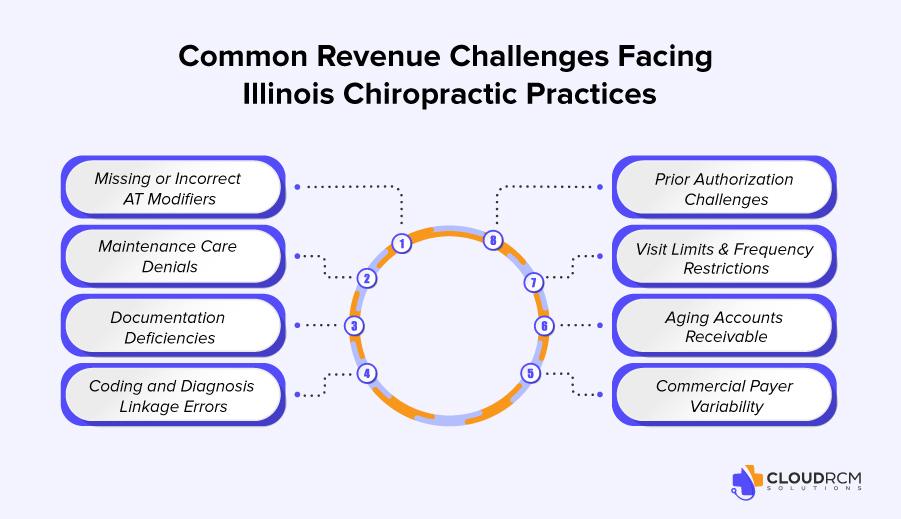
Whether you operate a solo practice in Springfield, a multi-provider clinic in Chicago, or a growing rehabilitation center in Naperville, many chiropractic providers experience similar reimbursement challenges.
Claim Denials
Denied claims remain one of the biggest obstacles to consistent cash flow. Common reasons include missing modifiers, coding errors, incomplete documentation, eligibility issues, and payer-specific edits.
Medicare Compliance
Medicare only reimburses chiropractic manipulative treatment when services meet strict documentation and medical necessity requirements. Failure to comply with Medicare guidelines may lead to denied claims, payment recoupments, or audit risks.
Commercial Insurance Variations
Every insurance carrier has different coverage policies, authorization rules, documentation standards, and reimbursement requirements. Managing multiple payer guidelines can quickly become time-consuming without experienced billing support.
Documentation Gaps
Clinical documentation plays a significant role in reimbursement. Missing treatment plans, incomplete progress notes, or unsupported diagnoses often lead to payment delays and denials.
Aging Accounts Receivable
Outstanding claims that are not followed up promptly reduce collection rates and disrupt cash flow. Effective accounts receivable management helps practices recover unpaid claims before filing deadlines expire.
Without a structured billing process, these issues often repeat month after month, reducing revenue and increasing administrative burden.
What to Look for in a Chiropractic Billing Company
Not every medical billing company understands the complexities of chiropractic reimbursement. Choosing a billing partner with chiropractic-specific expertise can help reduce claim denials, improve collections, and ensure compliance with Medicare and commercial payer requirements.
| What to Evaluate | Why It Matters |
|---|---|
| Chiropractic Billing Expertise | Experience with chiropractic CPT codes, modifiers, and documentation requirements improves claim accuracy. |
| Certified Coding Team | Ensures accurate CPT, ICD-10-CM, and HCPCS coding while reducing compliance risks. |
| Medicare & Commercial Payer Knowledge | Familiarity with Medicare, Illinois Medicaid, BCBSIL, UnitedHealthcare, Aetna, Cigna, Humana, and other payer guidelines helps minimize denials. |
| Insurance Verification & Authorizations | Confirms patient eligibility, benefits, and authorization requirements before treatment. |
| Claim Scrubbing | Detects coding and documentation errors before claims are submitted. |
| Denial & Appeals Management | Investigates denied claims, submits appeals, and works to recover lost revenue. |
| Accounts Receivable Follow-Up | Proactively follows up on unpaid claims to improve cash flow and reduce aging A/R. |
| Performance Reporting | Provides insights into collections, denial trends, reimbursement, and financial performance. |
| HIPAA Compliance | Protects patient data through secure and compliant billing processes. |
A reliable chiropractic billing company does more than submit claims. It continuously monitors payer trends, identifies revenue leakage, resolves denials, and optimizes your revenue cycle to help maximize reimbursement.
For chiropractic practices in Illinois, it’s beneficial to partner with a billing company that understands regional payer requirements and has experience working with Medicare, Illinois Medicaid, and major commercial insurance carriers across the state.
Chiropractic EHR & Practice Management Software Comparison
Selecting the right Electronic Health Record (EHR) and practice management software can significantly impact your billing efficiency, documentation quality, and revenue cycle performance. While every practice has different operational needs, the ideal platform should support accurate clinical documentation, streamline claim submission, and integrate seamlessly with your billing workflow.
Popular Chiropractic EHR Software Comparison
| Software | Best For | Specialty-Specific Templates | Integrated Billing | Insurance Eligibility | Appointment Scheduling | Clearinghouse Integration | Cloud-Based |
|---|---|---|---|---|---|---|---|
| ChiroTouch | Medium to large chiropractic clinics | ✔ | ✔ | ✔ | ✔ | ✔ | ✔ |
| Jane App | Solo and small practices | ✔ | ✔ | ✔ | ✔ | ✔ | ✔ |
| Genesis Chiropractic Software | High-volume clinics | ✔ | ✔ | ✔ | ✔ | ✔ | ✔ |
| EZBIS | Multi-provider practices | ✔ | ✔ | ✔ | ✔ | ✔ | ✔ |
| Platinum System | Established chiropractic offices | ✔ | ✔ | Limited | ✔ | ✔ | Limited |
| AdvancedMD | Multi-specialty organizations | ✔ | ✔ | ✔ | ✔ | ✔ | ✔ |
| DrChrono | Mobile and cloud-first practices | ✔ | ✔ | ✔ | ✔ | ✔ | ✔ |
| Practice Fusion | Small healthcare practices | Limited | Limited | Limited | ✔ | Third-party | ✔ |
Choosing the Right Chiropractic EHR
When evaluating an EHR or practice management platform, consider features that directly affect billing performance rather than documentation alone.
| Feature | Why It Matters |
|---|---|
| Chiropractic-specific SOAP note templates | Supports accurate clinical documentation for Medicare and commercial payers. |
| ICD-10 & CPT coding assistance | Reduces coding errors before claims are submitted. |
| Modifier support | Helps document AT and other required modifiers correctly. |
| Insurance eligibility verification | Identifies coverage issues before the patient visit. |
| Electronic claim submission | Speeds up claim processing and reduces manual work. |
| Payment posting | Simplifies reconciliation of ERA and EOB payments. |
| Denial tracking | Helps monitor rejected claims and improve collections. |
| Reporting dashboard | Provides visibility into collections, A/R, and reimbursement trends. |
| Clearinghouse integration | Enables faster and more accurate electronic claim submission. |
| HIPAA-compliant security | Protects patient data and supports regulatory compliance. |
Cloud RCM Solutions works with most leading chiropractic EHR and practice management systems (ChiroTouch, Jane App, EZBIS, Genesis Chiropractic Software, AdvancedMD, DrChrono, or another platform), helping Illinois practices improve documentation, coding accuracy, claim submission, denial management, and reimbursement without changing their existing software.
Medicare Chiropractic Billing Requirements & Rules
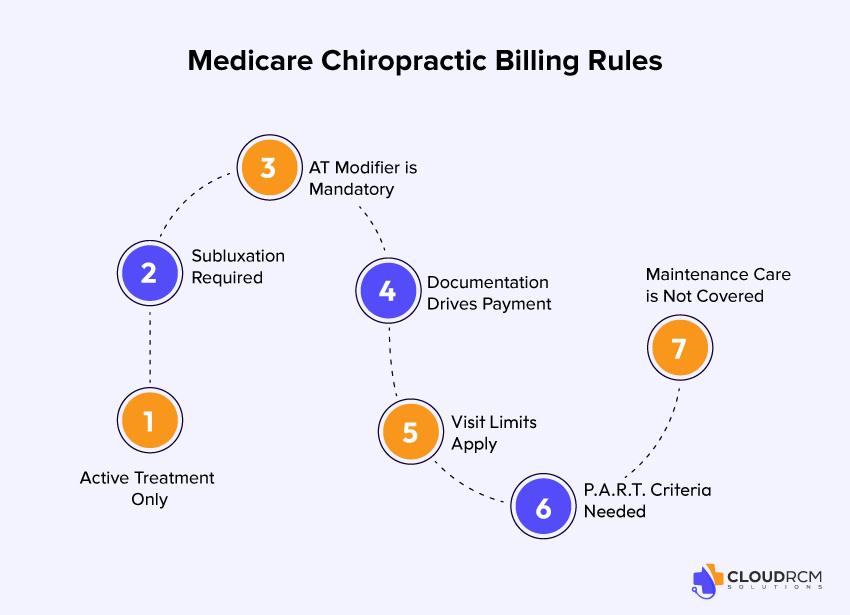
1. Active Treatment Only
Medicare only pays for active corrective care – not maintenance or wellness visits.
2. Subluxation Required
Every claim must include a valid M99.01–M99.05 diagnosis linked to the treated spinal region.
3. AT Modifier is Mandatory
Missing AT modifier = automatic denial for chiropractic manipulation claims.
4. Documentation Drives Payment
No proper notes = no reimbursement.
Include history, exam, plan, and progress updates.
5. Visit Limits Apply
Exceeding payer-defined visit caps without justification leads to denials or audits.
6. P.A.R.T. Criteria Needed
At least 2 findings required (Pain, Asymmetry, ROM, Tissue changes).
7. Maintenance Care is Not Covered
Preventive or long-term maintenance care is non-reimbursable under Medicare.
Revenue Leakage Analysis For Chiropractor
Many chiropractic practices lose revenue because of preventable billing issues that go unnoticed over time. Identifying these gaps early helps improve reimbursement, reduce denials, and strengthen cash flow.
| Revenue Leakage Area | Impact on Your Practice | How Cloud RCM Solutions Help |
|---|---|---|
| Documentation Gaps | Missing treatment plans, incomplete progress notes, or insufficient medical necessity documentation can lead to denied claims and audit risks. | We review documentation to support compliant claim submission and reduce denials. |
| Missed Charge Capture | Services performed but not billed accurately result in lost revenue. | Our billing specialists identify missed charges and ensure all eligible services are submitted correctly. |
| Coding Errors | Incorrect CPT, ICD-10-CM, or modifier selection can trigger denials, underpayments, and compliance issues. | We perform coding validation to improve claim accuracy and maximize reimbursement. |
| Insurance Underpayments | Payers may reimburse less than contracted amounts, reducing overall revenue. | We reconcile payments, identify underpayments, and pursue reimbursement corrections. |
| Unresolved Claim Denials | Delayed appeals and lack of follow-up can result in permanent revenue loss. | Our denial management team investigates, appeals, and resubmits eligible claims to recover revenue. |
Chiropractic Denial Management & Accounts Receivable Recovery
Denied claims can significantly impact cash flow if they are not addressed promptly. Our billing specialists perform root-cause analysis for every denial, correct billing issues, prepare supporting documentation, and communicate directly with insurance payers to recover eligible reimbursement before filing deadlines expire.
| Our Recovery Services | Benefit to Your Practice |
|---|---|
| Denial Analysis & Appeals | Identifies denial causes, prepares appeals, and resubmits eligible claims for reimbursement. |
| Accounts Receivable Follow-Up | Reduces aging balances through consistent payer communication and claim tracking. |
| Claim Status Investigation | Resolves delayed, pending, or rejected claims before they become write-offs. |
| Underpayment Recovery | Identifies payment discrepancies and pursues additional reimbursement when appropriate. |
| Secondary Insurance Billing | Coordinates remaining balances with secondary payers to maximize collections. |
| Appeal & Filing Deadline Tracking | Ensures claims and appeals are submitted within payer timelines to protect revenue. |
The Result: By combining revenue leakage analysis, denial management, and proactive accounts receivable follow-up, Cloud RCM Solutions helps chiropractic practices across Illinois reduce write-offs, accelerate reimbursements, and maintain a healthier revenue cycle.
Partner with Cloud RCM Solutions for Chiropractic Billing Success
Chiropractic billing is becoming increasingly complex as Medicare, Medicaid, and commercial insurers update their coding, documentation, and compliance requirements. Cloud RCM Solutions helps chiropractic practices across Illinois improve revenue cycle performance through accurate medical billing, proactive denial management, accounts receivable recovery, and compliance-driven billing solutions.
If your practice is facing claim denials, delayed reimbursements, or inconsistent cash flow, our experienced billing specialists can help you maximize collections and achieve long-term financial stability.
FAQs
What makes chiropractic billing different from other medical specialties?
Chiropractic billing is highly regulated and primarily limited to spinal manipulation services reported under CPT codes 98940–98942. Reimbursement is strictly tied to documented subluxation (ICD-10 M99.01–M99.09), medical necessity, and proper modifier use such as the AT modifier for active treatment. Unlike many specialties, maintenance care is generally not covered, making documentation and compliance critical for payment.
Why are chiropractic claims frequently denied?
Chiropractic claims are often denied due to missing AT modifiers, lack of medical necessity documentation, incorrect ICD-10 linkage, maintenance care billing, exceeding visit limits, or failure to obtain prior authorization. Medicare and commercial payers also frequently deny claims when documentation does not clearly support active treatment and measurable patient improvement.
What is the AT modifier in chiropractic billing?
The AT modifier is required by Medicare to indicate that chiropractic services are being provided as active treatment aimed at improving a patient’s condition. Without this modifier, claims are typically denied automatically. Proper use of the AT modifier is essential for reimbursement of chiropractic manipulative treatment services.
Can chiropractors bill Medicare for maintenance care?
No. Medicare generally does not cover maintenance or preventive chiropractic care. Only active treatment that demonstrates improvement or stabilization of a patient’s condition is eligible for reimbursement. Maintenance care, even if clinically beneficial, is considered non-covered and must be properly handled with ABNs and modifiers like GA, GY, or GZ when applicable.
What documentation is required for chiropractic billing compliance?
Chiropractic documentation must include patient history, examination findings, diagnosis (including subluxation level), treatment plan, progress notes, and objective evidence of improvement. Medicare also requires documentation of active care, medical necessity, and ongoing evaluation of treatment effectiveness using standardized measures when applicable.