
 Medical Billing
 Medical Coding
 Medical Audit
 Provider Credentialing
 Denial Management
 A/R Follow-up
 Private Practice
 Patient Help Desk
 Customized Reporting
 Out-of-Network Billing
 Internal Medicine
 Pediatrics
 Radiology
 Surgery
 Emergency Medicine
 Anesthesiology
 Cardiology
 Orthopedic
 Psychiatry
 Dentistry
 OB-GYN
 Family Medicine
Is your plastic surgery practice performing procedures but waiting months to get paid? In 2026, plastic surgery AR management has become increasingly complex due to rising patient responsibility, stricter medical necessity requirements, reimbursement delays, and greater payer scrutiny. Even busy practices can experience cash flow challenges when claims remain unpaid for extended periods.
This guide explains why plastic surgery practices struggle with high AR Days in 2026, the hidden factors slowing collections, and practical strategies to recover revenue faster and strengthen profitability.
1. What Is Plastic Surgery AR Management?
Plastic surgery AR management is the process of tracking, monitoring, and recovering outstanding insurance and patient balances after services have been provided.
Effective plastic surgery accounts receivable management includes:
- Insurance claim follow-up
- Denial management
- Underpayment recovery
- Patient collections
- AR aging analysis
- Revenue recovery
- Payer communication
The primary goal is to reduce reimbursement delays, improve cash flow, and maximize revenue collection.
2. What Are AR Days in Medical Billing?
Accounts Receivable (AR) Days measure the average number of days it takes a healthcare practice to collect payment after claims have been submitted.
AR Days are one of the most important revenue cycle management metrics because they reflect how efficiently a practice converts billed services into collected revenue.
AR Days Formula
AR Days = Total Accounts Receivable ÷ Average Daily Charges
Example
If a plastic surgery practice has $300,000 in accounts receivable and averages $10,000 in daily charges:
AR Days = 30 Days
Generally, lower AR Days indicate stronger financial performance, while higher AR Days often suggest collection inefficiencies, reimbursement delays, denial issues, or underpayments.
3. Why AR Days Matter for Plastic Surgery Practices
AR Days directly impact a practice’s financial stability and operational performance. When receivables remain outstanding for extended periods, earned revenue becomes trapped in the revenue cycle rather than supporting payroll, technology investments, facility expenses, marketing initiatives, and practice growth.
High AR Days can contribute to:
- Delayed cash flow
- Increased write-offs
- Revenue leakage
- Higher administrative costs
- Reduced profitability
- Greater collection challenges
- Slower reimbursement cycles
For plastic surgery providers, where reimbursement often depends on medical necessity documentation, prior authorizations, operative reports, and payer-specific requirements, monitoring AR performance is especially important.
4. Understanding Insurance AR vs Patient AR
Successful plastic surgery AR management requires providers to monitor insurance balances and patient balances separately. Each type of receivable has different collection challenges, reimbursement risks, and follow-up requirements.
| Category | Insurance AR | Patient AR |
|---|---|---|
| Who Owes the Balance? | Commercial payers, Medicare, Medicaid, and managed care organizations | Patients |
| Primary Revenue Source | Insurance reimbursements | Patient responsibility amounts |
| Common Balance Types | Unpaid claims, denied claims, underpaid claims | Deductibles, coinsurance, copayments, self-pay balances |
| Most Common Causes of Aging AR | Authorization issues, claim denials, coding errors, payer delays, medical necessity reviews | High deductibles, missed payments, lack of payment plans, financial hardship |
| Collection Strategy | Insurance follow-up, denial management, appeals, underpayment recovery | Upfront collections, payment plans, patient reminders, financial counseling |
| Key Performance Focus | Faster claim reimbursement and denial resolution | Improved patient payment collection rates |
| Revenue Risk | Delayed insurance payments and lost reimbursements | Increasing patient responsibility balances |
| Impact on AR Days | Can significantly increase aging claims and reimbursement delays | Can create long-term outstanding balances if not collected promptly |
5. Warning Signs Your Practice Has an AR Problem
Many practices fail to recognize AR issues until collections begin to decline.
Common warning signs include:
- More than 20% of AR exceeding 90 days
- Increasing denial rates
- Frequent payer delays
- Rising write-offs
- Growing patient balances
- Increased staff time spent on claim follow-up
- Difficulty forecasting monthly revenue
These indicators often reveal deeper revenue cycle management problems that require immediate attention.
6. Top Causes of High AR Days in Plastic Surgery Practices
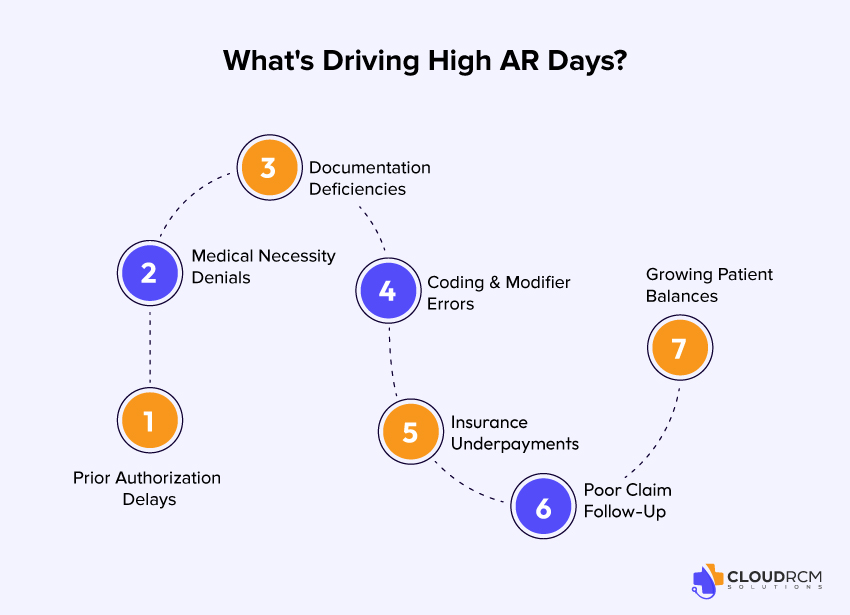
6.1 Prior Authorization Delays
Many reconstructive procedures require prior authorization before treatment. Missing approvals, incomplete requests, or authorization mismatches frequently result in delayed reimbursement.
6.2 Cosmetic vs Reconstructive Billing Challenges
Cosmetic and reconstructive procedures often follow very different reimbursement pathways. While cosmetic services are generally self-pay, reconstructive procedures frequently require prior authorization, medical necessity documentation, operative reports, and payer-specific coding requirements. Many AR issues begin long before a claim enters collections, making effective Plastic & Reconstructive Surgery Billing a critical foundation for preventing denials, accelerating reimbursement, and maintaining healthy accounts receivable performance.
6.3 Documentation Deficiencies
Successful plastic surgery billing depends on complete, accurate, and payer-compliant documentation. Supporting records often play a critical role in determining whether a claim is approved, denied, or subjected to additional review.
Claims often require:
- Operative reports
- Clinical notes
- Medical necessity documentation
- Photographic evidence
- Prior treatment records
Even minor documentation gaps can significantly delay payment.
6.4 Unresolved Claim Denials
Denials remain one of the leading causes of aging accounts receivable.
Common denial causes include:
- Authorization errors
- Coding mistakes
- Modifier issues
- Medical necessity denials
- Missing documentation
- Eligibility verification errors
Without prompt intervention, denied claims quickly move into older aging categories and become harder to recover.
6.5 Insurance Underpayments
Not all revenue losses appear as denials. Many insurers process claims, but reimburse contracted rates below. Without underpayment analysis and recovery efforts, significant revenue may go unnoticed.
6.6 Poor Insurance Follow-Up
Submitting a claim does not guarantee payment. Many aging balances exist simply because claims were never followed up on consistently after submission. Effective plastic surgery AR management requires ongoing monitoring, payer communication, and escalation when necessary.
6.7 Patient Collection Challenges
Increasing deductibles and coinsurance obligations continue to create collection challenges for plastic surgery providers. Without upfront collection processes and structured payment options, patient-related AR can accumulate rapidly.
7. Why Claims Remain Unpaid Despite Clean Submission
Many providers assume a clean claim will automatically be paid. Unfortunately, reimbursement delays can occur even when claims are submitted correctly.
Claims may remain unpaid because of:
- Payer processing delays
- Documentation requests
- Authorization mismatches
- Coordination of benefits issues
- Secondary billing delays
- Claim edit issues
- Insurance underpayments
- Lack of timely follow-up
This is why proactive insurance follow-up remains a critical component of plastic surgery revenue cycle management.
8. Why Denial Management Is Critical to Reducing AR Days
Denial management plays a significant role in overall AR performance.
Every unresolved denial increases the likelihood that a claim will move into older aging buckets, delaying reimbursement and increasing administrative costs.
Practices that actively monitor denial trends, identify root causes, and implement corrective actions often experience:
- Lower AR Days
- Faster reimbursement
- Improved clean claim rates
- Reduced revenue leakage
- Higher collection performance
9. What Is a Good AR Days Benchmark for Plastic Surgery Practices?
AR benchmarks help providers evaluate the overall health of their revenue cycle and identify potential AR benchmarks help providers evaluate the overall health of their revenue cycle and identify potential reimbursement or collection issues before they affect cash flow.
| AR Days | Performance Level | Recommended Action |
|---|---|---|
| Under 30 Days | Excellent | Maintain current revenue cycle and AR management processes. |
| 30–40 Days | Healthy | Continue monitoring key performance indicators and payer trends. |
| 40–50 Days | Needs Monitoring | Review denial rates, payer delays, underpayments, and aging claims. |
| 51–60 Days | Revenue Risk | Conduct a detailed AR audit and strengthen follow-up workflows. |
| Over 60 Days | Immediate Action Required | Investigate systemic billing, denial management, authorization, and collection issues. |
Practices that consistently exceed 50 AR Days often experience reimbursement delays, increased administrative costs, and reduced cash flow. A comprehensive review of billing operations, denial management, insurance follow-up, patient collections, and revenue cycle performance can help identify the root causes of aging receivables and improve collection outcomes.
10. AR Benchmarks Plastic Surgery Practices Should Monitor in 2026
| KPI | Recommended Target |
|---|---|
| AR Days | Under 40 Days |
| Top-Performing AR Days | 30–35 Days |
| AR Over 90 Days | Below 15% |
| Clean Claim Rate | Above 95% |
| First-Pass Resolution Rate | Above 90% |
| Net Collection Rate | Above 95% |
| Denial Rate | Below 5% |
Regular KPI monitoring helps identify reimbursement problems before they significantly affect financial performance.
11. How Often Should Plastic Surgery Practices Review AR Reports?
Recommended review frequency includes:
- Weekly AR aging reviews
- Weekly denial analysis
- Monthly payer performance reviews
- Monthly underpayment audits
- Quarterly AR assessments
- Quarterly denial trend evaluations
Regular reporting enables providers to identify problems early and improve collection outcomes.
12. Proven Strategies to Reduce High AR Days
Strengthen Eligibility Verification
Verify insurance coverage, benefits, deductibles, and authorization requirements before services are provided.
Improve Documentation Quality
Ensure documentation fully supports medical necessity and payer requirements.
Prioritize Aging Accounts
Focus follow-up efforts on claims approaching the 90-day mark.
Implement Proactive Denial Management
Review denials daily, identify root causes, and appeal claims promptly.
Monitor Payer Performance
Track reimbursement trends and recurring payer issues.
Conduct Routine AR Audits
Identify underpayments, missed follow-up opportunities, and revenue leakage.
Improve Patient Collections
Collect estimated patient balances before procedures whenever possible and offer structured payment plans.
13. Common Plastic Surgery AR Management Mistakes to Avoid
Avoid these common mistakes:
- Delaying insurance follow-up
- Ignoring underpayments
- Waiting too long to appeal denials
- Failing to review AR aging reports
- Inadequate documentation
- Weak patient collection processes
- Lack of denial trend analysis
Correcting these issues can significantly improve reimbursement performance.
14. Case Study: How an Illinois Plastic Surgery Practice Reduced AR Days by 35%
A multi-provider plastic surgery practice in Illinois specializing in breast reconstruction, post-traumatic reconstruction, scar revision, and functional rhinoplasty began experiencing increasing reimbursement delays despite maintaining consistent patient volume.
A revenue cycle assessment revealed that the practice’s AR Days had increased to 52 days, while nearly 19% of outstanding receivables had aged beyond 90 days. Most delays were concentrated among reconstructive surgery claims that required prior authorization, medical necessity review, and extensive supporting documentation.
Key Revenue Cycle Findings
The practice identified several recurring issues:
- Missing documentation requests from commercial payers were not being addressed promptly.
- Authorization approvals did not always match the procedures ultimately billed.
- Denied reconstructive surgery claims remained unresolved for extended periods.
- Underpayments were rarely reviewed against payer contracts.
- Follow-up activities varied significantly among billing staff members.
Corrective Actions
The practice implemented a structured accounts receivable management strategy that included:
- Weekly AR aging reviews for all claims older than 30 days.
- Dedicated denial tracking and escalation workflows.
- Standardized documentation checklists for reconstructive procedures.
- Monthly underpayment audits for high-value surgical claims.
- Improved communication between clinical and billing teams regarding medical necessity documentation.
- Consistent payer follow-up schedules for unresolved claims.
Results After Six Months
Following implementation, the practice achieved measurable improvements:
| Revenue Cycle Metric | Before | After |
|---|---|---|
| AR Days | 52 Days | 37 Days |
| AR Over 90 Days | 19% | 12% |
| Denial Rate | 7.4% | 4.8% |
| Net Collection Rate | 93% | 97% |
| Clean Claim Rate | 94% | 98% |
Key Takeaway
The practice did not increase revenue by performing more procedures. Instead, it focused on strengthening plastic surgery AR management, improving denial resolution processes, standardizing documentation workflows, and increasing insurance follow-up consistency.
The result was faster reimbursement, healthier cash flow, lower aging receivables, and improved overall revenue cycle performance.
Conclusion
High AR Days are rarely caused by a single issue. More often, they result from a combination of authorization delays, documentation deficiencies, unresolved denials, underpayments, patient collection challenges, and inconsistent follow-up.
By strengthening revenue cycle processes, monitoring key performance indicators, and proactively managing accounts receivable, plastic surgery practices can reduce AR Days, improve collections, and create a more predictable financial future.
FAQ’s
What are AR Days in plastic surgery billing?
AR Days measure how long it takes a plastic surgery practice to collect payment after services have been provided and claims have been submitted. Lower AR Days generally indicate stronger revenue cycle performance and healthier cash flow.
What is a good AR Days benchmark for plastic surgery practices?
Most successful practices aim to keep AR Days below 40 days. Top-performing practices often maintain AR Days between 30 and 35 days.
What percentage of AR should be over 90 days?
What percentage of AR should be over 90 days?
How can plastic surgery practices reduce AR Days?
Providers can reduce AR Days by strengthening eligibility verification, improving documentation, accelerating denial management, auditing underpayments, prioritizing aging claims, and enhancing patient collection processes.