
 Medical Billing
 Medical Coding
 Medical Audit
 Provider Credentialing
 Denial Management
 A/R Follow-up
 Private Practice
 Patient Help Desk
 Customized Reporting
 Out-of-Network Billing
 Internal Medicine
 Pediatrics
 Radiology
 Surgery
 Emergency Medicine
 Anesthesiology
 Cardiology
 Orthopedic
 Psychiatry
 Dentistry
 OB-GYN
 Family Medicine
Healthcare reimbursement is becoming increasingly complex, making payer contracts a key driver of a practice’s revenue, profitability, and long-term stability, yet many providers still operate under outdated agreements that don’t reflect current market rates or rising costs. Payer contract negotiation services help address this gap by using billing data, reimbursement analytics, and benchmarking to secure better reimbursement, improve collections, and strengthen overall financial performance.
What Are Payer Contract Negotiations?
Payer contract negotiation services help healthcare providers evaluate, negotiate, and optimize contracts with commercial insurance companies and managed care organizations. The goal is to secure reimbursement rates and contract terms that accurately reflect a practice’s clinical value, specialty expertise, patient demand, and operational costs.
These services typically include:
- Comprehensive payer contract analysis
- Fee schedule and reimbursement benchmarking
- Medical billing and payment variance analysis
- Underpayment identification
- CPT code utilization review
- Contract language and compliance review
- Payer reimbursement strategy development
- Direct negotiation support with commercial insurance payers
- Contract implementation monitoring after approval
Why Payer Contracts Matter More Than Ever
Insurance companies use data-driven models, while provider costs continue to rise. Outdated contracts often lead to low reimbursement, delays, underpayments, and restrictive terms.
Even small rate improvements in high-volume CPT codes can significantly increase revenue. This makes contract negotiation an ongoing financial strategy, not a one-time task.
Signs Your Practice Needs Payer Contract Negotiation Services
Many providers don’t realize they are losing revenue until reimbursements decline or costs begin to outpace collections. Insurance contracts should be reviewed regularly to ensure payment rates and terms still support financial goals.
You may need payer contract negotiation services if you notice:
- Contracts not reviewed in the last 12–24 months
- Reimbursement rates below rising costs or market benchmarks
- Increasing claim denials or payment delays
- High-volume CPT codes reimbursed below fair value
- Expansion into new providers, specialties, or locations
- Lack of internal resources for contract analysis and negotiation
- Flat revenue despite growing patient volume
Identifying these signs early helps protect profitability and improve cash flow.
The High-Impact Leverage Points That Influence Payer Decisions
Insurance companies approve reimbursement increases when providers can demonstrate measurable value. The following factors can strengthen your negotiating position:
- Patient volume and payer dependency
- Specialty services and complexity
- Quality outcomes and satisfaction scores
- Network adequacy contribution
- Billing, denial, and reimbursement analytics
Six-Step Framework for Successful Payer Contract Negotiation
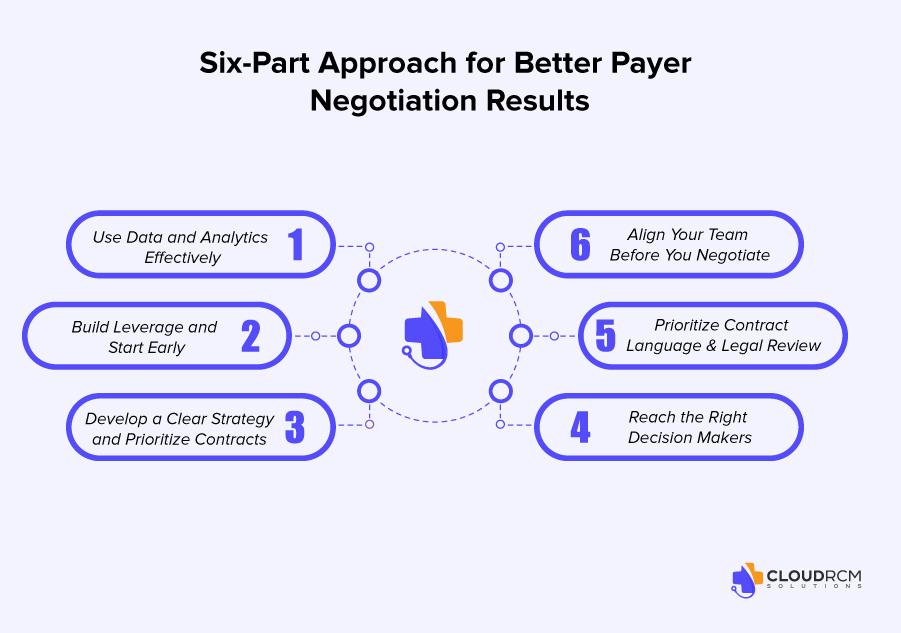
Successful payer contract negotiation is a planned process, not a last-minute discussion. Insurance companies rely on data, utilization trends, and financial benchmarks, so providers who prepare with clear evidence are more likely to secure better reimbursement and contract terms.
Most negotiations take about 6–9 months depending on contract complexity, and starting 9–12 months before renewal gives enough time for analysis, proposal development, and revisions..
Typical Payer Contract Negotiation Timeline
| Timeline | Key Activities |
|---|---|
| Months 1–2 | Contract review, reimbursement analysis, benchmarking, and opportunity identification |
| Month 3 | Proposal preparation backed by financial and billing data |
| Months 4–6 | Payer review, counteroffers, and negotiation of rates and terms |
| Months 7–9 | Final agreement, system updates, and reimbursement validation |
Step 1: Review Current Contracts & Performance
Every successful negotiation begins with understanding how existing contracts perform. Many providers assume their reimbursement is competitive until a detailed review reveals underpaid CPT codes, outdated fee schedules, or contract clauses that limit revenue.
A comprehensive contract analysis should include:
- Commercial payer reimbursement rates.
- CPT code utilization.
- Medical billing trends.
- Payment turnaround times.
- Claim denial patterns.
- Underpayment analysis.
- Revenue generated by each payer.
- Historical reimbursement performance.
Providers should also benchmark against Medicare, CMS, and regional rates to identify gaps. Instead of focusing only on total collections, priority should be given to high-volume CPT codes where small improvements can significantly increase annual revenue.
Step 2: Benchmark Against Market Rates
Negotiations become stronger when providers compare their reimbursement with similar practices and market standards.
Effective benchmarking includes:
- Commercial payer reimbursement
- Medicare allowable rates
- Regional reimbursement averages
- Specialty-specific payment trends
- Local competitor rates (when available)
- FAIR Health benchmark data
This helps identify key gaps such as underpaid insurers, priority contracts, undervalued CPT codes, and the largest revenue opportunities. Professional payer contract negotiation services use this data to build stronger, evidence-based negotiation strategies.
Step 3: Build a Strong Value Case
Insurance companies rarely increase reimbursement just because costs rise. Providers must clearly show the value they bring to the payer network.
An effective proposal highlights:
- High patient volume
- Strong network contribution
- Specialized services
- Quality outcomes and patient satisfaction
- Cost-efficient care delivery
- Low complications and readmissions
- Timely claims and compliance
For example, practices like behavioral health groups or cardiology providers may have stronger negotiating power than they realize. When combined with billing data and reimbursement analytics, these strengths build a strong case for higher reimbursement.
Step 4: Optimize Beyond Fee Schedules
Many providers focus only on fee schedules, but contract language can impact revenue just as much as reimbursement rates.
Key terms to review include:
- Timely filing requirements
- Prior authorization rules
- Appeal deadlines
- Payment timelines
- Audit procedures
- Modifier policies
- Medical necessity rules
- Recoupment terms
- Termination notice periods
- Dispute resolution processes
Step 5: Review Counteroffers Carefully
Commercial insurers rarely accept initial proposals without revisions, so counteroffers should not be judged only by percentage increases.
Instead, providers should evaluate the real financial impact on:
- Annual collections
- High-volume CPT codes
- Specialty services
- Procedure profitability
- Overall payer mix
- Long-term revenue projections
A higher percentage offer may still deliver limited value if it doesn’t apply to frequently billed services. Scenario modeling helps determine whether a counteroffer truly improves overall financial performance.
Step 6: Monitor After Implementation
Negotiations don’t end once a contract is signed. Many providers assume new rates are implemented correctly, but errors during system updates can lead to payment discrepancies.
After implementation, providers should verify:
- Updated fee schedules
- EOBs and ERAs
- Payment posting accuracy
- Underpayment reports
- Claim reimbursements
- Contract effective dates
Ongoing monitoring helps catch errors early and ensures negotiated rates are fully reflected in payments. Professional payer contract negotiation services also include post-contract tracking, reimbursement validation, and underpayment checks to protect revenue long after negotiation.
Contract Clauses Every Healthcare Provider Should Review Before Signing
Before signing or renewing any commercial payer agreement, review these critical contract terms. Overlooking even one clause can lead to lower reimbursement, payment delays, or unnecessary administrative burden.
| Contract Clause | Why It Matters | Best Practice |
|---|---|---|
| Fee Schedule | Determines how your services are reimbursed. | Compare rates against Medicare, CMS, and market benchmarks. |
| Timely Filing | Short deadlines increase claim denial risk. | Negotiate filing limits of 180 days or longer when possible. |
| Appeal Rights | Protects your ability to dispute denied or underpaid claims. | Ensure appeal deadlines and dispute procedures are clearly defined. |
| Audit & Recoupment | Broad audit rights can lead to unexpected repayment demands. | Limit audit periods and require clear recoupment policies. |
| Prior Authorization | Complex requirements delay treatment and reimbursement. | Request reasonable authorization requirements and response timelines. |
| Termination Clause | Defines how either party can end the agreement. | Confirm fair notice periods (typically 90–120 days) and termination terms. |
Contract Red Flags That Can Reduce Practice Revenue
Some contract provisions appear harmless but can significantly affect reimbursement and operational flexibility.
Be cautious of clauses such as:
| Contract Clause | Why It’s a Risk | What Providers Should Do |
|---|---|---|
| Unilateral Amendment Clause | Allows the payer to change reimbursement rates, policies, or fee schedules without your approval. | Negotiate language requiring advance written notice and mutual agreement before changes take effect. |
| All-Products Clause | Automatically enrolls your practice in all insurance products, including lower-paying Medicaid, exchange, or narrow-network plans. | Accept only the insurance products that align with your reimbursement goals and patient mix. |
| Silent PPO Clause | Permits discounted reimbursement rates to be shared with third-party networks without your knowledge, reducing expected payments. | Request clear restrictions on network leasing and require transparency for any third-party access. |
| Automatic Renewal Clause | Renews the contract automatically, preventing timely reimbursement negotiations or contract updates. | Track renewal dates and begin payer contract negotiations 9–12 months before the renewal deadline. |
| Restrictive Timely Filing Limits | Short claim submission deadlines increase the risk of denied claims and lost revenue. | Negotiate filing limits of 180 days or longer whenever possible. |
| Broad Audit & Recoupment Rights | Allows payers to recover payments years later, creating unexpected financial liabilities. | Define reasonable audit periods, documentation requirements, and provider appeal rights. |
| Unclear Payment Terms | Vague payment policies often lead to delayed reimbursements and disputes. | Ensure payment timelines, reimbursement methodology, and fee schedules are clearly documented. |
| Limited Appeal Rights | Restricts your ability to challenge denials, underpayments, or audit findings. | Negotiate clear appeal timelines and dispute resolution procedures. |
Common Mistakes That Reduce Negotiating Power
Even experienced healthcare organizations sometimes miss opportunities to improve reimbursement because they enter negotiations without adequate preparation.
The most common mistakes include:
- Waiting until contract expiration to begin negotiations.
- Negotiating without reimbursement benchmarking.
- Focusing only on percentage increases instead of overall contract value.
- Ignoring contract language beyond reimbursement rates.
- Accepting the payer’s first counteroffer without financial modeling.
- Failing to review payment accuracy after implementation.
- Not tracking underpayments throughout the contract term.
- Renewing contracts automatically without performance analysis.
Avoiding these mistakes helps providers negotiate stronger agreements while protecting long-term revenue.
Questions to Ask Vendors
Before selecting a partner, ask these questions during your consultation:
Consider asking:
- How many payer contracts do you negotiate each year?
- Do you have experience with my medical specialty?
- Which commercial insurance companies do you work with most frequently?
- How do you benchmark reimbursement rates?
- What data do you require from our practice?
- Do you review contract language as well as reimbursement rates?
- How do you measure return on investment (ROI)?
- What pricing model do you use?
- Will you monitor reimbursement after the new contract is implemented?
- Can you provide examples of measurable reimbursement improvements?
The answers to these questions can help you evaluate whether a vendor offers comprehensive support or only limited contract review services.
How Cloud RCM Solutions Helps Providers Negotiate Stronger Payer Contracts
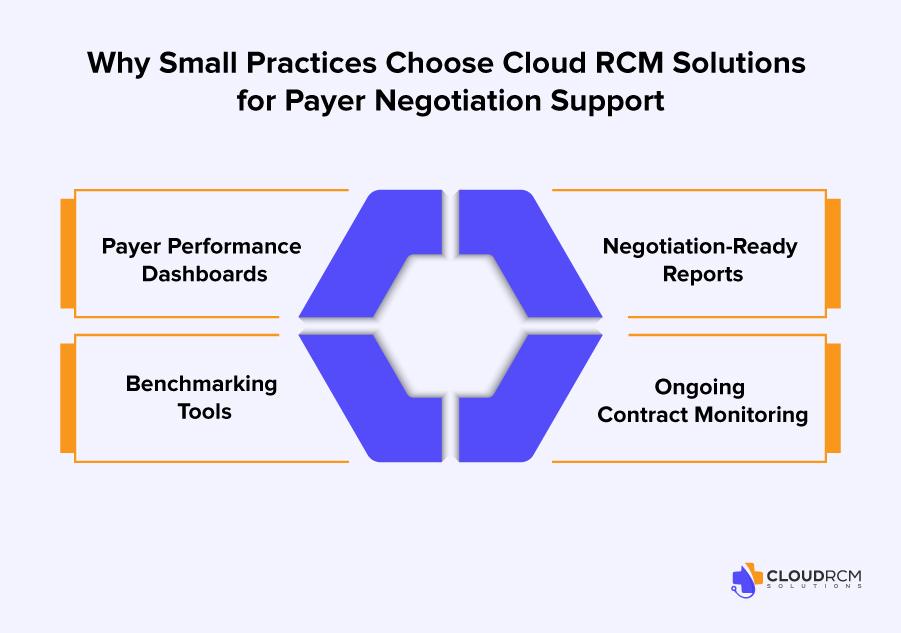
We act as an extension of your team at Cloud RCM Solutions, using real medical billing data, reimbursement analytics, and payer insights to help providers negotiate stronger contracts and improve financial performance. We work with independent practices and specialty groups to identify underpayments, benchmark reimbursement rates, and build data-driven negotiation strategies that reflect the true value of your services.
Our approach is focused on practical results helping providers secure fair contracts, improve cash flow, and strengthen long-term payer relationships.
Conclusion
Payer contracts directly impact reimbursement, cash flow, and profitability, yet many providers still work under outdated agreements that don’t reflect current market rates. Cloud RCM Solutions helps healthcare providers improve these outcomes through data-driven payer contract negotiation using medical billing analytics, benchmarking, and contract review to identify underpayments, secure better reimbursement, and strengthen long-term payer relationships.
FAQ’s
How can data analytics be used to improve healthcare outcomes?
Data analytics helps healthcare practices identify trends in patient care, streamline workflows, and measure the effectiveness of treatments. By tracking metrics like denial patterns, reimbursement rates, and service utilization, practices can uncover inefficiencies and redirect resources to where they make the most impact. Data-driven insights also allow providers to monitor performance, reduce claim errors, and enhance the overall quality of care through informed decision-making.
What are the approaches for Better Payer Negotiation Results?
Better payer negotiation results come from a structured, data-driven approach. Practices should analyze reimbursement trends, start negotiations early, set clear financial goals, align internal teams, review contract terms carefully, and connect with authorized payer representatives. Using data and preparation not pressure, helps small practices secure fair and profitable contracts.
How can healthcare organizations leverage data to ensure and improve the quality of care and patient experience in the organization?
Healthcare organizations can use data to understand both operational and clinical performance. Through payer analytics, claim turnaround data, and patient satisfaction trends, providers gain visibility into care delivery and payment efficiency. By comparing outcomes with benchmarks such as FAIR Health or CMS data, they can improve patient access, reduce delays, and maintain consistent, high-quality service, leading to a better overall patient experience.
How Payers Can Leverage Data in Contract Negotiations?
Payers rely heavily on data modeling to determine reimbursement rates and coverage terms. They use analytics to assess provider performance, cost efficiency, and patient outcomes. Understanding this, practices can mirror payer logic by presenting their own data, such as denial trends, turnaround times, and benchmarking comparisons, to justify fairer rates. When both sides use transparent, evidence-based data, contract discussions become more balanced and outcome-focused
Why do small practices struggle to negotiate fair reimbursement rates?
Smaller practices often face challenges like limited administrative capacity, a lack of data analytics tools, and outdated fee schedules. Many avoid renegotiations due to fear of losing network participation or experiencing payer pushback. These factors make it difficult to prove value or track underpayments. However, by using analytics, benchmarking, and proactive payer monitoring, small practices can close these gaps and negotiate more effectively for fair, competitive rates.