
 Medical Billing
 Medical Coding
 Medical Audit
 Provider Credentialing
 Denial Management
 A/R Follow-up
 Private Practice
 Patient Help Desk
 Customized Reporting
 Out-of-Network Billing
 Internal Medicine
 Pediatrics
 Radiology
 Surgery
 Emergency Medicine
 Anesthesiology
 Cardiology
 Orthopedic
 Psychiatry
 Dentistry
 OB-GYN
 Family Medicine
Orthopedic practices in Illinois manage high-value claims involving joint replacements, arthroscopy, fracture care, spine procedures, trauma, injections, DME, and post-operative services. That complexity makes Orthopedic Billing Services in Illinois more specialized than general medical billing.
This guide explains the most important Illinois orthopedic billing, RCM, coding, payer, and compliance considerations and how practices can reduce denials, improve A/R performance, and protect reimbursement.
How Orthopedic Billing Works in Illinois
Orthopedic billing is more than submitting CPT and ICD-10-CM codes after a visit. A strong revenue cycle starts before the patient encounter and continues through payment, denial resolution, and A/R recovery.
A typical Illinois orthopedic billing workflow includes:
- Insurance eligibility and benefits verification
- Referral and prior authorization checks
- Surgical scheduling and charge capture
- CPT, HCPCS, and ICD-10-CM coding
- Modifier and bundling review
- Implant and device charge reconciliation
- Claim submission and payment posting
- Denial and underpayment management
- A/R follow-up and patient billing
Orthopedic practices may bill for joint replacement, fracture care, arthroscopy, rotator cuff repair, spine procedures, joint injections, sports medicine, bracing, DME, and post-operative care. Each service can have different coding, documentation, authorization, and payer requirements, making specialty-specific billing important for protecting reimbursement.
Illinois Orthopedic Billing Rules and Payer Requirements
Orthopedic RCM in Illinois is shaped by Medicare rules, Illinois insurance laws, Medicaid requirements, Workers’ Compensation regulations, and payer-specific contracts.
- Illinois Prompt-Payment Rules: Illinois Insurance Code Section 368a generally requires applicable insurers and managed care plans to pay covered claims within 30 days after receiving due written proof of loss. Late payments may be subject to 9% annual interest, when the statute applies. Billing teams should track claim receipt dates and payment deadlines while confirming whether the specific plan is subject to Illinois requirements.
- Illinois Medicaid: HealthChoice Illinois continues to use automated claim edits that can identify issues such as incorrect Medicaid ID numbers, member information, dates of birth, and eligibility dates. Orthopedic practices should verify Medicaid eligibility before services and monitor Illinois HFS and MCO billing updates to reduce preventable claim rejections.
- 2026 Medicare Changes: CMS updated the 2026 Physician Fee Schedule, including conversion factors of $33.57 for qualifying APM participants and $33.40 for non-qualifying APM participants. Orthopedic practices should also update CPT code sets, fee schedules, charge masters, and payer edits each year to reflect current coding and reimbursement requirements.
- Illinois Workers’ Compensation: Workers’ Compensation claims follow Illinois-specific fee schedule and billing requirements. Orthopedic practices should carefully track claim numbers, injury dates, authorization, medical necessity, documentation, diagnosis coding, fee schedule payments, and appeals. A dedicated workers’ compensation workflow can help reduce payment delays and reimbursement discrepancies.
Common Orthopedic Billing Challenges in Illinois
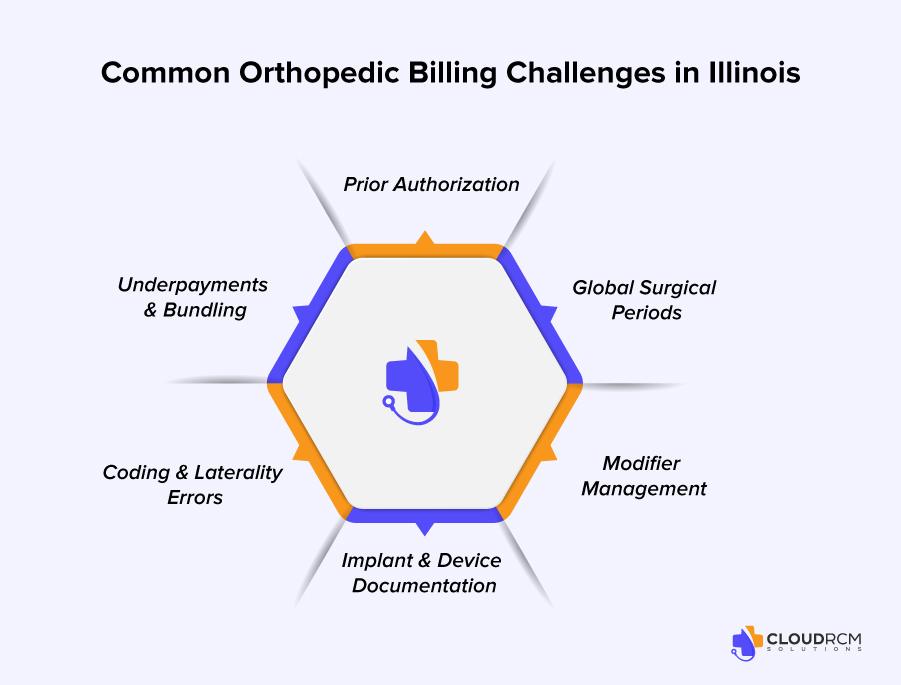
1. Prior Authorization
Joint replacements, advanced imaging, injections, DME, and certain surgical procedures may require authorization depending on the payer.
An authorization should be matched against the actual procedure, diagnosis, provider, facility, date range, and payer requirements.
2. Global Surgical Periods
Many orthopedic procedures have 90-day global surgical periods. Routine post-operative services included in the global package generally should not be separately billed to Medicare simply because a follow-up visit occurred.
Billing teams must distinguish routine postoperative care from separately reportable services, unrelated problems, staged procedures, and complications.
3. Modifier Management
Orthopedic claims frequently involve modifiers such as 25, 50, 51, 52, 57, 58, 59, 62, 78, 79, RT, and LT.
For example, modifier 25 may be relevant when a significant, separately identifiable E/M service is performed on the same day as another procedure, while modifier 59 addresses distinct procedural services when appropriate.
Modifier selection should be based on documentation, CPT guidance, NCCI edits, payer policies, and the circumstances of the encounter rather than using modifiers simply to bypass a denial.
4. Implant and Device Documentation
Joint replacements and complex orthopedic surgeries can involve expensive implants and surgical hardware. Missing implant information, incorrect HCPCS reporting, or incomplete documentation can result in lost reimbursement or payment disputes.
A strong orthopedic RCM process reconciles operative reports, implant records, invoices, charges, and claims.
5. Coding and Laterality Errors
Orthopedic ICD-10-CM coding often requires precise anatomical information and laterality. Errors involving right versus left anatomy, fracture location, encounter type, severity, or postoperative status can cause claim rejection or medical necessity problems.
6. Underpayments and Bundling
A claim can be paid without being paid correctly. Orthopedic billing teams should compare payer payments against contracted rates, multiple-procedure rules, contractual adjustments, implant reimbursement, and applicable fee schedules.
Common EHR & Practice Management Software for Orthopedic Practices in Illinois
The best orthopedic EHR depends on practice size, surgical volume, imaging requirements, ASC relationships, number of locations, payer mix, and RCM strategy. Orthopedic practices should evaluate both clinical functionality and billing interoperability.
| EHR / Software | Best Fit | Orthopedic Capabilities | RCM & Integration Considerations |
| Epic | Large orthopedic groups and health systems | Enterprise clinical workflows, imaging, surgical documentation and interoperability | Strong option for organizations exchanging records with large health systems; evaluate interfaces, payer connectivity and orthopedic-specific workflows |
| athenaOne | Independent to large orthopedic groups | Orthopedic-specific workflows, documentation, imaging, authorization support and reporting | Combines EHR, practice management and RCM; athenahealth reports more than 6,700 orthopedic providers on its network as of June 2024. |
| ModMed Orthopedics | Specialty-focused orthopedic practices | Orthopedic workflows, adaptive documentation, image management and coding support | Includes practice management, billing, analytics and interoperability; its orthopedic platform supports PACS and HL7 Modality Worklist interfaces. |
| Phoenix Ortho | Small to mid-sized orthopedic practices | Orthopedic-specific EHR, integrated PACS, imaging and clinical workflows | Combines EHR, PM, RCM and PACS; its integrated PACS supports X-rays, MRI and other imaging workflows. |
| eClinicalWorks | Independent and multi-provider practices | Orthopedic templates, musculoskeletal documentation, imaging and therapy workflows | Cloud EHR/PM with orthopedic-specific templates and charge capture functionality. |
| DrChrono | Smaller or mobile practices | Cloud and mobile documentation, scheduling and patient engagement | Useful where mobility and cloud access are priorities; verify orthopedic-specific templates and billing integrations during evaluation |
Already using an EHR or practice management platform? CloudRCM Solutions can work with your existing system to support orthopedic billing, coding, claims, denials, payment posting, and A/R management—without requiring you to replace your current software.
How to Improve Orthopedic Revenue Cycle Management
An effective orthopedic RCM strategy should connect front-end, clinical, coding, billing, and A/R workflows.
1. Verify Before the Procedure
Confirm eligibility, network status, benefits, authorization requirements, deductible, coinsurance, and applicable payer policies before surgery.
2. Audit High-Value Claims
Prioritize joint replacements, spine procedures, trauma cases, complex arthroscopy, and other high-dollar claims for pre-bill coding and documentation review.
3. Reconcile Charges
Compare the surgical schedule, operative reports, implant records, charge tickets, and claims to identify missed charges.
4. Monitor Payer-Specific Denials
Track denials by payer, CPT code, surgeon, location, modifier, authorization reason, and diagnosis.
5. Review Payments for Underpayments
Do not stop at “paid” status. Compare allowed amounts against contracts, fee schedules, and expected reimbursement.
Partner With an Illinois Orthopedic Billing Team
Every missed charge, coding error, authorization issue, or unpaid claim can quietly reduce an orthopedic practice’s revenue. CloudRCM Solutions offers Orthopedic Billing Services in Illinois focused on accurate coding, efficient claim submission, denial management, underpayment analysis, and A/R recovery. We help orthopedic practices simplify complex billing workflows, reduce preventable revenue loss, and improve reimbursement without adding more administrative work to their staff.
Schedule a free billing assessment with CloudRCM Solutions to identify revenue leakage, billing inefficiencies, and opportunities to improve your orthopedic practice’s financial performance.
FAQ’s
How does Workers’ Compensation billing affect Illinois orthopedic practices?
Workers’ Compensation claims require workflows that differ from standard commercial insurance billing. Practices should closely track the claim number, injury date, authorization, carrier information, documentation, fee schedule reimbursement, and claim status to reduce avoidable delays and payment discrepancies.
How can orthopedic practices identify whether they are being underpaid by insurance companies?
Payment posting should compare payer payments against the practice’s contracted reimbursement terms. Regular contractual allowance and underpayment analysis can identify claims where the payer reimbursed less than the expected amount and determine whether additional follow-up or appeal is appropriate.
What causes high-value orthopedic claims to remain unpaid?
Large orthopedic claims can become stuck because of missing authorization, eligibility problems, coding discrepancies, documentation requests, incorrect payer information, claim edits, coordination-of-benefits issues, or provider enrollment problems. High-dollar claims should receive prioritized A/R follow-up because delays can have a disproportionate effect on cash flow.
What are the biggest orthopedic billing challenges in Illinois?
The most common challenges include prior authorization, global surgical-period billing, modifier errors, implant documentation, laterality and diagnosis coding, Workers’ Compensation claims, denials, and underpayments.