
 Medical Billing
 Medical Coding
 Medical Audit
 Provider Credentialing
 Denial Management
 A/R Follow-up
 Private Practice
 Patient Help Desk
 Customized Reporting
 Out-of-Network Billing
 Internal Medicine
 Pediatrics
 Radiology
 Surgery
 Emergency Medicine
 Anesthesiology
 Cardiology
 Orthopedic
 Psychiatry
 Dentistry
 OB-GYN
 Family Medicine
Optometry billing and coding isn’t just a back-office task; it’s the backbone of your practice’s revenue cycle. In 2025, many optometry practices found themselves struggling with rising denials, complex Medicare rules, and the constant updates to CPT and ICD‑10 codes. As we step into 2026, the situation isn’t getting any easier; it’s getting more complicated.
Changes from CMS and government regulations are set to make this year even more challenging for practices that aren’t prepared. Those that don’t stay on top of evolving rules risk losing revenue, facing compliance issues, and watching their accounts receivable days balloon.
The good news? With the right tools and strategies, you can stay ahead of the curve, minimize billing mistakes, and keep your practice profitable.
Understanding Optometry Billing and Coding Services
Optometry billing and coding services involve the accurate translation of medical procedures performed by optometrists into standardized codes for submission to payers (Medicare, Medicaid, private insurers) for reimbursement. These services are critical for ensuring that optometry practices are compensated correctly and promptly for their services, while remaining compliant with government regulations and payer requirements.
Essential Coding Guide for Optometry Practices
Optometry billing is about making sure your practice gets paid for the services you provide. Optometry billing relies on several types of codes:
| Code Type | Code | Description | Used For |
| CPT | 92002 | Comprehensive Eye Exam (New Patient) | Routine comprehensive eye exam for new patients. |
| CPT | 92004 | Comprehensive Eye Exam (Established Patient) | Routine comprehensive eye exam for established patients. |
| CPT | 92012 | Intermediate Eye Exam (New/Established) | Eye exam for patients with established problems includes a detailed assessment. |
| CPT | 92014 | Comprehensive Eye Exam (Established Patient) | Full eye exam for established patients with more extensive diagnostic work. |
| CPT | 92132 | OCT Imaging (Macular/Retinal) | Optical Coherence Tomography for macular and retinal scans. |
| CPT | 92133 | OCT Imaging (Optic Nerve) | OCT imaging for optic nerve head and related structures. |
| CPT | 92083 | Visual Field Test | Visual field testing, often used for glaucoma management. |
| ICD-10 | H52.4 | Hypermetropia (Farsightedness) | Diagnosis for patients with farsightedness. |
| ICD-10 | H54.7 | Legal Blindness | Diagnosis for patients meeting the definition of legal blindness. |
| ICD-10 | H52.6 | Presbyopia | Diagnosis for age-related vision changes. |
| ICD-10 | H33.9 | Retinal Disorder, NOS | General diagnosis for retinal disorders (unspecified). |
| HCPCS | V2787 | Low Vision Device | Low vision devices for patients who have impaired vision despite corrective lenses. |
| HCPCS | V2631 | Contact Lens, Cosmetic | Cosmetic contact lenses used to alter eye appearance. |
| HCPCS | V2641 | Contact Lens, Corrective | Corrective contact lenses prescribed for vision correction. |
Modifiers for Optometry Services
| Modifier | Code Example | Description | Usage |
| -25 | 92002-25 | Significant, Separate Service | Use when a significant, separate eye exam is performed in addition to another service. |
| -59 | 92132-59 | Distinct Procedural Service | Use when a service is distinct from other services provided on the same day. |
| -RT | 92002-RT | Right Eye | Used to indicate that the service was performed on the right eye. |
| -LT | 92002-LT | Left Eye | Used to indicate that the service was performed on the left eye. |
A single mistake in coding can lead to denials, delays, and even audits. That’s why precise coding and proper documentation are essential for maintaining a healthy cash flow.
Common Billing Tips:
- Ensure Medical Necessity: All CPT and ICD-10 codes must support the medical necessity of the service. Without this, claims can be denied.
- Link ICD-10 Correctly: Properly link the ICD-10 diagnosis code with the corresponding CPT code for reimbursement.
- Modifiers for Separate Services: Use the –25 modifier if a separate and distinct service is provided alongside an exam, especially if it is a significant intervention.
- Telehealth Coding: For tele-optometry services, use the correct telehealth modifiers (e.g., G2010, G2012) and ensure the service is reimbursed based on current CMS guidelines.
Key Updates from CMS and Government Regulations in 2026
2025 CMS Optometry Updates
In 2025, CMS focused on increasing documentation scrutiny for medical necessity, particularly for procedures such as eye exams, diagnostic testing, and imaging. These changes are crucial because incomplete or insufficient documentation often leads to claim denials.
CPT Code Updates
The American Medical Association (AMA) has released over 288 new CPT codes for 2026, which will affect optometry billing, especially regarding advanced diagnostic services. Ensuring that practices update their billing software and train staff on these changes is vital to avoid revenue loss.
Medicare Fee Schedule
The 2025 Medicare Physician Fee Schedule included a slight reduction in reimbursement rates for certain optometric services. Practices need to adjust their business models to ensure they remain profitable despite this change. Additionally, payment rates for some diagnostic services were updated, which could affect reimbursement for services like retinal imaging.
Telehealth and Remote Care Billing
Telehealth services in optometry are evolving rapidly. Starting in 2026, CMS will restrict certain telehealth services to rural areas or require specific conditions for coverage. Practices must adapt their billing practices to reflect these changes, ensuring they remain compliant with telehealth reimbursement policies.
Challenges Faced by Optometry Practices in 2025
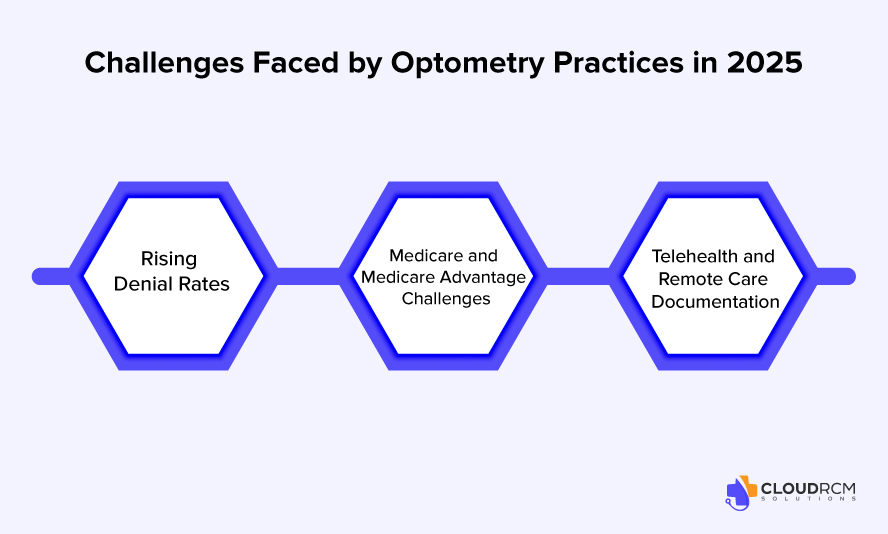
2025 was a challenging year for many optometry practices, and unfortunately, many of the same obstacles are expected to continue into 2026. The top issues that caused revenue setbacks last year include:
1. Rising Denial Rates
Claim denials have been steadily increasing, and they’re not just a minor inconvenience they are revenue killers. Here’s why:
- Coding errors: Incorrect CPT or ICD‑10 codes often result in rejections.
- Medical necessity: Many payers scrutinize the medical necessity of exams and procedures, and without clear, detailed documentation, claims get denied.
- Incorrect modifiers: If modifiers like 59 (distinct procedural service) or 25 (significant, separately identifiable service) are used incorrectly, claims are immediately rejected.
2. Medicare and Medicare Advantage Challenges
Medicare continues to be a significant challenge for optometry practices:
- Fee schedule changes: The Medicare Physician Fee Schedule in 2025 included adjustments that affected reimbursement for certain optometric services.
- Medicare Advantage complexities: These plans have different requirements than traditional Medicare. Optometry practices struggled to keep up with the varying rules around prior authorizations, eligibility, and coding, which led to delayed payments and claims rejections.
3. Telehealth and Remote Care Documentation
Tele-optometry exploded in 2020 due to the pandemic, but as we move into 2026, there are still several hurdles:
- Telehealth reimbursements: CMS continues to revise its telehealth policies. While some services remain reimbursable, others face tighter restrictions.
- Documentation errors: For virtual visits, the documentation must be as robust as in-person visits. Many practices are still missing critical documentation that makes telehealth claims vulnerable to denials.
How Optometry Practices Can Overcome These Challenges
To successfully navigate these changes and recover lost revenue, optometry practices need to implement effective billing strategies. Here’s how:
1. Update Your Coding and Documentation Processes
Keeping your coding practices up to date is essential:
- Train staff regularly: Billing staff and optometrists should be regularly trained on the latest CPT, ICD‑10, and modifier changes.
- Use checklists for documentation: Create documentation checklists to ensure every claim is supported with the right codes and medical necessity statements.
2. Implement a Robust Denial Management System
Denial management is crucial for improving cash flow:
- Track and analyze denials: Identify patterns in denials and address the root causes. Whether it’s coding errors, medical necessity concerns, or payer-specific issues, resolving these will reduce future denials.
- Appeal denied claims: Don’t let denied claims sit on your desk. Have a structured appeals process in place to ensure that claims are re-submitted and recovered.
3. Embrace Telehealth Billing Compliance
Tele-optometry is here to stay, but it requires careful billing practices:
- Follow payer guidelines: Stay on top of CMS guidelines and payer-specific telehealth policies to ensure your practice remains compliant.
- Document everything: For virtual visits, make sure that all documentation is thorough and supports the medical necessity of the tele-optometry service.
4. Use Automation and Analytics
Automation tools can streamline your billing processes:
- Automated claim submission: Reduce human errors and speed up your claims process with automated systems that ensure your claims are accurate before submission.
- Revenue cycle analytics: Use data to identify inefficiencies, track performance, and make data-driven decisions that optimize your revenue cycle.
How Cloud RCM Solutions Can Help Optometry Practices Thrive in 2026
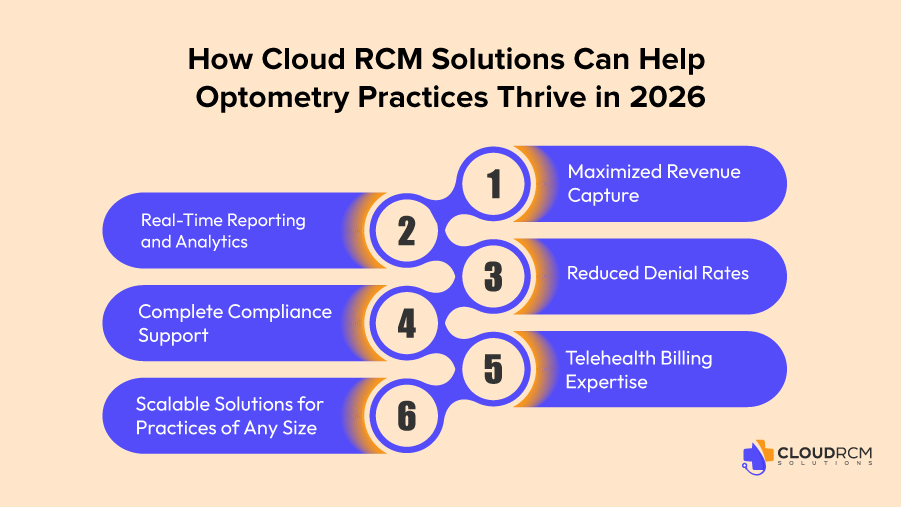
Billing and coding in optometry can be a minefield of complexities, but with the right support, you can overcome these challenges and maximize your revenue. Here’s how Cloud RCM Solutions can help your practice:
1. Maximized Revenue Capture
We ensure that every service is properly coded and all documentation is in place to ensure you’re reimbursed for every dollar you’re owed. We stay on top of coding updates and payer requirements so you don’t miss a thing.
2. Reduced Denial Rates
Our expert team specializes in proactive claim scrubbing and denial management. We ensure claims are clean before submission, and when denials happen, we’re quick to address them, resubmit corrected claims, and appeal when necessary.
3. Telehealth Billing Expertise
Tele-optometry can be tricky, but we help you navigate the complexities of remote care billing. From ensuring compliance with CMS guidelines to managing telehealth claims and documentation, we handle it all so you can focus on providing excellent care.
4. Real-Time Reporting and Analytics
Our dashboard gives you real-time access to all your billing data, enabling you to track payer performance, monitor claim statuses, and analyze trends in your revenue cycle. This empowers you to make data-driven decisions that improve cash flow.
5. Complete Compliance Support
We ensure that your practice remains compliant with ever-changing CMS and payer regulations. Our team handles the updates, so you don’t have to worry about missing critical changes to regulations or coding requirements.
6. Scalable Solutions for Practices of Any Size
Whether you’re a solo practitioner or a multi-location practice, our services are scalable to meet your needs. We provide customized billing solutions that grow with your practice.
Conclusion
As optometry billing and coding continue to evolve in 2026, staying on top of the latest changes and challenges is crucial for maintaining a healthy revenue cycle. By partnering with a professional billing service like Cloud RCM Solutions, you can navigate these complexities with ease and ensure that your practice stays profitable.
Ready to streamline your revenue cycle? Contact us today for a free consultation and take the first step toward maximising your reimbursement rates and minimising claim denials.
FAQ’s
Why is optometry billing and coding becoming more complex in 2026?
Optometry billing is becoming more complex due to increased CMS documentation requirements, frequent CPT and ICD-10 updates, reduced Medicare reimbursement rates, and stricter scrutiny around medical necessity. In 2026, practices that fail to stay compliant with these changes face higher denial rates, delayed payments, and audit risks.
What are the most common billing and coding mistakes in optometry practices?
The most common mistakes include incorrect CPT or ICD-10 code selection, improper use of modifiers such as -25 and -59, insufficient documentation to support medical necessity, and errors in linking diagnosis codes to procedures. Even small mistakes can result in claim denials or underpayments.
How do CPT, ICD-10, and HCPCS codes work together in optometry billing?
CPT codes describe the services or procedures performed, ICD-10 codes explain the medical reason for the service, and HCPCS codes are used for supplies like contact lenses and low-vision devices. For successful reimbursement, all three must align correctly and clearly support medical necessity.
What documentation is required to support medical necessity for optometry claims?
Documentation must clearly show the patient’s symptoms, diagnosis, clinical findings, and why the service or test was medically necessary. CMS and commercial payers closely review records for eye exams, OCT imaging, visual field tests, and tele-optometry visits, making detailed documentation essential for payment.
How are Medicare and Medicare Advantage affecting optometry reimbursement in 2026?
Medicare reimbursement has seen slight reductions, and Medicare Advantage plans continue to introduce payer-specific rules, prior authorization requirements, and documentation standards. These variations make billing more complex and increase the risk of delayed or denied claims if not managed properly.
Are tele-optometry services still reimbursable in 2026?
Yes, but with restrictions. CMS is tightening telehealth coverage, limiting certain services to rural areas or specific conditions. Practices must use the correct telehealth codes and modifiers, follow payer guidelines closely, and ensure documentation is as thorough as in-person visits to avoid denials.
How can optometry practices reduce claim denials and improve cash flow?
Practices can reduce denials by keeping coding up to date, training staff regularly, using documentation checklists, tracking denial trends, and implementing a structured appeals process. Automation tools and revenue cycle analytics also help catch errors before claims are submitted.