
 Medical Billing
 Medical Coding
 Medical Audit
 Provider Credentialing
 Denial Management
 A/R Follow-up
 Private Practice
 Patient Help Desk
 Customized Reporting
 Out-of-Network Billing
 Internal Medicine
 Pediatrics
 Radiology
 Surgery
 Emergency Medicine
 Anesthesiology
 Cardiology
 Orthopedic
 Psychiatry
 Dentistry
 OB-GYN
 Family Medicine
Neurosurgery billing requires specialized knowledge of complex cranial and spinal procedures, surgical documentation, CPT coding, global surgery rules, and payer-specific reimbursement policies. Even a small coding or authorization error can delay payment, trigger a medical necessity denial, or leave a practice with unrecovered revenue.
A 2019 AANS survey found that 95% of neurosurgeons reported a high prior authorization burden, 82% said it often delayed necessary care, and 60% experienced repeated payment denials despite authorization.
In this guide: Explore key billing challenges, including prior authorization, spine coding, co-surgeon billing, global periods, and underpayments, and learn how CloudRCM Solutions helps practices improve claim accuracy and reimbursement.
Why Does Neurosurgery Billing Require Specialized Expertise?
Neurosurgery involves procedures that require detailed clinical documentation and precise code selection. Unlike routine office-based services, surgical claims may involve multiple procedures, different surgical approaches, instrumentation, co-surgeons, assistant surgeons, and postoperative care.
A claim must accurately represent the services performed and comply with CPT instructions, ICD-10-CM diagnosis coding, National Correct Coding Initiative (NCCI) edits, and individual payer policies.
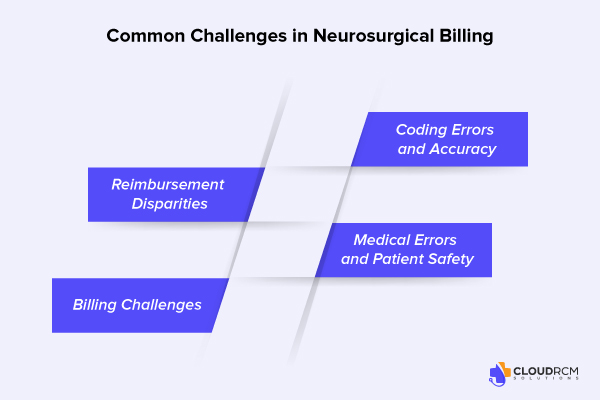
Common neurosurgical billing challenges include:
- Complex operative reports: The documentation must support the procedure, surgical approach, diagnoses, and additional services reported.
- Prior authorization: Payers may require clinical records, imaging findings, conservative treatment history, and medical necessity documentation before approving surgery.
- Multiple procedure coding: Spine and cranial procedures may involve primary and add-on codes with specific reporting requirements.
- Co-surgeon and assistant billing: Incorrect modifier selection or incomplete documentation can delay reimbursement.
- Global surgical periods: Routine postoperative services may be included in the surgical payment.
- Underpayments and denials: Incorrect coding, authorization mismatches, missing records, and payer edits can affect final reimbursement.
A specialized billing process helps practices address these issues before claims reach the payer.
Common Neurosurgery Billing Challenges and How to Address Them
1. Prior Authorization and Medical Necessity Denials
Neurosurgical procedures such as spinal fusion, deep brain stimulation (DBS), and other complex interventions may require prior authorization depending on the payer, procedure, and site of service.
Authorization requests often require:
- Relevant ICD-10-CM diagnosis codes.
- MRI, CT, and other diagnostic imaging reports.
- Documentation of symptoms and neurological findings.
- Previous conservative treatment and its outcomes.
- Physician notes supporting the proposed procedure.
- Requested CPT codes and surgical details.
A common problem occurs when the approved procedure does not match the final operative report or submitted claim. Authorization alone does not guarantee payment.
How to reduce authorization-related denials:
- Verify benefits and authorization requirements before scheduling.
- Confirm the approved procedure, provider, facility, and authorization dates.
- Submit relevant clinical documentation with the request.
- Track pending requests and peer-to-peer reviews.
- Compare the authorization approval with the operative report and final claim.
- Appeal denials with supporting clinical and coding documentation.
Practices should also track authorization denials separately from coding denials. This helps identify whether payment problems originate during scheduling, clinical review, or claim submission.
2. Complex Spine Surgery Coding
Spine surgery billing requires accurate identification of the surgical approach, anatomical level, procedure performed, and applicable instrumentation.
For example, a spinal fusion claim may involve arthrodesis, decompression, interbody device placement, and instrumentation. However, these services cannot automatically be reported separately simply because they appear in the operative report.
The coder must review CPT instructions, code-specific reporting requirements, and applicable NCCI edits.
Common coding areas include:
- Cervical and lumbar spinal fusion.
- Laminectomy and decompression.
- Discectomy.
- Interbody device insertion.
- Spinal instrumentation.
- Revision and additional-level procedures.
How to improve coding accuracy:
- Review the complete operative report rather than relying only on the scheduled procedure.
- Identify the approach, anatomical level, and actual work performed.
- Validate primary and add-on code relationships.
- Review applicable NCCI procedure-to-procedure edits.
- Confirm payer-specific requirements for additional levels and instrumentation.
- Ensure diagnosis codes support the services billed.
Accurate documentation and code selection help reduce incorrect code combinations, claim edits, and avoidable reimbursement delays.
3. Co-Surgeon and Assistant Surgeon Billing
Complex neurosurgical procedures may involve two surgeons or an additional assistant. Each role has different billing requirements.
Modifier 62: Co-surgeons
Modifier 62 applies when two surgeons, generally of different specialties, perform distinct parts of the same procedure and meet the applicable co-surgery criteria. Both surgeons must document their roles and the medical necessity for co-surgery when required.
For Medicare, each eligible co-surgeon generally receives 62.5% of the global surgical fee schedule amount for the procedure, subject to applicable payment rules.
Modifiers 80, 81, and 82: Assistant surgeons
These modifiers identify different assistant-at-surgery circumstances:
- Modifier 80: Assistant surgeon.
- Modifier 81: Minimum assistant surgeon.
- Modifier 82: Assistant surgeon when a qualified resident surgeon is unavailable in the applicable teaching-hospital circumstances.
Modifier AS identifies qualifying non-physician practitioners, such as physician assistants, nurse practitioners, or clinical nurse specialists, assisting at surgery under applicable payer rules.
What practices should verify:
- Whether the procedure permits co-surgeon or assistant-surgeon payment.
- Whether the payer recognizes the reported modifier.
- Whether each surgeon’s role is clearly documented.
- Whether the operative report supports medical necessity.
- Whether Medicare assistant-at-surgery indicators or commercial payer policies affect reimbursement.
Co-surgeon and assistant-surgeon billing should never be based on the number of providers present in the operating room alone. The documented work and applicable payment rules determine whether separate reporting is appropriate.
4. Global Surgical Period and Postoperative Billing
Medicare uses global surgical packages to include specified preoperative, intraoperative, and postoperative services in a single payment.
The three common global surgery indicators are:
| Global indicator | Payment period | General description |
|---|---|---|
| 000 | 0-day postoperative period | Certain minor procedures and endoscopic services |
| 010 | 10-day postoperative period | Other minor procedures |
| 090 | 90-day postoperative period | Major surgical procedures, including the applicable preoperative and postoperative period |
Many major neurosurgical procedures have a 90-day global period, but practices should verify the global indicator for each CPT code using the Medicare Physician Fee Schedule.
Routine postoperative visits included in the global package generally cannot be billed separately to Medicare. However, certain unrelated services and qualifying exceptions may be separately reportable.
Modifiers commonly relevant to global surgery include:
- Modifier 24: Unrelated E/M service during a postoperative period.
- Modifier 57: E/M service resulting in the decision for major surgery.
- Modifier 58: Staged or related procedure during the postoperative period.
- Modifier 78: Unplanned return to the operating room for a related procedure.
- Modifier 79: Unrelated procedure during the postoperative period.
Billing best practice: Maintain a global-period tracking process that records surgery dates, applicable postoperative periods, follow-up services, and any qualifying exceptions. Documentation must support the use of a modifier.
5. Implant Documentation and Surgical Charge Capture
Spinal procedures may involve interbody devices, instrumentation, graft materials, and other surgical supplies. Missing or inconsistent documentation can create billing and reconciliation problems.
For professional billing, the operative report must support the physician services and applicable CPT codes. Facility billing has separate requirements for reporting supplies, devices, and other charges.
Practices should reconcile:
- Operative reports and procedure details.
- Implant and device documentation.
- Anatomical levels and interspaces.
- Applicable CPT and HCPCS codes.
- Facility and professional billing responsibilities.
- Payer-specific coverage and payment policies.
This helps identify missing charges, unsupported coding, and differences between expected and actual reimbursement.
Specialized Neurosurgery Billing Services
CloudRCM Solutions supports the billing and revenue cycle needs of neurosurgery and spine practices through specialty-focused services.
| Service | How it supports your practice |
|---|---|
| Eligibility and benefits verification | Identifies coverage limitations and payer requirements before services |
| Prior authorization support | Tracks requests and helps organize medical necessity documentation |
| Neurosurgery coding | Reviews operative reports, CPT, ICD-10-CM, and applicable modifiers |
| Claim submission | Checks claims for coding and billing errors before submission |
| Payment posting | Records payer payments, adjustments, and patient responsibilities |
| Denial management | Investigates rejections and prepares supported appeals |
| A/R follow-up | Tracks unpaid claims and outstanding reimbursement |
| Customized reporting | Provides visibility into denials, collections, and claim performance |
Our goal is to help neurosurgery practices maintain accurate billing workflows while reducing the administrative pressure associated with complex surgical claims.
Neurosurgery CPT Codes and Modifiers
Neurosurgery coding may involve cranial procedures, spinal decompression, fusion, instrumentation, stereotactic navigation, and neurostimulation.
The following examples provide a starting point for understanding commonly encountered code families. They are not a complete billing guide. Always verify current CPT descriptors, add-on code instructions, NCCI edits, and payer policies before claim submission.
Common Neurosurgery CPT Code Examples
| Procedure category | Example CPT codes | Coding consideration |
|---|---|---|
| Lumbar discectomy | 63030 | Verify the documented procedure and anatomical level |
| Lumbar decompression | 63047 | Confirm the actual decompression performed |
| Cervical spinal fusion | 22551 | Review approach and applicable code instructions |
| Posterior lumbar fusion | 22612 | Validate the documented fusion technique |
| Combined posterior fusion and interbody technique | 22633 | Confirm the documented procedure and applicable coding rules |
| Interbody biomechanical device | 22853 | Add-on code subject to applicable reporting requirements |
| Cranial tumor surgery | 61510 | Select based on the specific documented procedure |
| Intracranial hematoma evacuation | 61312 | Confirm the procedure and clinical documentation |
| Cranial stereotactic navigation | +61781 | Add-on code; verify the primary procedure requirements |
| Spinal stereotactic navigation | +61782 | Add-on code; check current CPT instructions |
Common Neurosurgery Billing Modifiers
| Modifier | Description |
|---|---|
| 22 | Increased procedural services |
| 24 | Unrelated E/M service during postoperative period |
| 25 | Significant, separately identifiable E/M service |
| 51 | Multiple procedures |
| 57 | Decision for surgery |
| 58 | Staged or related procedure |
| 62 | Co-surgeons |
| 78 | Unplanned return to operating room for a related procedure |
| 79 | Unrelated procedure during postoperative period |
| 80 | Assistant surgeon |
| 81 | Minimum assistant surgeon |
| 82 | Assistant surgeon when a qualified resident is unavailable |
| AS | Non-physician practitioner assistant at surgery |
Important: Codes such as 61781 and 61782 are CPT add-on codes, not modifiers. Their use depends on the documented service and applicable CPT instructions. Similarly, modifier 62, assistant-at-surgery modifiers, and multiple-procedure modifiers have distinct requirements. Do not apply them solely because multiple services or providers were involved.
For Medicare coding, review the CMS NCCI Policy Manual and the applicable Medicare Physician Fee Schedule files.
2026–2027 Medicare and Regulatory Updates for Neurosurgery Practices
Medicare payment policies, authorization requirements, and patient billing protections can affect neurosurgery practices. Billing teams should review current CMS guidance rather than relying on outdated conversion factors or general payer assumptions.
2026 Medicare Physician Fee Schedule Conversion Factors
For calendar year 2026, CMS finalized two Medicare Physician Fee Schedule conversion factors:
| Provider participation category | 2026 conversion factor |
|---|---|
| Qualifying APM participants | $33.5675 |
| Non-qualifying APM participants | $33.4009 |
The applicable conversion factor is only one component of Medicare reimbursement. Actual payment depends on work RVUs, practice expense RVUs, malpractice RVUs, geographic practice cost indices (GPCIs), and other payment policies.
2027 Medicare Physician Fee Schedule Updates
CMS’s CY 2027 proposed rule included the following conversion factors:
| Provider participation category | 2027 proposed conversion factor |
|---|---|
| Qualifying APM participants | $33.1693 |
| Non-qualifying APM participants | $32.8409 |
These figures were proposed, not finalized, in the CMS materials available for this article’s November 2026 review. The proposed decrease reflects the expiration of the one-time 2.5% statutory increase that applied in 2026, alongside other statutory and payment adjustments.
Neurosurgery practices should use the applicable finalized fee schedule and code-specific RVUs when forecasting Medicare reimbursement. A conversion factor alone cannot determine payment for an individual spinal or cranial procedure.
CMS WISeR Model and Prior Authorization
The Wasteful and Inappropriate Service Reduction (WISeR) Model began January 1, 2026, and is scheduled to run through December 31, 2031 in six states:
- Arizona
- New Jersey
- Ohio
- Oklahoma
- Texas
- Washington
The model uses technology-supported review with human clinical oversight for selected Original Medicare services. Examples include certain electrical nerve stimulator implantation services.
WISeR does not apply to Medicare Advantage and does not change Medicare coverage or payment policy. It is not a universal prior authorization requirement for all neurosurgery procedures.
Practices should check the CMS model’s current service list, applicable state, site of service, and beneficiary eligibility before assuming a procedure is subject to WISeR review.
No Surprises Act and Neurosurgery Billing
The No Surprises Act affects how certain out-of-network services are billed when patients receive care at in-network hospitals, hospital outpatient departments, or ambulatory surgical centers.
For neurosurgery practices, important considerations include:
- Covered non-emergency services provided by out-of-network physicians at in-network facilities may be subject to federal balance-billing protections.
- Assistant surgeons are considered ancillary providers and cannot ask patients to waive applicable federal balance-billing protections through notice and consent.
- Certain other non-ancillary out-of-network providers may use a notice-and-consent exception when legal requirements are met.
- Uninsured or self-pay patients generally must receive a Good Faith Estimate when they request one or schedule eligible services at least three business days in advance.
- An eligible uninsured or self-pay patient may use the patient-provider dispute resolution process when a provider’s bill is at least $400 above the applicable Good Faith Estimate.
Neurosurgery practices should coordinate with hospitals and surgical facilities to understand network status, patient estimates, assistant-surgeon billing, and applicable balance-billing protections.
The law has specific exceptions and does not apply to every insurance arrangement. Medicare and Medicaid beneficiaries have separate protections.
How Neurosurgery Practices Can Reduce Claim Denials and Improve A/R
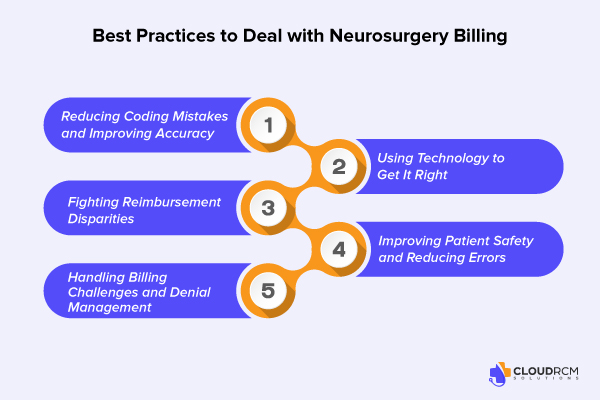
Reducing denials requires more than correcting claims after a payer rejects them. Practices need a process that connects scheduling, authorization, clinical documentation, coding, and payment reconciliation.
Consider these operational controls:
1. Verify coverage before surgery. Confirm active benefits, network status, authorization requirements, and applicable patient responsibility.
2. Review operative reports before coding. Ensure the submitted CPT codes reflect the actual procedure, approach, anatomical level, and documented work.
3. Validate modifiers and code combinations. Check global surgery indicators, co-surgeon eligibility, assistant-at-surgery rules, add-on code instructions, and NCCI edits.
4. Submit clean, complete claims. Check provider information, diagnosis codes, authorization references, procedure codes, and payer-specific claim requirements.
5. Track denials by root cause. Separate authorization, medical necessity, coding, eligibility, missing documentation, and timely filing denials.
6. Reconcile payments and underpayments. Compare remittance advice with expected reimbursement and contractual payment terms. Investigate unexplained adjustments and short payments.
7. Monitor A/R performance. Review aging by payer, procedure, denial category, and outstanding balance to prioritize follow-up.
These controls help practices identify where reimbursement is being delayed or lost and make improvements based on actual claim trends.
How CloudRCM Solutions Supports Neurosurgery Practices
CloudRCM Solutions helps neurosurgery and spine practices manage complex billing through specialized coding support, claim submission, denial management, and A/R follow-up. Our team works to identify billing errors, address reimbursement delays, and improve revenue cycle visibility while your staff focus on patient care.
Need support with neurosurgery billing and coding?
Schedule an appointment or call (224) 231-6880 to discuss your practice’s billing and revenue cycle needs.
FAQS
What are the primary CPT code ranges used for common neurosurgical procedures?
Codes beginning with “61” cover intracranial procedures like craniotomies, while codes starting with “62” are typically for spinal surgeries.
How do I accurately code for a complex procedure involving multiple steps or approaches?
Break down the procedure into its components, use appropriate modifiers, and consult the most specific codes to cover each distinct step.
What are some common coding errors to watch out for in neurosurgery billing?
Common errors include incorrectly applying modifiers, failing to report all procedure steps, and using outdated code versions.
How do I ensure proper documentation for a neurosurgical procedure to support accurate coding?
Maintain detailed operative notes, ensure all stages of the procedure are clearly documented, and confirm the medical necessity of each step.
What resources are available to stay updated on the latest neurosurgery coding guidelines?
Utilize resources like the AMA’s CPT code updates, CMS guidelines, and professional organizations such as the American Association of Neurological Surgeons (AANS).