
 Medical Billing
 Medical Coding
 Medical Audit
 Provider Credentialing
 Denial Management
 A/R Follow-up
 Private Practice
 Patient Help Desk
 Customized Reporting
 Out-of-Network Billing
 Internal Medicine
 Pediatrics
 Radiology
 Surgery
 Emergency Medicine
 Anesthesiology
 Cardiology
 Orthopedic
 Psychiatry
 Dentistry
 OB-GYN
 Family Medicine
Missed charges, coding errors, and payer delays can quietly drain a nephrology practice’s revenue. Nephrology Billing Services in Illinois help practices navigate complex dialysis billing, CKD and ESRD coding, documentation requirements, and changing payer rules while keeping claims accurate and payments moving.
This guide covers practical ways to reduce denials, recover A/R, prevent revenue leakage, and improve nephrology revenue cycle performance.
How Nephrology Billing Works in Illinois
Nephrology billing covers a broad range of physician services related to kidney disease and renal care. Depending on the practice, services may include office and hospital E/M visits, CKD management, dialysis-related services, consultations, care coordination, diagnostic services, and procedures related to vascular access.
Nephrology practices may treat patients across multiple care settings, including:
- Physician offices
- Hospitals
- Outpatient facilities
- Dialysis centers
- Skilled nursing facilities
- Ambulatory settings
This creates additional billing complexity because coding, documentation, place-of-service requirements, and payer policies may vary depending on where the service is performed.
For 2026, staying current is especially important. CMS set the ESRD Prospective Payment System (PPS) base rate at $281.71 per treatment for ESRD facilities, while physician billing for many ESRD-related services may follow the separate Monthly Capitation Payment (MCP) methodology. These are different payment systems and should not be treated as interchangeable.
Illinois Resources Nephrology Practices Should Monitor
Nephrology billing in Illinois is influenced by more than Medicare rules. Practices must also keep track of Illinois Medicaid (HFS) updates, managed care requirements, payer policies, and nephrology-specific guidance that can affect reimbursement. CMS remains essential for ESRD payment and Medicare billing information, while the Renal Physicians Association (RPA) provides specialty-focused practice and policy resources. Keeping these sources on a regular review cycle can help practices identify billing changes before they become denials or payment delays.
Common Nephrology Services That Require Careful Billing in IL
Nephrology practices may bill for services involving:
- Chronic kidney disease management
- End-stage renal disease (ESRD) care
- Acute kidney injury management
- Hypertension management
- Electrolyte and acid-base disorders
- Dialysis-related physician services
- Hemodialysis and peritoneal dialysis management
- Hospital consultations and follow-up care
- Vascular access-related procedures
- Transitional care and care coordination
- Diagnostic testing and interpretation
- Preventive and chronic disease management services
Accurate billing begins with complete documentation. The medical record should support the patient’s diagnosis, complexity, medical necessity, services performed, and applicable coding requirements.
Illinois nephrology practices must also monitor payer-specific requirements. Medicare, Medicare Advantage organizations, Illinois Medicaid managed care plans, and commercial insurers may apply different authorization, documentation, claim submission, and reimbursement policies.
Common Nephrology Billing Challenges
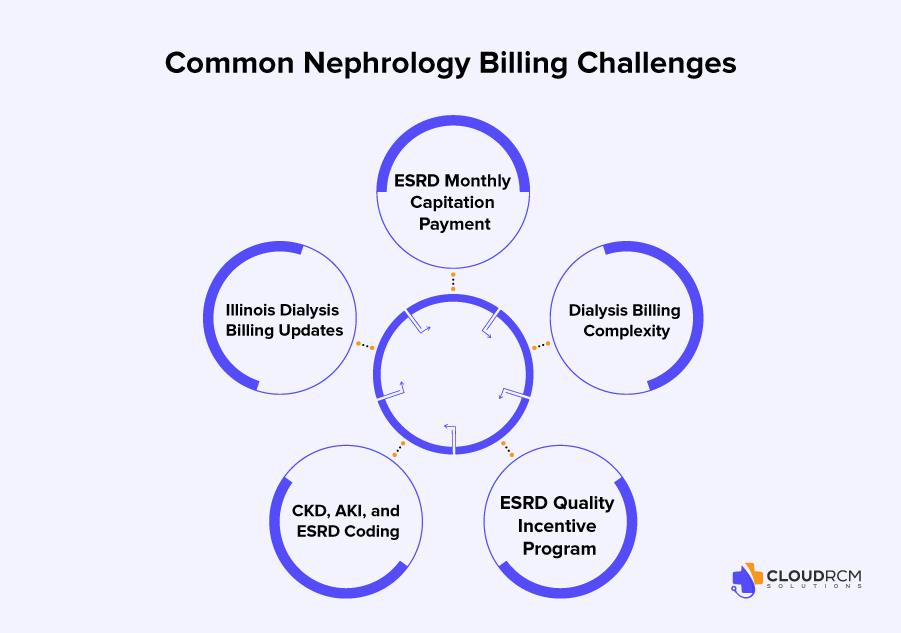
1. ESRD Monthly Capitation Payment
Medicare uses the Monthly Capitation Payment methodology for many physician services related to managing patients with ESRD. CMS continues to monitor MCP billing, including situations where multiple MCP services are incorrectly billed for the same patient and month.
A specialty billing team should understand the applicable MCP codes, visit requirements, patient status, and documentation before submitting claims.
2. Dialysis Billing Complexity
Dialysis billing requires careful coordination between the nephrologist, dialysis facility, payer, and billing team.
The distinction between physician professional services and services included in the ESRD facility PPS is particularly important. CMS states that the ESRD PPS provides a bundled, per-treatment payment to ESRD facilities for outpatient maintenance dialysis, while certain services are subject to consolidated billing rules.
3. Illinois Dialysis Billing Updates
Illinois Medicaid billing requirements also continue to change. In June 2026, Illinois HFS issued updated renal dialysis billing and payment guidance covering both fee-for-service and managed care programs. Effective June 1, 2026, certain renal dialysis claims require appropriate revenue codes, with specific condition codes for home dialysis and dialysis provided in long-term care settings.
This makes payer-specific knowledge particularly important for Illinois nephrology and dialysis providers.
4. CKD, AKI, and ESRD Coding
Accurate diagnosis coding helps establish the clinical condition being treated and supports medical necessity. Billing teams should distinguish among CKD stages, AKI, ESRD, and other documented renal conditions rather than relying on generalized kidney-disease coding.
5. ESRD Quality Incentive Program
Nephrology practices that work closely with dialysis facilities should also understand the financial implications of the ESRD Quality Incentive Program (QIP). CMS links dialysis-facility payment to performance on applicable quality measures, and facilities that do not meet required performance standards can receive payment reductions.
For Payment Year 2026, CMS evaluates multiple clinical, care coordination, safety, patient and family engagement, and reporting measures.
How to Improve Revenue Cycle Performance for Nephrology Practices
Improving nephrology revenue cycle performance requires a coordinated process that begins before the patient encounter and continues through final payment.
1. Improve Nephrology Coding Accuracy
Regular coding audits can identify incorrect CPT®, HCPCS, ICD-10-CM, and modifier usage. For nephrology practices, coding reviews should pay particular attention to:
- E/M services
- CKD staging
- ESRD diagnoses
- Dialysis-related services
- Hospital services
- Procedures
- Vascular access services
- Modifiers
- Place-of-service coding
Accurate coding supports appropriate reimbursement while reducing compliance risk.
2. Strengthen Clinical Documentation
Documentation should clearly support the diagnosis, medical necessity, treatment plan, and services provided. For CKD and ESRD patients, documentation should accurately reflect the patient’s kidney disease status and relevant clinical conditions.
Strong documentation gives coders the information they need to select appropriate codes and provides supporting evidence when claims are audited or appealed.
3. Verify Insurance Before Treatment
Eligibility verification should confirm:
- Active coverage
- Patient benefits
- Specialist coverage
- Dialysis-related coverage
- Referral requirements
- Prior authorization requirements
- Patient financial responsibility
Identifying coverage issues before treatment is significantly more effective than discovering them after a claim is denied.
4. Strengthen Charge Capture
Missed charges can create significant revenue leakage. Nephrology practices should reconcile schedules, clinical documentation, procedure records, and submitted claims to identify services that were performed but never billed.
A daily charge reconciliation process can help prevent lost revenue.
5. Monitor Revenue Cycle KPIs
Important nephrology billing KPIs include:
- Clean claim rate
- First-pass acceptance rate
- Claim denial rate
- Days in A/R
- A/R over 90 days
- Net collection rate
- Gross collection rate
- Payment turnaround time
- Underpayment rate
- Denial recovery rate
Tracking these metrics by payer can help practices identify where revenue cycle performance is weakening.
Common Nephrology EHR & Practice Management Software
The right EHR and practice management system can improve documentation, scheduling, charge capture, eligibility verification, claims management, and reporting.
| Software | Best For | Relevant Features | Billing & RCM Capabilities |
|---|---|---|---|
| athenahealth | Independent and larger practices | EHR, clinical documentation, patient engagement | Eligibility, claims, payment posting, reporting |
| eClinicalWorks | Physician groups | Clinical workflows, care management, interoperability | Claims, eligibility, billing, reporting |
| AdvancedMD | Multi-provider practices | Custom workflows, scheduling, documentation | Billing, claims, payment processing, financial reporting |
| NextGen Healthcare | Larger medical groups | Specialty workflows, interoperability, analytics | RCM, claims management, reporting |
| Tebra | Independent practices | Scheduling, EHR, patient engagement | Billing, claims, payments, eligibility |
| Epic | Hospitals and health systems | Enterprise clinical workflows | Enterprise RCM, claims, coding and financial analytics |
| DrChrono | Small and mobile practices | Mobile EHR, scheduling, telehealth | Claims, billing, payment posting |
The best system depends on the practice’s size, specialty workflow, payer mix, dialysis relationships, and existing technology environment.
Cloud RCM Solutions can work with major EHR, practice management, and clearinghouse platforms to support charge capture, coding, claim submission, payment posting, denial management, and A/R follow-up without requiring practices to replace their existing technology.
What’s Impacting Nephrology Revenue in Illinois?
Revenue leakage often occurs before a claim reaches the insurance company. A nephrology practice may lose revenue because a service was never captured, documentation did not support the billed level, an authorization was missed, a claim was submitted incorrectly, or an underpayment was never identified.
| Revenue Leakage Area | Impact on Your Practice | How Cloud RCM Solutions Helps |
| Incorrect E/M Coding | Underpayments and compliance risk | Coding review validates services against documentation |
| CKD/ESRD Coding Errors | Medical necessity issues and denials | Diagnosis coding review improves accuracy |
| Missed Charges | Services performed but not billed | Charge reconciliation identifies missing services |
| Dialysis Billing Errors | Denials and delayed reimbursement | Specialty billing workflows review dialysis-related claims |
| Eligibility Errors | Preventable claim rejections | Insurance verification identifies coverage problems |
| Authorization Issues | Non-payment or delayed reimbursement | Authorization tracking helps prevent avoidable denials |
| Procedure Coding Errors | Rejections and underpayments | Specialized coding review checks procedure claims |
| Credentialing Problems | Claims may remain unpaid | Enrollment monitoring helps maintain payer participation |
| Underpayments | Lost contractual revenue | Payment reviews identify reimbursement discrepancies |
| Aging A/R | Slower cash flow | Dedicated A/R follow-up prioritizes outstanding balances |
| Unresolved Denials | Permanent revenue loss | Root-cause analysis and appeals support recovery |
A proactive revenue cycle strategy identifies these problems early and creates processes to prevent them from recurring.
Nephrology Denial Management & Accounts Receivable Recovery
Denial management is an important component of nephrology revenue cycle management.
Nephrology claims may be denied because of:
- Incorrect diagnosis codes
- E/M coding errors
- Missing documentation
- Medical necessity issues
- Eligibility problems
- Authorization requirements
- Incorrect modifiers
- Duplicate claims
- Timely filing issues
- Incorrect payer information
- Provider enrollment discrepancies
- Incorrect place of service
Simply resubmitting a denied claim does not solve the underlying problem. Effective denial management analyzes why the claim failed, corrects the issue, submits the appropriate correction or appeal, and tracks the result.
A/R Management for Nephrology Practices
A/R management should prioritize claims according to payer, balance, age, denial reason, and filing deadline.
A structured A/R process includes:
- Reviewing unpaid claims
- Identifying stalled claims
- Contacting payers
- Correcting claim errors
- Submitting appeals
- Tracking appeal outcomes
- Identifying underpayments
- Escalating high-value balances
- Monitoring aging trends
This approach helps practices recover eligible revenue before claims become difficult or impossible to collect.
Nephrology Denial Recovery Process
A successful denial recovery process should follow a consistent workflow.
1. Identify the Denial
Determine whether the denial resulted from coding, eligibility, authorization, documentation, medical necessity, timely filing, credentialing, or another issue.
2. Review the Claim
Compare the submitted claim with the patient’s medical record, payer policy, authorization information, and remittance advice.
3. Correct the Root Cause
Fix the underlying issue rather than repeatedly submitting the same claim.
4. Submit a Corrected Claim or Appeal
Use the appropriate payer process and include supporting documentation when required.
5. Track the Claim
Monitor the claim until the payer processes the correction or appeal.
6. Analyze Recurring Denials
Group denials by reason, payer, provider, location, and service type to identify patterns.
For example, repeated authorization denials from one payer may indicate a front-end workflow problem rather than a billing problem.
A data-driven denial management process helps nephrology practices improve first-pass claim performance and recover revenue that might otherwise remain unpaid.
Partner With an Illinois-Based Nephrology Billing Team
Every missed charge, coding error, or unpaid claim can quietly reduce a nephrology practice’s revenue. Cloud RCM Solutions offers Nephrology Billing Services in Illinois focused on accurate coding, efficient claim submission, denial management, and A/R recovery. We help nephrology practices simplify complex billing workflows, reduce preventable revenue loss, and improve reimbursement without adding more administrative work to their staff.
Schedule a free billing assessment with Cloud RCM Solutions to identify revenue leakage, billing inefficiencies, and opportunities to improve your nephrology practice’s financial performance.
FAQ’s
How does nephrology billing differ from general medical billing?
Nephrology billing involves specialty-specific services such as CKD management, ESRD care, dialysis-related services, vascular access procedures, and complex inpatient and outpatient care. These services require specialized coding and documentation knowledge.
What are common nephrology billing denials?
Common denials involve incorrect diagnosis or procedure coding, eligibility problems, authorization requirements, medical necessity, missing documentation, modifier errors, timely filing, and provider enrollment issues.
Why is Medicare important for nephrology practices?
Many patients receiving treatment for advanced kidney disease or ESRD have Medicare coverage. Practices therefore need strong knowledge of Medicare billing rules and applicable payer requirements.
How can Illinois nephrology practices reduce claim denials?
Practices can reduce denials by verifying eligibility, confirming authorization requirements, improving documentation, reviewing coding, validating provider enrollment information, submitting clean claims, and analyzing recurring denial patterns.