
 Medical Billing
 Medical Coding
 Medical Audit
 Provider Credentialing
 Denial Management
 A/R Follow-up
 Private Practice
 Patient Help Desk
 Customized Reporting
 Out-of-Network Billing
 Internal Medicine
 Pediatrics
 Radiology
 Surgery
 Emergency Medicine
 Anesthesiology
 Cardiology
 Orthopedic
 Psychiatry
 Dentistry
 OB-GYN
 Family Medicine
Healthcare providers often face Denial Code 50, a common but challenging issue in medical billing. Imagine delivering essential care, only to have the insurer deem it “not medically necessary.” This isn’t just a clerical mistake; it disrupts cash flow and strains patient relationships.
In 2024, 38% of healthcare providers reported having at least one claim denied, with some seeing denial rates over 15%. Medical necessity denials account for $2.5 billion in annual losses.
Understanding Denial Code CO 50 is critical for billing teams. A proactive approach can save time, resources, and ensure patients get the care they need without unnecessary financial setbacks.
What Is Denial Code 50?
Denial Code 50, officially known as Claim Adjustment Reason Code (CARC) 50, indicates that the payer considers a service non-covered because it does not meet the payer’s medical necessity requirements.
The official CARC 50 description is:
These are non-covered services because this is not deemed a “medical necessity” by the payer.
This adjustment may occur when clinical documentation is insufficient, the diagnosis does not support the billed service under the applicable coverage policy, or the service does not meet payer requirements.
CARC 50 can appear with different adjustment group codes, including:
- CO-50: Contractual Obligation.
- PR-50: Patient Responsibility.
- PI-50: Payor Initiated Reduction.
The reason code remains 50. The adjustment group code identifies the financial adjustment category. X12 Claim Adjustment Reason Codes.
PR-50 Denial Code Description: What Does PR-50 Mean?
The PR-50 denial code indicates that the payer has categorized a CARC 50 medical necessity adjustment under Patient Responsibility.
People searching for PR 50 denial code, PR50 denial code, or PR-50 denial code are generally looking for the description of CARC 50 when it appears with the PR group code.
Important: A PR-50 adjustment should not automatically be transferred to the patient without reviewing applicable payer rules, benefit provisions, required notices, and patient financial responsibility requirements.
CO-50 Denial Code Description: How Is It Different from PR-50?
The CO-50 denial code uses the same CARC 50 medical necessity description. However, CO stands for Contractual Obligation.
When a claim contains CO-50, the payer categorizes the adjustment as a contractual obligation rather than patient responsibility.
| Adjustment | Meaning |
|---|---|
| CO-50 | CARC 50 categorized as Contractual Obligation |
| PR-50 | CARC 50 categorized as Patient Responsibility |
| PI-50 | CARC 50 categorized as Payor Initiated Reduction |
Therefore, CO-50 and PR-50 are not different medical necessity reason codes. They use the same CARC 50 description but have different adjustment group codes.
Occurrence Code 50: Is It the Same as CO-50 or PR-50?
No. Occurrence Code 50 is different from Denial Code 50.
Occurrence Code 50 is a UB-04 institutional billing code that identifies an assessment date in applicable billing situations. It is reported in the occurrence code fields (FL 31–34) with the relevant date.
For example, skilled nursing facilities (SNFs) use Occurrence Code 50 to report the Assessment Reference Date (ARD) for applicable assessment periods associated with revenue code 0022.
According to CMS SNF billing guidance, providers report Occurrence Code 50 with the assessment reference date for each applicable assessment period on the claim.
| Code | Description | Purpose |
|---|---|---|
| CARC 50 | Medical necessity adjustment | Explains a claim adjustment |
| CO-50 | Contractual Obligation + CARC 50 | Identifies the adjustment category |
| PR-50 | Patient Responsibility + CARC 50 | Identifies the adjustment category |
| Occurrence Code 50 | Assessment Date | Reports an applicable assessment date on an institutional claim |
Providers researching Occurrence Code 50 should review UB-04 billing requirements rather than medical necessity denial guidelines.
The correct spelling is Occurrence Code 50. Variations such as “occurence code 50” and “occurance code 50” refer to the same search topic.
CARC 50 and Remark Code N115
When a medical necessity adjustment appears on a Medicare remittance advice, additional information may be provided through a Remittance Advice Remark Code (RARC).
One common combination is CO-50 with N115.
| Code | Description |
|---|---|
| CARC 50 | Services are considered non-covered because the payer does not deem them medically necessary. |
| RARC N115 | Indicates that the decision was based on a Local Coverage Determination (LCD). |
| RARC N386 | Indicates that the decision was based on a National Coverage Determination (NCD). |
These remark codes provide additional context about the coverage policy behind the adjustment.
For example, Noridian identifies CO-50 with N115 as a medical necessity adjustment based on an LCD. Noridian Medicare guidance.
Payer-Specific Differences in CO-50 Denials
Although CARC 50 has a standardized description, medical necessity requirements vary between insurance companies.
Medicare: Medicare uses National Coverage Determinations (NCDs) and Local Coverage Determinations (LCDs). A denial may include an additional remark code explaining which coverage determination applies.
Medicaid: Coverage requirements vary by state. Providers should review their state Medicaid billing manuals and applicable coverage policies.
Commercial Insurance: Payers such as UnitedHealthcare and Blue Cross Blue Shield may apply medical policies, clinical criteria, documentation requirements, and frequency limitations when determining coverage.
Billing teams should review the specific payer policy and remittance advice rather than assuming every CO-50 adjustment has the same underlying cause.
Common Causes of Denial Code 50
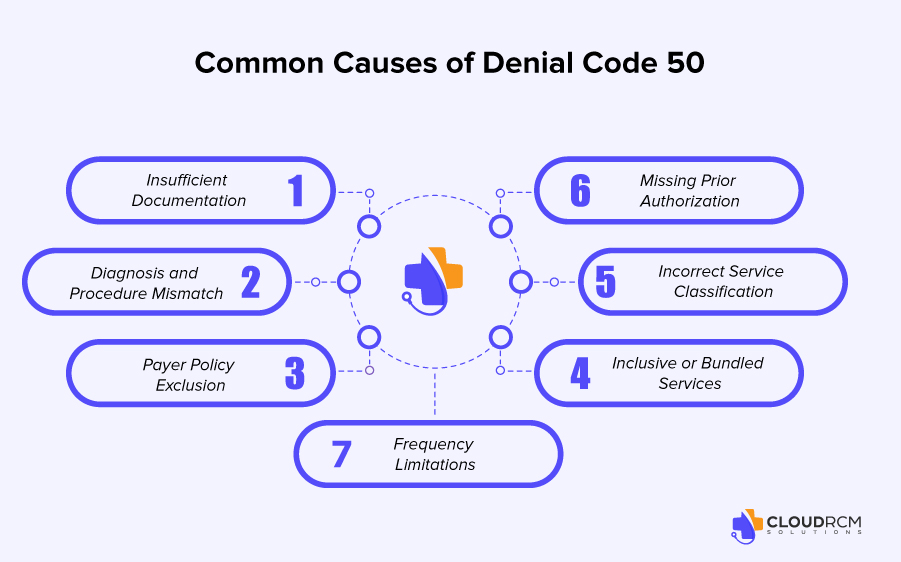
CO-50 adjustments can result from differences between submitted claim information, clinical documentation, and payer coverage requirements. Identifying the underlying issue helps billing teams determine whether a claim requires correction, additional documentation, or an appeal.
1. Insufficient Clinical Documentation
Missing or incomplete clinical documentation may prevent the payer from establishing the medical necessity of a service. Progress notes, diagnostic reports, physician assessments, and treatment plans should support the services billed.
2. Diagnosis and Procedure Mismatch
A diagnosis code that does not support the billed procedure under the payer’s coverage policy may result in a medical necessity denial.
Billing teams should verify that the diagnosis accurately reflects the provider’s clinical documentation and satisfies the applicable coverage criteria. Diagnosis codes should never be changed simply to obtain payment.
3. Payer Policy Exclusions
Some services may be excluded under a patient’s insurance benefits or classified as investigational, experimental, or cosmetic. Providers should confirm coverage requirements before performing services when possible.
4. Frequency Limitations
Insurance companies may restrict how frequently specific procedures, tests, or treatments can be covered. Claims exceeding these limitations may require additional documentation or a review of the applicable coverage policy.
5. Incorrect Service Classification
Incorrectly classifying a service as preventive, diagnostic, or therapeutic can create coverage and reimbursement problems. The billed service must accurately reflect the provider’s documentation and the purpose of the encounter.
6. Missing Prior Authorization
Some services require prior authorization or additional payer approval. Although authorization-related denials may use other adjustment codes, authorization requirements should be reviewed when investigating a medical necessity denial.
7. Services Not Supported by Coverage Criteria
A procedure may be clinically appropriate but still fail to meet a particular payer’s coverage requirements. Providers should distinguish clinical judgment from the payer’s published reimbursement criteria.
5 Steps to Appeal a Denial Code CO-50
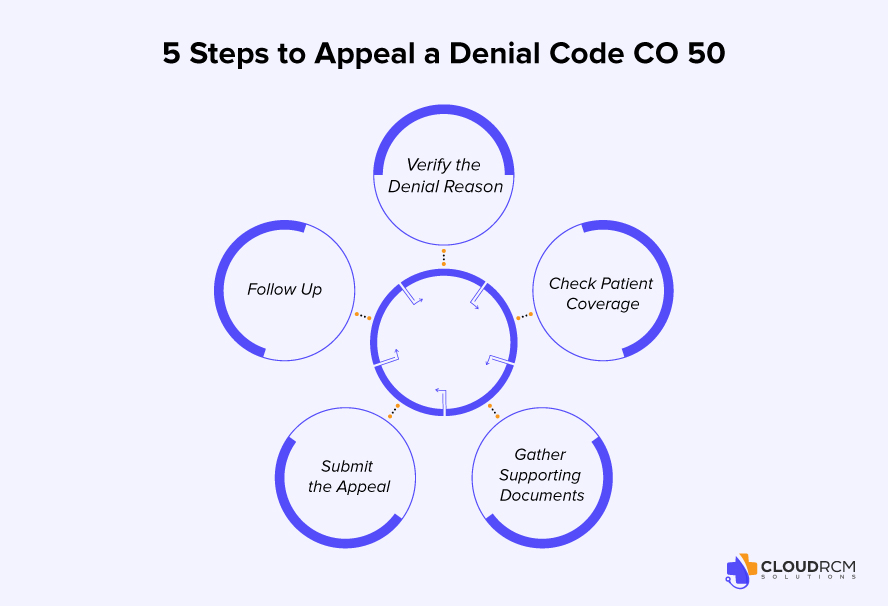
A CO-50 denial does not necessarily mean the claim cannot be reimbursed. When the documentation and coverage policy support the service, providers may have grounds to request reconsideration or submit a formal appeal.
1. Verify the Denial Reason
Review the Explanation of Benefits (EOB) or Electronic Remittance Advice (ERA) to confirm the CARC 50 adjustment and accompanying remark codes.
Check whether the payer cited a specific LCD, NCD, medical policy, or documentation requirement.
2. Review Patient Coverage and Payer Policy
Verify the patient’s eligibility and benefits for the date of service. Review the applicable medical necessity criteria, diagnosis requirements, and frequency limitations.
3. Gather Supporting Documentation
Collect the records needed to support the medical necessity of the service, including:
- Physician progress notes and clinical assessments
- Diagnostic test results and reports
- Treatment plans and medical history
- Referral documents, when applicable
- Prior authorization records, when relevant
4. Submit a Detailed Appeal
Prepare an appeal explaining why the service meets the payer’s coverage requirements. Include the relevant policy references, claim information, clinical documentation, and supporting medical records.
A successful appeal should directly address the reason for the original denial rather than simply request reconsideration.
5. Track the Appeal and Follow Up
Monitor the appeal through the payer portal or by contacting the payer. Record submission dates, reference numbers, deadlines, and status updates.
If the initial appeal is unsuccessful, review the payer’s decision and determine whether another appeal level or review option is available.
How to Avoid Denial Code 50
Preventing medical necessity denials requires a consistent process that connects clinical documentation, coding, authorization, and payer coverage requirements.
Verify Medical Necessity Guidelines
Review applicable payer policies before providing services. For Medicare claims, check the relevant LCD or NCD requirements.
Use Accurate and Specific Diagnosis Codes
Ensure that reported diagnosis codes accurately reflect the patient’s condition and support the service when required by the coverage policy.
Submit Complete Clinical Documentation
Maintain clear physician notes, diagnostic findings, treatment plans, and other records that establish the medical necessity of the service.
Check Prior Authorization Requirements
Verify payer-specific authorization requirements before performing procedures or services that require advance approval.
Monitor Frequency Limitations
Track service frequency and review payer limits to identify potential coverage issues before claim submission.
Understand Payer-Specific Coverage Policies
Maintain updated information about commercial, Medicare, and Medicaid coverage requirements, including exclusions and medical policy changes.
Classify Services Correctly
Ensure that preventive, diagnostic, and therapeutic services are accurately represented in the claim.
Use Medical Necessity Verification Tools
Use payer policy resources, Medicare coverage databases, and appropriate billing tools to identify potential medical necessity issues before submitting claims.
Final thought:
Denial Code CO 50 can be frustrating, but it doesn’t have to disrupt your revenue cycle. By understanding payer-specific medical necessity rules, improving documentation practices, and proactively verifying coverage, providers can minimize denials and strengthen their appeal success rate. The key is to treat each CO 50 denial not as a dead end, but as an opportunity to refine your billing workflow and ensure patients receive the care they need without reimbursement barriers. Stay informed, stay compliant, and stay proactive.
How CloudRCM Helps with CO 50 Denials
CloudRCM is here to help healthcare providers navigate the complexities of CO 50 denials and medical necessity issues. Our experts identify gaps in coding and documentation before submission, helping to prevent denials from the start. If claims are denied, we act quickly with strong appeals, referencing payer-specific guidelines to increase the likelihood of success.
Need help resolving Denial Code 50? Schedule an appointment with our billing experts today and get the support you need to navigate and prevent these denials.
FAQ’s
How to handle CO 50 denial?
Review the payer’s medical necessity criteria, correct any documentation or coding issues, and submit a well-supported appeal with all required records.
What is claim adjustment reason code 50?
Code 50 means the service is not covered because the payer deems it not medically necessary under their policy.
What is occurrence code 50 used for?
Occurrence code 50 indicates the start date of hospice care for billing hospice-related services.
What is a remark code for medical necessity?
Common remark codes like N115 explain that the denial is based on a Local or National Coverage Determination (LCD/NCD) regarding medical necessity.
What is a CO 50 remark code?
A CO 50 denial often pairs with Remark Code N115, meaning the service was denied due to payer policies defining it as not medically necessary.
What should you do if a claim is denied due to medical necessity?
Review the denial, ensure proper documentation and diagnosis coding, and submit an appeal with evidence supporting the medical need for the service.