
 Medical Billing
 Medical Coding
 Medical Audit
 Provider Credentialing
 Denial Management
 A/R Follow-up
 Private Practice
 Patient Help Desk
 Customized Reporting
 Out-of-Network Billing
 Internal Medicine
 Pediatrics
 Radiology
 Surgery
 Emergency Medicine
 Anesthesiology
 Cardiology
 Orthopedic
 Psychiatry
 Dentistry
 OB-GYN
 Family Medicine
Internal medicine practices play a critical role in managing preventive care, chronic conditions, acute illnesses, and long-term patient health. However, behind every patient visit is a complex billing process that determines whether providers receive accurate and timely reimbursement. As payer policies continue to evolve, Internal Medicine Billing Services in Illinois have become increasingly important for practices navigating complex coding requirements, documentation standards, claim regulations, and reimbursement challenges.
Illinois internal medicine providers must manage billing requirements from multiple sources, including Medicare, Illinois Medicaid Managed Care Organizations (MCOs), Medicare Advantage plans, and commercial insurers. Even small errors in coding, documentation, eligibility verification, or claim submission can result in denied claims, delayed payments, and revenue loss.
This guide covers internal medicine billing requirements, Illinois payer rules, Medicare guidelines, and proven strategies to improve coding, reduce denials, and maximize reimbursement.
How Internal Medicine Billing Works in Illinois
Internal medicine billing involves much more than submitting claims after patient visits. These practices generate revenue from a wide range of services, including Evaluation and Management (E/M) visits, annual wellness visits, preventive services, chronic care management (CCM), transitional care management (TCM), remote patient monitoring (RPM), diagnostic testing, and care coordination.
Unlike procedure-based specialties that often rely on fewer high-value services, internal medicine practices typically handle a large volume of routine and complex patient encounters. This creates additional billing challenges because each visit requires accurate documentation, appropriate diagnosis coding, and correct CPT® code selection.
Illinois providers must also stay updated with changing payer requirements. Medicare updates, Medicaid policies, commercial insurance edits, and prior authorization rules can directly affect reimbursement. Without an organized billing workflow, practices may experience increased claim denials, longer payment cycles, and unnecessary administrative burden.
Common Revenue & Billing Challenges for Illinois Internal Medicine Practices
Internal medicine practices manage a high volume of office visits, preventive care, chronic disease management, diagnostic testing, and Medicare-covered services. As payer policies become more complex, maintaining a healthy revenue cycle requires more than accurate coding. According to Experian Health’s 2025 State of Claims report, 54% of healthcare organizations report rising claim denials, while 41% say at least one in every ten claims is denied. For Illinois providers, compliance with Medicare, Illinois Medicaid Managed Care Organizations (MCOs), Medicare Advantage plans, and commercial insurers adds another layer of billing complexity.
1. Evaluation & Management (E/M) Coding Errors
Evaluation & Management (E/M) services generate a significant share of internal medicine revenue. Incorrect code selection, unsupported medical decision-making, or incomplete documentation can lead to underpayments, claim denials, compliance risks, and payer audits.
2. Care Management Documentation
Billing for Chronic Care Management (CCM), Principal Care Management (PCM), Transitional Care Management (TCM), and Remote Patient Monitoring (RPM) requires complete documentation, patient consent, and accurate time tracking. Missing any required element may delay or prevent reimbursement.
3. Insurance Verification & Prior Authorization
Inactive insurance coverage, eligibility errors, and missing prior authorizations remain common causes of preventable claim denials. Verifying benefits and authorization requirements before each visit helps reduce payment delays and unexpected patient balances.
4. Medicare, Illinois Medicaid & Commercial Payer Compliance
Illinois internal medicine practices must comply with Medicare, HealthChoice Illinois Medicaid MCOs, Medicare Advantage plans, and commercial insurers such as BCBSIL, Aetna, Cigna, Humana, and UnitedHealthcare. Each payer has unique documentation standards, authorization rules, coding edits, and reimbursement policies that require continuous monitoring.
5. Claim Denials & Underpayments
Coding errors, missing documentation, medical necessity issues, payer edits, and timely filing mistakes continue to drive claim denials. Practices should also review reimbursements regularly to identify contractual underpayments that often go unnoticed.
4. Provider Credentialing & Enrollment
Expired enrollments, incorrect provider taxonomy, and outdated practice information can delay reimbursements even when claims are submitted correctly. Ongoing credentialing management is essential for uninterrupted revenue.
6. Aging Accounts Receivable (A/R)
Outstanding claims become harder to collect as they age, increasing administrative costs and reducing cash flow. Consistent A/R follow-up, timely appeals, and proactive payer communication help recover revenue before filing deadlines expire.
How to Improve Revenue Cycle Performance for Internal Medicine Practices
Improving financial performance requires a complete revenue cycle approach rather than focusing only on claim submission. Internal medicine practices can strengthen reimbursement by implementing the following strategies:
Improve Coding Accuracy
Regular coding audits help identify incorrect CPT®, ICD-10-CM, and modifier usage. Accurate coding ensures providers receive appropriate reimbursement while maintaining compliance with payer guidelines.
Strengthen Clinical Documentation
Providers should document patient conditions, treatment decisions, and medical necessity clearly. Better documentation supports accurate billing and reduces audit exposure.
Implement Effective Denial Management
Successful denial management involves identifying why claims fail and correcting the underlying problem. Reviewing denial trends allows practices to address recurring issues instead of repeatedly treating the same errors.
Monitor Key Revenue Cycle Metrics
Tracking performance indicators helps identify financial weaknesses. Important internal medicine billing KPIs include:
- Clean claim rate
- Claim denial rate
- Days in Accounts Receivable
- Net collection rate
- First-pass payment rate
- Average reimbursement per visit
Regular monitoring allows practices to make data-driven improvements.
Popular Internal Medicine EHR & Practice Management Software Comparison
Selecting the right Electronic Health Record (EHR) and Practice Management (PM) system can significantly improve documentation quality, coding accuracy, and reimbursement. When comparing platforms, internal medicine practices should evaluate not only clinical functionality but also features that support efficient billing, Medicare compliance, and revenue cycle management.
| Software | Best For | Key Internal Medicine Features | Billing & RCM Capabilities |
| athenahealth | Small to enterprise practices | E/M coding support, preventive care templates, chronic disease management, patient engagement | Eligibility verification, integrated billing, claim scrubbing, ERA posting, reporting |
| eClinicalWorks | Primary care & Internal Medicine | AWV, CCM, RPM, telehealth, population health management | Electronic claims, clearinghouse integration, payment posting, denial management |
| AdvancedMD | Multi-provider practices | Custom templates, telehealth, care coordination, e-prescribing | Integrated billing, coding assistance, financial reporting, eligibility verification |
| NextGen Healthcare | Large physician groups | Specialty workflows, interoperability, value-based care tools | Revenue cycle management, analytics, claims management, payer reporting |
| Tebra (Kareo) | Independent practices | Cloud-based charting, scheduling, patient communication | Billing, insurance verification, electronic claims, payment tracking |
| Practice Fusion | Solo and small practices | Basic charting, e-prescribing, preventive care documentation | Third-party billing integration, electronic claim submission, scheduling |
| DrChrono | Mobile-first practices | Mobile documentation, customizable templates, telehealth | Integrated billing, coding support, claim submission, payment posting |
| Epic | Hospitals & large health systems | Enterprise clinical workflows, interoperability, advanced analytics | Enterprise RCM, coding tools, claim processing, financial analytics |
Every practice has unique technology requirements. Cloud RCM Solutions integrates seamlessly with most major Internal Medicine EHR, Practice Management (PM), and clearinghouse platforms to ensure secure data exchange, accurate charge capture, efficient claims processing, and uninterrupted revenue cycle operations. Our goal is to enhance your existing workflow, not replace it.
Where Internal Medicine Practices Lose Revenue
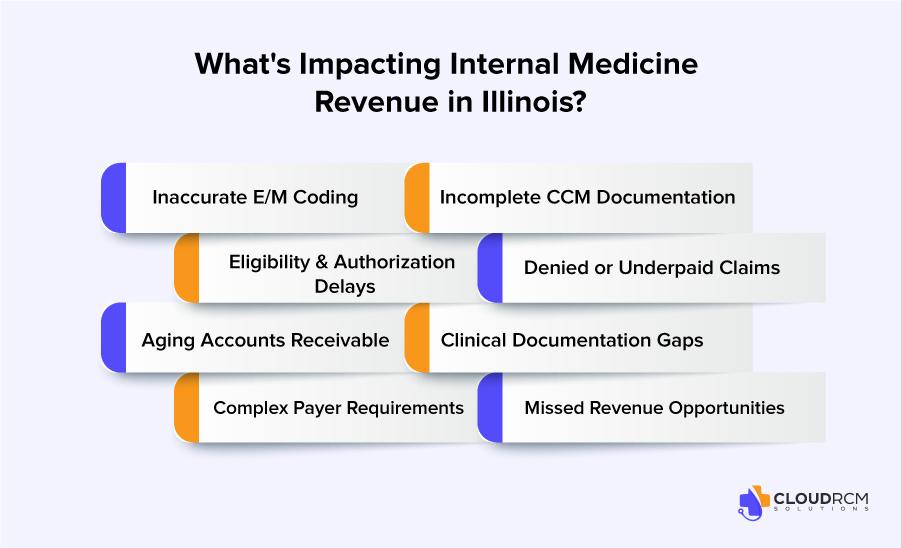
Many Illinois internal medicine practices unknowingly lose thousands of dollars every month through preventable revenue leakage. Most losses occur long before a claim is denied.
A proactive revenue cycle strategy identifies and corrects these issues before they affect cash flow.
| Revenue Leakage Area | Impact on Your Practice | How Cloud RCM Solutions Help |
| Inaccurate E/M Coding | Underpayments, compliance risks, missed revenue | Certified coders validate E/M levels using current documentation guidelines. |
| Documentation Gaps | Claim denials and payer audits | Documentation reviews ensure services meet medical necessity requirements. |
| Missed Charge Capture | Services performed but never billed | Charge reconciliation captures every billable encounter. |
| Eligibility Errors | Immediate claim denials | Insurance verification before every visit reduces eligibility-related rejections. |
| Authorization Issues | Non-payment for covered services | Prior authorization workflows minimize preventable denials. |
| Coding Errors | Rejections and payment delays | Multi-level coding review improves clean claim rates. |
| Insurance Underpayments | Reduced reimbursement | Payment audits identify underpaid claims and recover contractual balances. |
| Aging Accounts Receivable | Slower cash flow | Dedicated A/R follow-up accelerates collections before filing deadlines expire. |
| Unresolved Denials | Permanent revenue loss | Root-cause denial analysis and timely appeals recover eligible reimbursement. |
Internal Medicine Denial Management & Accounts Receivable Recovery
Claim denials remain the largest source of revenue leakage for physician practices. According to MGMA’s 2026 Revenue Cycle Benchmark, 48% of medical practices identify denials and appeals as their biggest financial challenge, while 23% report front-end registration and eligibility errors as the second-largest source of lost revenue. For Illinois internal medicine practices managing high volumes of Evaluation & Management (E/M) visits, chronic care management, preventive services, and Medicare patients, even small workflow gaps can significantly impact reimbursement and cash flow.
An effective denial management strategy goes beyond appealing rejected claims. It focuses on identifying root causes, correcting workflow issues, recovering underpayments, and monitoring A/R performance to prevent recurring revenue loss.
Internal Medicine Denial Recovery Process
Effective denial management requires more than appealing rejected claims. Illinois internal medicine practices need a proactive approach to identify denial causes, recover lost revenue, and prevent recurring billing issues.
- Denial Analysis & Appeals: Reviewing denial trends helps identify coding errors, documentation gaps, eligibility issues, and payer-specific problems. Accurate appeals with supporting documentation improve reimbursement recovery.
- A/R Follow-Up: Regular monitoring of unpaid claims helps recover outstanding payments, reduce aging accounts receivable, and improve cash flow.
- Claim & Underpayment Review: Tracking delayed claims and comparing payments against payer contracts helps identify missed reimbursements and resolve payment discrepancies.
- Timely Filing & Payment Monitoring: Managing payer deadlines and analyzing payment patterns prevents avoidable revenue loss and improves billing performance.
A strong denial recovery strategy allows internal medicine practices to reduce claim failures, improve first-pass payments, and maintain a healthier revenue cycle. By addressing the root causes of denials, practices can achieve more consistent reimbursement and long-term financial stability.
Partner with an Illinois-Based Internal Medicine Billing Team
Rising claim denials, complex payer rules, and evolving Medicare requirements can impact your practice’s revenue and cash flow. Cloud RCM Solutions provides Illinois Internal Medicine Billing Services that improve coding accuracy, reduce denials, streamline claims, and optimize your entire revenue cycle.
Schedule a free billing assessment today and discover how our Illinois-based billing experts can help your practice increase collections, accelerate reimbursements, and focus more on patient care.
FAQ’s
How do Illinois Medicaid MCOs affect internal medicine billing?
Illinois Medicaid Managed Care Organizations (MCOs) such as CountyCare, Molina, Meridian, and Aetna Better Health each maintain unique authorization rules, billing edits, and reimbursement policies. Claims must be submitted according to the specific MCO’s requirements.
How can I reduce claim denials in my practice?
Denial prevention requires: Eligibility verification before visits Accurate coding Claim scrubbing Prior authorization tracking Documentation audits Denial trend analysis Timely appeals
Which Illinois Medicaid MCOs create the most billing complexity?
Practices commonly need to manage payer-specific requirements for plans such as: Blue Cross Community Health Plans Meridian Health Plan Molina Healthcare Aetna Better Health of Illinois CountyCare YouthCare Meridian Complete
Can the same service require authorization for one MCO but not another?
Yes. That is one of the most common Illinois billing challenges. Authorization requirements can vary by MCO, Medicare Advantage plan, and commercial payer.
How do you reduce aging accounts receivable?
We prioritize older balances, follow up with payers consistently, investigate pending claims, recover underpayments, and submit appeals before filing deadlines expire.