
 Medical Billing
 Medical Coding
 Medical Audit
 Provider Credentialing
 Denial Management
 A/R Follow-up
 Private Practice
 Patient Help Desk
 Customized Reporting
 Out-of-Network Billing
 Internal Medicine
 Pediatrics
 Radiology
 Surgery
 Emergency Medicine
 Anesthesiology
 Cardiology
 Orthopedic
 Psychiatry
 Dentistry
 OB-GYN
 Family Medicine
Missed charges, coding errors, authorization issues, and payer-specific requirements can reduce revenue for cardiology practices without being immediately visible. Cardiology Billing Services in Illinois help cardiologists, cardiovascular groups, electrophysiology practices, diagnostic centers, and other cardiac providers manage complex coding, claims, payment, denial, and A/R workflows.
This guide explains the major billing considerations for cardiologists, cardiovascular groups, electrophysiology practices, diagnostic facilities, and other cardiac providers in Illinois.
How Cardiology Billing Works in Illinois
Cardiology billing spans E/M visits, ECGs, echocardiography, cardiac monitoring, stress testing, catheterization, PCI, electrophysiology, structural heart procedures, and cardiac imaging. Because these services may be performed across offices, hospitals, outpatient departments, and specialty labs, billing requirements can vary by procedure, setting, payer, and provider role.
Accurate reimbursement depends on matching the CPT®, ICD-10-CM, modifiers, documentation, medical necessity, place of service, and authorization requirements to the service actually performed. A specialty-focused billing workflow helps capture charges correctly, prevent avoidable claim issues, and support timely payment.
Illinois Payer Requirements for Cardiology Practices
Illinois cardiology billing involves Medicare, Illinois Medicaid, HealthChoice Illinois managed-care organizations, and commercial insurers. Each payer may have different eligibility, authorization, medical necessity, claim-submission, and reimbursement requirements.
- Medicare: Illinois falls under MAC Jurisdiction 6, so practices should follow current CMS and MAC guidance for Part A and Part B claims.
- Medicaid: HealthChoice Illinois plans may have specific eligibility and claim-submission requirements, including member information and coverage dates.
- Commercial Payers: Authorization, network, medical necessity, and reimbursement policies vary by plan. Verify payer-specific requirements before submitting every claim.
Common Cardiology Billing Challenges in 2026
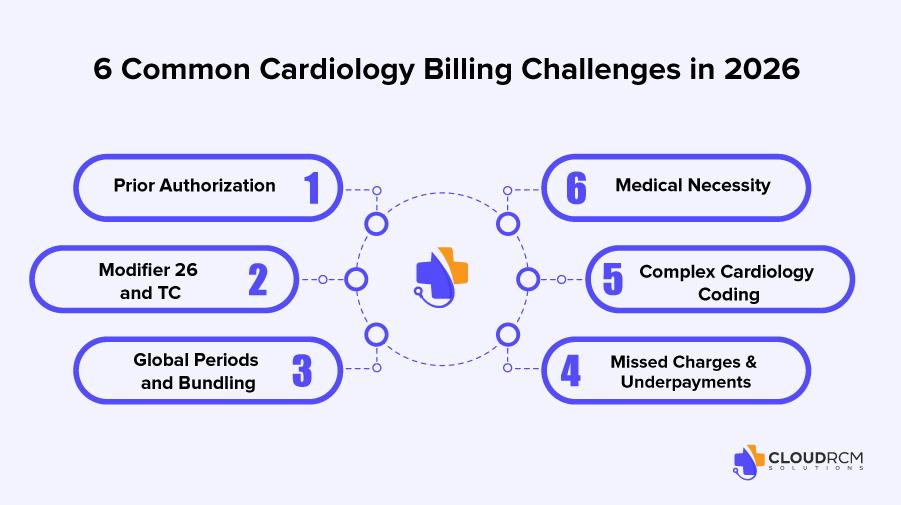
1. Prior Authorization
Advanced cardiac imaging, diagnostic testing, and certain cardiovascular procedures may require prior authorization. Missing, expired, or mismatched authorization can result in denials or payment delays.
Authorization workflows should confirm that the approved service, diagnosis, provider, location, and date of service correspond with the procedure actually performed.
2. Modifier 26 & TC
Diagnostic services may involve professional and technical components. Modifier 26 generally identifies the professional component, while TC identifies the technical component when applicable.
The correct reporting depends on the service, provider role, setting, and payer requirements. Incorrect component billing can lead to rejections or incorrect reimbursement.
3. Global Periods & Bundling
Cardiology procedures may involve global surgical-period rules and coding edits. Billing teams should determine whether a subsequent service is separately reportable and whether applicable modifier and documentation requirements are satisfied.
4. Medical Necessity
Cardiac imaging, diagnostic testing, invasive procedures, and other services require documentation that supports the diagnosis, clinical indication, and medical necessity under the applicable payer policy.
5. Complex Cardiology Coding
Interventional cardiology and electrophysiology procedures often require detailed documentation. Coders must understand the procedure performed, approach, components, clinical indication, and applicable coding rules.
6. Missed Charges & Underpayments
Revenue leakage can occur when a service is performed but never reaches the billing system. It can also occur when a payer processes a claim but reimburses less than the expected contractual amount.
Charge reconciliation and payment variance analysis can identify both missed revenue and recurring underpayments.
How to Improve Cardiology Revenue Cycle Performance
A strong cardiology revenue cycle begins before the patient encounter and continues through final payment.
Improve Coding & Documentation
Regular coding audits should review CPT®, HCPCS, ICD-10-CM, modifiers, units, place of service, global-period services, and professional or technical components.
Clinical documentation should support:
- Diagnosis and clinical indication
- Medical necessity
- Procedure performed
- Relevant findings
- Provider participation
- Treatment and follow-up
Complete documentation helps coders select appropriate codes and provides support when claims are reviewed or appealed.
Verify Eligibility & Authorization
Before treatment, billing teams should verify:
- Active insurance coverage
- Specialist benefits
- Network status
- Referral requirements
- Prior authorization
- Deductibles and copayments
- Patient responsibility
Resolving eligibility and authorization problems before the service is generally more effective than correcting them after a denial.
Strengthen Charge Capture
Cardiology practices can reduce revenue leakage by reconciling:
Schedule → Clinical Documentation → Procedure Report → Charge → Claim
This workflow helps identify services that were performed but not captured correctly for billing.
Monitor Key Revenue Cycle Metrics
Important cardiology billing KPIs include:
- Clean claim rate
- First-pass acceptance rate
- Denial rate
- Days in A/R
- A/R over 90 days
- Net collection rate
- Underpayment rate
- Denial recovery rate
- Charge lag
- Payment turnaround time
Reviewing these metrics by payer, provider, location, and service type can reveal recurring problems.
Common Cardiology EHR & Practice Management Software
| Software | Best For | Billing & RCM Capabilities |
| athenahealth | Independent and larger practices | Eligibility, claims, payments, reporting |
| eClinicalWorks | Physician groups | Claims, eligibility, billing, reporting |
| AdvancedMD | Multi-provider practices | Billing, claims, payments, financial reporting |
| NextGen Healthcare | Larger medical groups | RCM, claims management, analytics |
| Epic | Hospitals and health systems | Enterprise RCM, coding, claims and financial workflows |
| Tebra | Independent practices | Billing, claims, payments and eligibility |
| DrChrono | Smaller and mobile practices | Claims, billing and payment posting |
CloudRCM Solutions can work with major EHR, practice-management, and clearinghouse environments to support charge capture, coding, claim submission, payment posting, denial management, and A/R follow-up without requiring practices to replace their existing technology.
Cardiology Denial Management & A/R Recovery
Cardiology claims may be denied due to coding errors, authorization, eligibility, documentation, medical necessity, bundling edits, timely filing, or payer-specific rules. Delayed follow-up can quickly increase A/R and slow cash flow.
Effective denial management requires identifying the denial reason, correcting the underlying issue, and submitting a corrected claim or appeal when appropriate. A strong cardiology A/R recovery strategy prioritizes high-value, aging, and deadline-sensitive claims while tracking each balance to resolution.
Reviewing denials by payer, procedure, provider, and reason also helps practices identify recurring issues, prevent repeat denials, and improve reimbursement.
2026 Illinois Cardiology Billing Considerations
Illinois cardiology practices should monitor CMS, Illinois HFS, payer policies, and annual coding updates to stay compliant.
For 2026, accurate Medicaid member identification, date of birth, and eligibility dates are important for HealthChoice Illinois managed-care claims. Practices participating in MIPS should also track current CMS reporting requirements for the 2026 performance year.
Always verify the latest payer and coding requirements before submitting claims.
Partner With an Illinois-Based Cardiology Billing Team
Every missed charge, denial, or authorization issue can cost a cardiology practice revenue. CloudRCM Solutions provides Cardiology Medical Billing Services in Illinois with specialty-focused coding, claims, eligibility, denials, and A/R management.
Schedule a free billing assessment to uncover missed revenue, aging A/R, and recurring denial problems.
FAQ’s
How do modifier 26 and TC affect cardiology billing?
Modifier 26 generally identifies the professional component of certain services, while TC identifies the technical component when applicable. Correct reporting depends on the service, setting, payer rules, and whether the provider performed the professional or technical portion.
Can CloudRCM Solutions handle Medicare cardiology billing in Illinois?
Yes. CloudRCM Solutions supports Medicare cardiology billing workflows including coding, claim submission, payment posting, denial management, and A/R follow-up. Claims should be processed according to current CMS and applicable Illinois J6 requirements.
Do you provide cardiology billing services throughout Illinois?
Yes. CloudRCM Solutions supports cardiology and other healthcare providers across Illinois, including practices in Chicago, Aurora, Naperville, Rockford, Joliet, Springfield, Peoria, Elgin, Waukegan, Champaign, and surrounding communities.