
 Medical Billing
 Medical Coding
 Medical Audit
 Provider Credentialing
 Denial Management
 A/R Follow-up
 Private Practice
 Patient Help Desk
 Customized Reporting
 Out-of-Network Billing
 Internal Medicine
 Pediatrics
 Radiology
 Surgery
 Emergency Medicine
 Anesthesiology
 Cardiology
 Orthopedic
 Psychiatry
 Dentistry
 OB-GYN
 Family Medicine
Rheumatology is a specialty that deals with complex, often chronic, autoimmune diseases and musculoskeletal disorders. With over 10 million people in the U.S. affected by these conditions, rheumatology billing has become increasingly complex. Providers must manage multiple types of services, including office visits, imaging, biologics, joint injections, and physical therapy, all requiring unique coding, documentation, and payer-specific rules. In 2026, the challenge lies in staying up to date with new regulations, payer rules, and coding changes while optimizing revenue and minimizing denials.
This guide will help you navigate the changes in rheumatology billing and provide actionable steps to ensure your practice stays compliant and financially healthy in 2026.
Why Rheumatology Billing Has Become More Complex
The complexity of rheumatology billing does not stem solely from volume. It stems from financial concentration.
A significant portion of revenue is tied to high-cost biologics administered under buy-and-bill arrangements. These drugs can cost thousands of dollars per dose. A single documentation or coding misalignment can result in denied reimbursement, directly impacting cash flow.
In 2026, complexity is driven by several intersecting pressures:
- Medicare Part B drug reimbursement adjustments are tied to ASP calculations
- Increased scrutiny of J-code units and NDC reporting
- White bagging expansion among commercial insurers
- Strict enforcement of incident-to billing requirements
- NCCI bundling edits impacting injections and imaging
- Telehealth coding oversight
- MIPS performance-linked reimbursement adjustments
Rheumatology practices must now operate with the precision of infusion centers while maintaining compliance across multiple payer types.
2026 Regulatory Updates and Their Impact on Rheumatology Billing
CMS Updates
The 2026 CMS Physician Fee Schedule introduces:
- Conversion factor: $32.36 (a slight decrease from 2025)
- RVU adjustments for high-volume musculoskeletal services
- Documentation guidelines for infusion therapies and biologics
- Telemedicine coding updates for virtual rheumatology consultations
Commercial Payer Tightening
Private insurers are requiring more thorough documentation and medical necessity reviews, particularly for imaging and biologic treatments. Practices must be prepared for increased prior authorization requests.
Workers’ Compensation Changes
New regulations for workers’ compensation claims include enhanced verification processes and pre-authorizations for high-cost procedures. Ensure compliance with updated therapy documentation and post-surgical care requirements.
Core Components of Rheumatology Billing
E/M Coding (Evaluation & Management)
E/M codes (e.g., 99202–99215) are used for office visits. It’s essential to document:
- Medical decision-making (MDM) or time-based E/M
- Tests ordered and their results
- Justification for same-day procedures using modifier 25
Injection and Procedure Coding
For procedures like joint injections or biologics administration:
- Use correct CPT codes (e.g., 20610 for joint injections)
- Properly document laterality, approach, and technique
- Apply modifiers like -59 for distinct services
Imaging and Diagnostics
Ensure that:
- Medical necessity is documented for X-rays, MRIs, and other imaging services
- Correct POS and CPT/HCPCS codes are used
- Document prior conservative care when required
Therapy and Rehabilitation Coding
Therapy services require:
- Measurable goals, progress documentation, and compliance with 2026 Medicare therapy rules
- Timed codes for physical therapy and occupational therapy should be accurately tracked
Durable Medical Equipment (DME) Billing
For DME such as braces and orthotics, ensure:
- Medical necessity documentation
- HCPCS codes (e.g., L codes) and prior authorization are included
- Use the correct modifier NU for new equipment
Most Common Denials in Rheumatology Billing
- Incorrect Modifiers (e.g., -25, -59)
- Failure to meet medical necessity requirements for imaging/procedures
- Prior authorization issues
- Missing or incorrect charges (e.g., for biologics or DME)
- Split billing errors (professional vs. technical components)
Revenue Loss Areas & Root-Cause Analysis
| Problem | Impact | Solution |
| Incorrect CPT/ICD Pairing | Claims rejected or underpaid | Audit-ready coding workflow |
| Missing Modifiers | Denied E/M + procedures | Modifier training & auto-checks |
| Weak Therapy Documentation | Denied therapy sessions | Use structured templates |
| DME Billing Issues | Claim rejection or downcoding | Verify orders, codes, and authorization |
| Missed Charges | Lost revenue | Integrate charge capture with EHR |
| Slow Follow-Up | Lost revenue due to timely filing limits | Dedicated AR follow-up system |
Most Common Billing Errors and How to Avoid Them in 2026
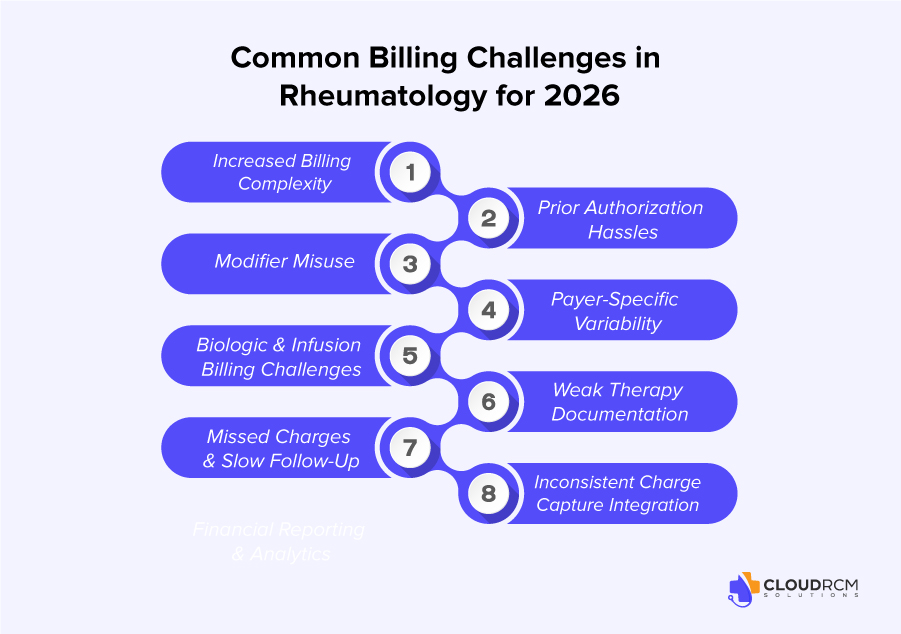
While the complexity of rheumatology billing is necessary for proper reimbursement, it also leads to common errors. Some of the most frequent issues include:
Incorrect Coding for E/M Visits
Ensure that your documentation supports the level of service being billed. Many rheumatology practices use level 4 or 5 codes for complex patients, but the documentation must reflect sufficient detail in history, exam, and medical decision-making.
| Category | Code | Description / Use Case |
|---|---|---|
| Evaluation & Management (E/M) | 99203–99205 | New patient office visits (dependent on complexity) |
| 99213–99215 | Established patient office visits; 99214–99215 commonly used for complex patients | |
| G2211 | HCPCS add-on code for visit complexity/intensity | |
| 99417 | Prolonged services (15+ minutes beyond standard time) | |
| Procedures & Injections | 20610 | Major joint injection/aspiration (knee, shoulder) |
| 20605 | Intermediate joint injection | |
| 20600 | Small joint injection | |
| 20550–20553 | Trigger point or tendon injections | |
| 76942 | Ultrasound guidance for needle placement | |
| Infusion & Therapeutic Injection | 96365 | Initial IV infusion (first hour) |
| 96366 | Each additional infusion hour | |
| 96372 | Therapeutic injections (SubQ/IM) | |
| 96401 | Chemotherapy/biologic therapeutic drug injection | |
| J0129 | Orencia (abatacept) – biologic drug HCPCS code | |
| J1602 | Simponi Aria (golimumab) – biologic drug HCPCS code | |
| J1745 | Remicade (infliximab) – biologic drug HCPCS code | |
| ICD-10 Diagnostic Codes | M05.79 | Rheumatoid arthritis with multiple sites |
| M06.9 | Rheumatoid arthritis, unspecified | |
| M32.9 | Systemic lupus erythematosus (SLE), unspecified | |
| M17.0 | Bilateral knee osteoarthritis | |
| M16.0 | Bilateral hip osteoarthritis | |
| M79.0 | Rheumatism, unspecified | |
| M79.1 | Myalgia | |
| Modifiers | 25 | Significant, separately identifiable E/M service on same day as procedure |
| 50 | Bilateral procedure (e.g., both knees) | |
| LT / RT | Left side / Right side | |
| JZ / JW | Drug waste documentation for biologics |
Denied Claims for Biologics
Biologic drugs are often subject to more scrutiny by insurers. Ensure you use the correct HCPCS codes and document the patient’s medical necessity, response to previous treatments, and failure of less expensive drugs.
Telehealth Coding Errors
Telemedicine for rheumatology is growing, but telehealth visits must be coded correctly to avoid denials. Remember to use the appropriate modifiers (e.g., -95) and document the type of communication clearly (audio-only vs. video).
Missed Modifier Usage
Modifiers like -25 (separate identifiable service on the same day) or -59 (distinct procedural service) are often misused or omitted. Ensure these are applied appropriately to prevent denials.
Best Practices for Rheumatology Billing in 2026
Effective rheumatology billing in 2026 requires a combination of precise documentation, accurate coding, proactive authorization management, and timely claim follow-up. Establishing structured workflows ensures that claims are submitted correctly, denials are minimized, and revenue is maximized.
Authorization Workflow
Before any high-cost service, it is critical to confirm coverage and obtain prior authorization. This includes MRI scans, ultrasounds, joint injections, durable medical equipment (DME), and therapy sessions. Pre-checks help prevent delays and claim denials, ensuring that patient care is not interrupted.
Ensure pre-checks for:
- MRIs
- Ultrasounds
- Injections
- DME (Durable Medical Equipment)
- Therapy sessions
Documentation Standards
Accurate documentation is the backbone of compliance and revenue optimization. For therapy services, ensure that time, measurable goals, progress notes, and functional scores are consistently recorded. Procedure documentation should include laterality, site, technique, and any relevant imaging. For DME, document orders, diagnosis codes, and clinical notes to justify medical necessity.
- Therapy: Document time, goals, progress, and functional scores
- Procedures: Record laterality, site, findings, and imaging
- DME: Document orders, diagnosis, and clinical notes
Modifier Accuracy
Modifiers are frequently overlooked but are essential for correct claim adjudication. Use modifier -25 when an E/M service occurs on the same day as a procedure. Laterality should be reported with RT/LT modifiers. Modifier -59 should be applied for distinct procedural services, while 76/77 indicate repeat services. Proper use of modifiers reduces denials and ensures correct reimbursement.
- 25 for E/M and procedure on the same day
- RT/LT for laterality
- 59 for distinct services
- 76/77 for repeat services
Therapy Compliance Audits
Regular auditing of therapy documentation prevents denials and ensures compliance with Medicare and payer requirements. Monthly therapy audits should verify that time is accurately captured and that progress toward goals is documented. Structured audits reduce the risk of claim rejections and support long-term revenue integrity.
- Monthly therapy audits to prevent denials
- Capture therapy time accurately
- Document progress towards goals
Charge Capture Protocols
All supplies used during patient care, such as braces, slings, or boots, must be tied directly to patient encounters in the EHR. Claims should be submitted within 24-48 hours of service, and any denials should be followed up promptly within 7-14 days. Efficient charge capture ensures timely reimbursement, reduces lost revenue, and improves cash flow.
- Track all supplies like braces, slings, and boots
- Tie charges to encounters in EHR
- Submit claims within 24-48 hours
- Follow up on denials within 7-14 days
How Cloud RCM Solutions Can Support Your Rheumatology Practice in 2026
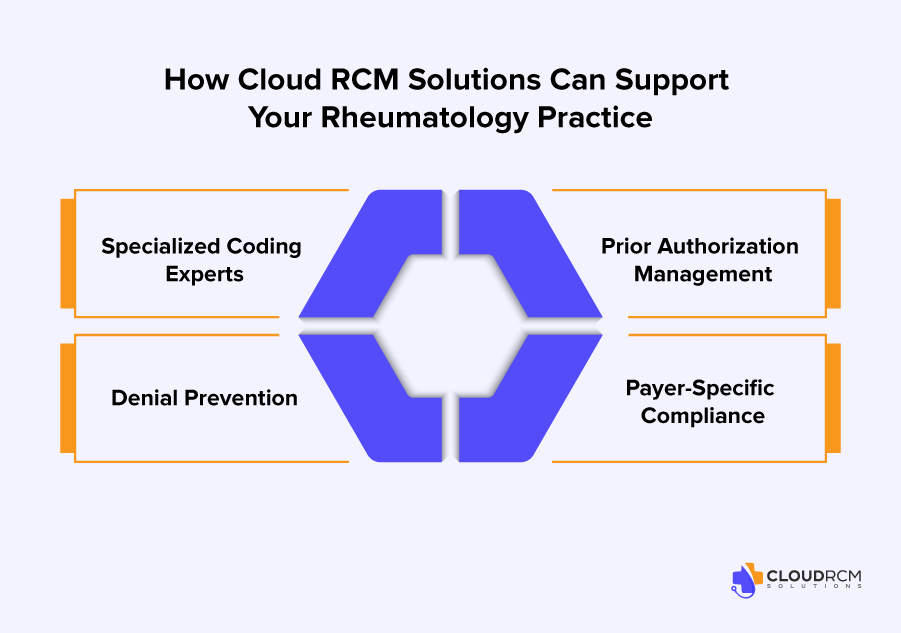
In 2026, successful rheumatology practices require more than a traditional billing team. Cloud RCM Solutions provides a strategic revenue cycle partnership that combines specialty coding expertise, payer compliance tracking, denial prevention, and real-time analytics.
Our coders specialize in E/M services, biologic therapy, joint injections, and imaging, ensuring that claims are accurate and documentation aligns with payer requirements. We track changes across Medicare, commercial insurance, and workers’ compensation to reduce claim rejections and maintain compliance. Pre-submission checks, proactive denial prevention, and structured appeal processes protect your revenue from common pitfalls. Real-time dashboards allow practice leaders to monitor denial trends, AR days, payer mix, and missing charges, giving complete visibility into financial performance.
By integrating specialized coding, payer rule expertise, and data-driven revenue monitoring, Cloud RCM Solutions helps rheumatology practices protect margins, accelerate reimbursement, and maintain audit readiness. Practices can focus on patient care while knowing their revenue cycle is strategically managed.
Conclusion
Rheumatology billing and coding in 2026 will require heightened attention to detail due to the increasing complexity of payer rules, new regulatory updates, and advanced treatments. By ensuring that your practice stays compliant, uses the correct codes, and follows proper documentation practices, you can optimize revenue and reduce denials.
Cloud RCM Solutions provides the tools, expertise, and support needed to manage your rheumatology practice’s revenue cycle effectively. We help you stay ahead of payer requirements, improve financial health, and streamline your billing processes.
FAQ’s
What are the most common billing issues in rheumatology?
Common billing errors include incorrect modifiers, missed documentation for biologics, and failure to obtain prior authorization for expensive treatments.
How does telemedicine affect rheumatology billing in 2026?
Telemedicine billing in 2026 requires the use of specific modifiers like -95 and must be documented correctly according to payer requirements for virtual consultations.
What updates should rheumatology practices expect from CMS in 2026?
CMS updates in 2026 focus on telemedicine coding, adjustments to musculoskeletal RVUs, and documentation standards for infusions and therapy.
How can Cloud RCM Solutions assist with rheumatology billing?
Cloud RCM Solutions offers specialized coders, denial management, real-time analytics, and payer-specific compliance tracking, ensuring optimal revenue for your rheumatology practice.
What’s the best way to prevent denials in rheumatology billing?
Preventing denials involves accurate coding, timely pre-authorization, and comprehensive documentation. Regular billing audits and modifier accuracy checks also help.