Medical Billing
 Medical Coding
 Medical Audit
 Provider Credentialing
 Denial Management
 A/R Follow-up
 Private Practice
 Patient Help Desk
 Customized Reporting
 Out-of-Network Billing
 Internal Medicine
 Pediatrics
 Radiology
 Surgery
 Emergency Medicine
 Anesthesiology
 Cardiology
 Orthopedic
 Psychiatry
 Dentistry
 OB-GYN
 Family Medicine
When it comes to billing and coding, Otolaryngology (ENT) is one of the most complex and essential aspects of medical revenue cycle management. The field covers everything from routine ear and sinus care to high-stakes surgeries like head and neck cancer treatments, airway procedures, and reconstructive surgeries. With such diversity, precision is a must in both coding and documentation to ensure reimbursements are accurate and your practice avoids costly errors.
In this comprehensive 2026 guide, we break down why Otolaryngology billing is uniquely complex, common claim pitfalls, payer‑specific issues, 2026 updates, and exact strategies to improve reimbursement. If your practice wants to optimize revenue and reduce denials, you need a specialized approach and this guide delivers it.
1. What Is Otolaryngology (ENT) Billing?
Otolaryngology medical billing is the process by which healthcare providers assign procedure and diagnosis codes, prepare claims, manage submissions, and follow up on reimbursement for services related to the ear, nose, throat, and related head and neck structures.
This specialty includes:
- Routine office visits and diagnostic exams
- Nasal endoscopy and sinus procedures
- Tonsillectomy and adenoidectomy
- Sleep apnea diagnosis and airway management
- Cochlear implant and hearing procedures
- Facial trauma and reconstructive operations
- Head and neck cancer surgeries
Every service must be accurately coded with appropriate CPT (Current Procedural Terminology) and ICD‑10 (International Classification of Diseases) codes and submitted in a way that aligns with payer rules.
2. Why Accurate Otolaryngology Billing is Non-Negotiable
Otolaryngology services are anything but ordinary. From simple consultations for ear infections to complex surgeries, each service demands its own billing strategy. The diversity in these services means one-size-fits-all billing doesn’t work, precision and customization are key.
Get Coding Right, Get Paid Right. Correct coding is the backbone of revenue optimization. It’s not just about choosing the right CPT or ICD-10 codes; it’s about understanding the nuances of global surgical periods, applying modifiers correctly, and adhering to payer-specific rules. Errors here can cost you not only in reimbursement but also in time and energy spent chasing down denials.
3. Why ENT Billing Is Complex and High-Risk
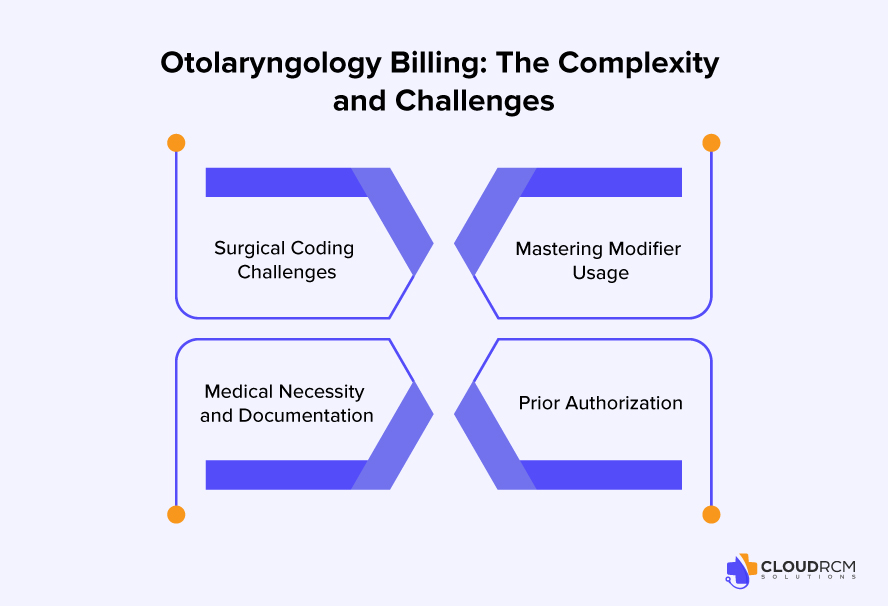
When it comes to Otolaryngology billing, the stakes are high, and the processes are layered. With a range of services, especially high-value surgical procedures, understanding the nuances of coding is critical. Let’s break down the main challenges your practice faces:
- Surgical Coding Challenges
ENT surgical procedures often involve multiple steps and multi-disciplinary care, each requiring accurate coding and documentation. For example, facial reconstructive surgery may include debridement, flap reconstruction, and grafting all of which must be coded appropriately to ensure proper reimbursement. Our team monitors global surgical periods closely to ensure post-operative care is billed correctly and separately billable services are captured with the correct modifiers. By managing these details proactively, we prevent revenue loss from mis-coded or incomplete claims.
- Mastering Modifier Usage
Modifiers like -25, -59, and laterality modifiers (RT/LT) are essential in Otolaryngology billing, especially when multiple procedures are performed on the same day. A small mistake can lead to claim denials or payment delays.
- Medical Necessity and Documentation
Because many Otolaryngology services are high-cost, payers scrutinize them closely. Detailed preoperative, operative, and postoperative notes are necessary to support the claim and justify medical necessity. Without this, claims are more likely to be denied or audited.
- Prior Authorization: A Must for Complex Procedures
Surgical procedures and diagnostic tests often require prior authorization. Failure to secure approval before performing the service can delay treatment or reimbursement, impacting both your practice’s bottom line and your patient care.
4. Revenue Risks of Incorrect ENT Coding
Common revenue leak points include:
- Modifier errors → claim denials
- Global period mismanagement → lost post-op revenue
- Documentation gaps → payer audits
- Prior authorization failures → delayed procedures
- Incorrect diagnosis or CPT codes → rejected claims
12–15% of ENT surgical claims are denied on first submission, costing practices 10–15% of potential annual revenue.
5. Core ENT CPT & ICD-10 Coding Essentials
Accurate coding begins with knowing the right codes and how they interact with payer rules.
5.1 Common ENT CPT Codes (2026)
Procedure CPT Code Notes Nasal Endoscopy 31231, 31237 Apply RT/LT laterality modifiers Septoplasty 30520 Use -50 for bilateral procedures Tonsillectomy 42820 Include medical necessity documentation Sinus Surgery 31256, 31267 Document scope and complexity Cochlear Implant 69930 Confirm preoperative functional hearing loss Laryngoscopy 31575 Scope use must be documented Sleep Apnea Procedures 42145 Prior authorization usually required 5.2 ICD-10 Codes
ENT billing often requires granular diagnosis coding — for example:
- J32.9 – Chronic sinusitis, unspecified
- H90.3 – Sensorineural hearing loss
- R09.3 – Abnormal sputum
- R49.0 – Dysphonia
Correct diagnosis selection establishes medical necessity, which is critical for payer approval.
6. Modifier for ENT Billing
Modifiers tell payers why two procedures on the same day are separate services or how global periods affect claims.
Modifier Purpose -25 Significant, separately identifiable E/M service -50 Bilateral procedure -RT / -LT Right / left laterality -59 Distinct procedural service -24 Unrelated E/M service during global period -78 / -79 Return to OR rules Incorrect modifier use is one of the top reasons ENT practices see denial increases year over year.
7. Documentation & Medical Necessity
Medical necessity documentation must justify every service:
- Detailed history and examination notes
- Diagnostic test findings
- Rationale for procedure
- Results of prior conservative management
- Follow‑up and post‑operative notes (if applicable)
Without clear documentation, payers will often deny reimbursement especially for high‑cost surgeries.
Best practice: Document why the procedure was medically necessary not just what was done.
8. Prior Authorization Requirements for ENT
Many ENT procedures require prior authorization before service delivery:
- Sleep apnea surgeries (e.g., uvulopalatopharyngoplasty)
- Balloon sinuplasty
- Cochlear implant procedures
- Allergy testing and immunotherapy
Failing to secure prior authorization can result in:
- Denied reimbursement
- Patient balance liability
- Treatment delays
Tip: Maintain a tracking system for authorization expiry dates and follow‑up.
9. 2026 Billing & Compliance Updates (Medicare & Payers)
Healthcare reimbursement rules change frequently. Key updates in 2026 include:
Medicare Fee Schedule Adjustments
- Increased scrutiny on global period services
- More stringent medical necessity requirements
- Revised payment weights on select ENT procedures
Commercial Payer Changes
- Expanded use of pre‑pay edits for sinus and sleep apnea procedures
- Modifier‑specific audit programs
- Increased denials for documentation gaps
State‑Level Reimbursement Shifts
Different states have unique rules that affect ENT billing workflows. For example:
- California: Stricter documentation requirements for sleep apnea procedures mean Otolaryngology practices risk delayed reimbursements if they don’t submit comprehensive preoperative reports.
- New York: Increased audits on Otolaryngology claims related to sinus surgeries have led to more frequent denials, especially for claims submitted with modifiers -59 or -25. Documentation of modifier use is now more critical than ever.
- Texas: Expanded telehealth ENT reimbursement codes continue to evolve.
According to recent reports, 12% of Otolaryngology claims are denied on first submission. A large portion of these denials happen due to incomplete documentation or incorrect modifier usage. The American Academy of Otolaryngology estimates that 15% of potential revenue is lost annually due to these issues.
How Cloud RCM Solutions Supports Otolaryngology Practices
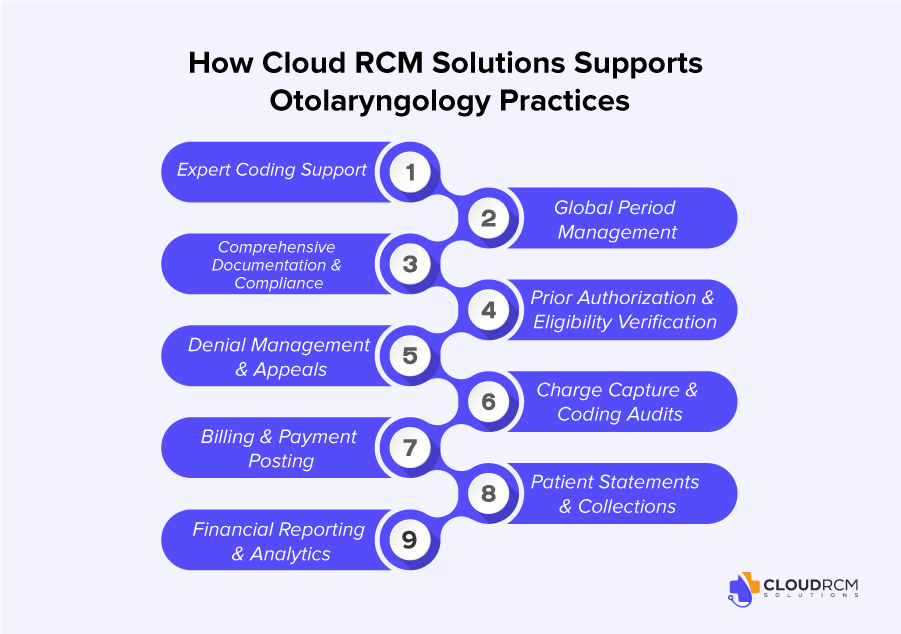
Did you know that ENT practices lose up to 15% of potential revenue each year due to coding errors, missed modifiers, and denied claims? At Cloud RCM Solutions, we specialize in Otolaryngology billing, providing end-to-end revenue cycle management that ensures every procedure is coded accurately, claims are approved, and reimbursements are maximized. From expert coding and documentation to prior authorization, denial management, and patient billing, we handle the complexities so your practice can focus on patient care while we safeguard your revenue and optimize cash flow.
Ready to streamline your Otolaryngology billing? Contact Cloud RCM Solutions today to optimize your revenue cycle and ensure accurate, on-time payments. Schedule a free consultation now!
FAQ’s
What makes Otolaryngology billing more complex than other medical specialties?
Otolaryngology billing is more complex because it spans a wide range of services from routine office visits to high-value surgical procedures such as head and neck cancer treatment, airway reconstruction, and facial surgery. These services involve advanced CPT coding, global surgical periods, extensive documentation, and strict payer scrutiny. Even minor errors in coding or documentation can lead to denials, underpayments, or audits, making specialized billing expertise essential.
Is there a difference between ENT billing and Otolaryngology billing?
Yes, while ENT and Otolaryngology refer to the same specialty clinically, their billing complexity differs significantly. General ENT billing focuses on outpatient visits, diagnostics, and minor procedures, whereas Otolaryngology billing includes complex surgeries, oncology services, and reconstructive care. Otolaryngology billing requires deeper documentation, advanced modifier usage, and careful global period management, all of which increase audit and denial risk.
Why is accurate documentation so critical in Otolaryngology billing?
Accurate documentation is critical because many Otolaryngology services are high-cost and closely reviewed by Medicare and commercial payers. Detailed preoperative, operative, and postoperative notes are required to support medical necessity. Incomplete or vague documentation often leads to claim denials, downcoding, delayed reimbursement, or post-payment recoupments.
What are the most common coding errors in Otolaryngology billing?
Common errors include incorrect CPT code selection, misuse or omission of modifiers such as -25, -59, and RT/LT, improper billing during global surgical periods, and weak diagnosis-to-procedure linkage. These mistakes frequently trigger denials or audits and can significantly impact practice revenue if not addressed proactively.
How do global surgical periods affect Otolaryngology billing?
Global surgical periods bundle certain postoperative services into the original surgical payment. Incorrectly billing bundled services or failing to capture separately billable services can result in lost revenue or compliance violations. Proper global period tracking is essential to ensure accurate reimbursement while remaining compliant with payer rules.
Do Otolaryngology procedures require prior authorization?
Yes, many Otolaryngology procedures and diagnostic tests require prior authorization, especially surgeries and advanced imaging. Failure to obtain authorization before services are rendered can result in claim denials or delayed payments. Effective authorization management is critical for both financial stability and uninterrupted patient care.
Why are Otolaryngology claims frequently audited?
Otolaryngology claims are frequently audited due to their high reimbursement value, surgical complexity, and use of modifiers. Head and neck surgeries, sinus procedures, and reconstructive services are common audit targets. Strong documentation, correct coding, and compliance-focused billing workflows are essential to reduce audit exposure.