Medical Billing
 Medical Coding
 Medical Audit
 Provider Credentialing
 Denial Management
 A/R Follow-up
 Private Practice
 Patient Help Desk
 Customized Reporting
 Out-of-Network Billing
 Internal Medicine
 Pediatrics
 Radiology
 Surgery
 Emergency Medicine
 Anesthesiology
 Cardiology
 Orthopedic
 Psychiatry
 Dentistry
 OB-GYN
 Family Medicine
Illinois dermatology practices face significant revenue-cycle pressure as coding errors, denials, and payer complexity can directly reduce reimbursement. A recent dermatology industry survey found that 44% of practices estimated losing 6% or more of annual revenue to coding errors and denials.
This guide explains how Dermatology Billing Services in Illinois should approach coding, dermatopathology, Mohs billing, payer rules, denials, A/R, and revenue leakage without relying on unsupported benchmarks or generic billing advice.
How Dermatology Billing Works in Illinois
Dermatology billing is more than submitting CPT and ICD-10-CM codes after a visit. A strong revenue cycle starts before the patient encounter and continues through payment, denial resolution, and A/R recovery.
A typical Illinois dermatology billing workflow includes:
- Insurance eligibility and benefits verification
- Referral and prior authorization checks
- Documentation and charge capture
- CPT, HCPCS, and ICD-10-CM coding
- Modifier and bundling review
- Medical vs. cosmetic service separation
- Claim submission and payment posting
- Denial and underpayment management
- A/R follow-up and patient billing
Dermatology practices may bill for biopsies, lesion destruction, excisions, Mohs surgery, repairs, pathology, injections, phototherapy, and specialty medications. Each service can involve different coding, documentation, authorization, and payer requirements, making specialty-specific billing important for protecting reimbursement.
The challenge is especially important for practices billing E/M services alongside biopsies and other procedures. HHS OIG found that about 56% of dermatologists' E/M claims in 2019 were billed on the same day as minor surgical procedures, making modifier 25 and documentation a key compliance and revenue risk.
Illinois Dermatology Billing Rules and Payer Requirements
Illinois dermatology billing involves several layers of rules. A practice may simultaneously deal with federal Medicare requirements, Illinois Medicaid requirements, commercial payer contracts, payer medical policies, and its own participation agreements.
- Illinois Prompt-Payment Rules: Illinois Insurance Code Section 368a generally requires applicable insurers and managed care plans to pay qualifying claims within 30 days after receiving due written proof of loss. Late payments may be subject to interest when the statute applies. Practices should track claim receipt dates and payment timelines.
- Illinois Medicaid & MCOs: Illinois Medicaid billing follows HFS requirements, while HealthChoice Illinois MCOs may have different billing and authorization policies. Dermatology practices should verify eligibility, MCO assignment, network status, authorization, coding, and claim routing before submission.
- 2026 Medicare Requirements: Dermatology practices should follow current CMS Physician Fee Schedule, NCCI edits, global surgery rules, medical-necessity policies, and modifier requirements. Annual updates should be reflected in CPT coding, fee schedules, charge masters, and payer edits.
- Dermatopathology & Laboratory Billing: Practices performing or coordinating pathology and laboratory services must follow applicable CLIA, CMS, payer, and billing requirements. Teams should confirm who performs the service and whether professional and technical components can be billed separately.
- Payer-Specific Requirements: Commercial plans may apply different rules for biopsies, excisions, Mohs surgery, pathology, modifiers, prior authorization, and medical necessity. See our guide to Payer Policies & Dermatology Reimbursement for more details.
Where Illinois Dermatology Practices Lose Revenue
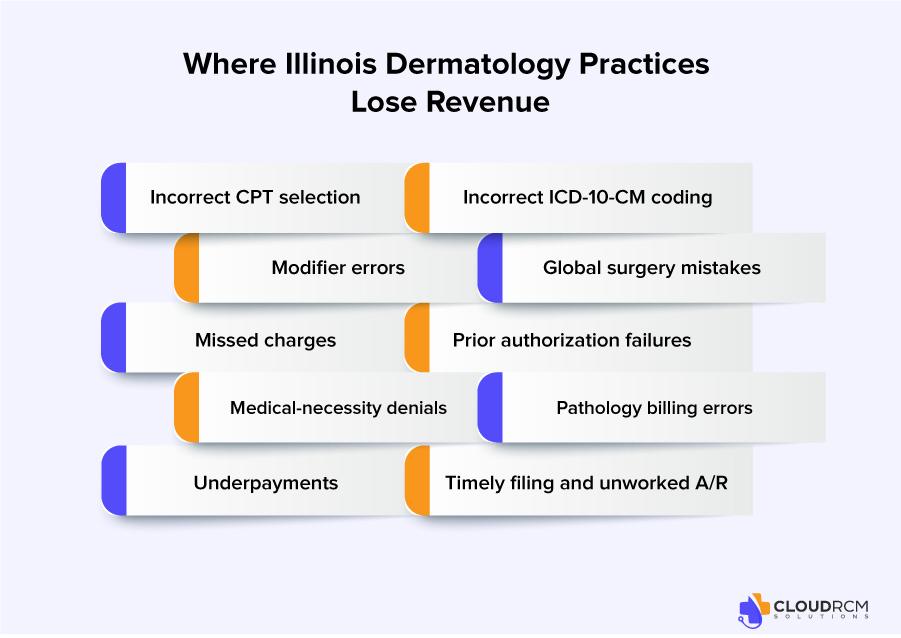
Revenue leakage does not always appear as a visible denial. It can occur before a claim is submitted, during adjudication, or after payment.
1. Prior Authorization
Biologics, specialty medications, phototherapy, and certain procedures may require authorization depending on the payer. Authorization should match the service, diagnosis, provider, and approved dates.
2. Modifier Management
Dermatology claims may use modifiers such as 25, 50, 51, 58, 59, 76, 78, 79, RT, and LT. Each modifier should be supported by documentation and payer rules.
3. CPT Coding Errors
Dermatology codes can depend on procedure type, technique, lesion size, location, number, and documentation. Accurate measurement is especially important for excision coding. Learn more about Lesion Measurement & Excision Coding.
4. ICD-10-CM Errors
Diagnosis codes should accurately reflect the documented condition and support medical necessity. Incorrect or nonspecific diagnoses can trigger payer denials.
5. Missed Charges
Biopsies, injections, pathology, phototherapy, and other services can be missed during charge capture. Practices should reconcile clinical documentation, procedure logs, charges, and claims.
6. Medical Necessity Denials
Payers may deny services when the diagnosis or documentation does not support medical necessity. Claims should be reviewed against payer policies and clinical documentation.
7. Underpayments and Bundling
A paid claim is not always correctly paid. Compare reimbursement against contracts, fee schedules, NCCI edits, units, modifiers, and bundling rules. See our guide to Dermatology Overbilling & Undercollection for additional insights.
8. Timely Filing and A/R
Late claims and unresolved denials can turn collectible revenue into permanent losses. Track filing deadlines, denial dates, appeals, aging A/R, and payer follow-up.
Common Dermatology Billing Denials in Illinois
Common dermatology denials often involve coding, eligibility, authorization, medical necessity, bundling, and timely filing.
| Denial | Common Cause | Key Action |
|---|---|---|
| CO-4 | Modifier/CPT issue | Review modifier and NCCI rules |
| CO-16 | Missing/incorrect information | Correct missing claim details |
| CO-18 | Duplicate claim | Verify original claim status |
| CO-22 | Other insurance | Verify COB and payer order |
| CO-29 | Timely filing | Submit proof of timely filing |
| CO-50 | Medical necessity | Review documentation and payer policy |
| CO-97 | Bundled service | Check NCCI and distinct-service rules |
| Authorization Denial | Missing/invalid authorization | Verify authorization before service |
| Eligibility Denial | Inactive/incorrect coverage | Verify eligibility and payer |
| Pathology Denial | Incorrect billing arrangement | Reconcile professional/technical components |
| Underpayment | Incorrect reimbursement | Compare payment with contract/fee schedule |
Important: A denial code alone may not explain the root cause. Review the RARC, payer policy, claim history, coding, documentation, and eligibility before correcting or appealing a claim.
Common EHR & Practice Management Software for Dermatology Practices in Illinois
The right EHR and practice management platform depends on practice size, number of providers, procedure volume, pathology workflow, medication management, locations, and RCM requirements.
| EHR / Software | Best Fit | Dermatology Capabilities | RCM & Integration Considerations |
| Modernizing Medicine (ModMed) | Dermatology-focused practices and groups | Specialty-specific documentation, dermatology workflows, image management, scheduling and clinical documentation | Integrated practice management, billing, analytics and specialty workflows |
| Epic | Large dermatology groups and health systems | Enterprise EHR, clinical documentation, imaging and interoperability | Strong health-system integration; evaluate dermatology workflows, interfaces and billing configuration |
| athenaOne | Independent to large practices | EHR, scheduling, documentation, patient engagement and practice management | Combines EHR, PM and RCM functionality with payer connectivity and reporting |
| eClinicalWorks | Independent and multi-provider practices | Clinical documentation, templates, patient engagement and practice management | Cloud-based EHR/PM with billing and RCM integrations |
| AdvancedMD | Independent specialty practices | EHR, scheduling, documentation and practice management | Integrated PM and RCM tools; evaluate dermatology-specific workflows during implementation |
| Tebra | Smaller independent practices | EHR, scheduling, documentation and patient engagement | Combines practice management and billing tools for independent practices |
Already using an EHR or practice management platform? CloudRCM Solutions can work with your existing system to support dermatology coding, claims, payment posting, denial management, and A/R without requiring your practice to replace its current software.
How Dermatology Billing Services Improve Illinois RCM
An effective dermatology RCM strategy connects front-end verification, clinical documentation, coding, billing, payment posting, denial management, and A/R recovery.
1. Verify Coverage Before the Encounter
Confirm eligibility, benefits, network status, deductible, coinsurance, exclusions, and authorization requirements before the service is performed. For specialty medications and procedures, verify the payer’s specific coverage criteria rather than relying only on general eligibility.
2. Audit High-Value Dermatology Claims
Prioritize claims involving:
- Mohs surgery
- Excision and repair
- Multiple biopsies
- Complex procedures
- Specialty medications
- Biologics
- Injection services
- High-dollar pathology-related workflows
Pre-bill review can identify documentation, coding, modifier, authorization, and charge-capture problems before they become denials.
3. Capture Every Billable Service
Compare appointment schedules, clinical notes, procedure documentation, medication administration records, pathology information, and charge tickets.
This helps identify missed procedures, incorrect units, missing drug charges, and other charge-capture issues that can reduce dermatology practice revenue.
4. Monitor Payer-Specific Denials
Track denials by:
- Payer
- CPT/HCPCS code
- ICD-10-CM diagnosis
- Provider
- Location
- Procedure
- Modifier
- Authorization issue
- Medical-necessity reason
Analyzing denial patterns helps practices address the underlying workflow problem instead of repeatedly correcting individual claims.
5. Review Payments for Underpayments
A claim marked “paid” is not necessarily a correctly paid claim. Dermatology billing teams should compare payer payments against contracted rates, fee schedules, allowed amounts, multiple-procedure rules, drug reimbursement, and applicable payer policies to identify underpayments and incorrect contractual adjustments.
Partner With an Illinois Dermatology Billing Team
Dermatology practices can lose revenue through missed charges, incorrect diagnosis coding, modifier errors, authorization problems, underpayments, and unresolved A/R. These issues become more significant when a practice handles medical dermatology, surgical dermatology, Mohs surgery, pathology coordination, specialty medications, and cosmetic services under one revenue cycle. CloudRCM Solutions provides Dermatology billing services in Illinois focused on specialty coding, charge capture, claim submission, denial management, payment posting, underpayment review, and A/R recovery.
Schedule a free billing assessment with CloudRCM Solutions to identify billing inefficiencies, revenue leakage, denial trends, and opportunities to strengthen your dermatology practice’s financial performance.
FAQ’s
What are the key Illinois payer requirements for dermatology billing?
Practices may need to follow Medicare, Illinois Medicaid/HFS, HealthChoice Illinois MCO, commercial payer, and contract-specific requirements.
What should dermatology practices know about Mohs billing?
Mohs billing requires accurate documentation, CPT selection, stages, units, modifiers, and compliance with applicable payer and global-surgery requirements.