Medical Billing
 Medical Coding
 Medical Audit
 Provider Credentialing
 Denial Management
 A/R Follow-up
 Private Practice
 Patient Help Desk
 Customized Reporting
 Out-of-Network Billing
 Internal Medicine
 Pediatrics
 Radiology
 Surgery
 Emergency Medicine
 Anesthesiology
 Cardiology
 Orthopedic
 Psychiatry
 Dentistry
 OB-GYN
 Family Medicine
To improve transparency and support healthcare research, the Centers for Medicare & Medicaid Services (CMS) released the Medicaid Provider Enrollment Segments public dataset covering provider enrollment activity from January 2018 through December 2024. While the dataset is primarily designed for researchers, policymakers, and healthcare analysts, it also offers valuable insights for physicians, hospitals, clinics, and medical billing professionals seeking to strengthen their Medicaid enrollment processes.
For providers, the key takeaway is simple: accurate enrollment is the foundation of timely reimbursement.
What Is the CMS Medicaid Provider Enrollment Segments Dataset?
The CMS Medicaid Provider Enrollment Segments dataset is derived from the Transformed Medicaid Statistical Information System (T-MSIS), the national data repository used by state Medicaid and CHIP programs to submit provider, beneficiary, and claims information to CMS.
Unlike a provider directory, this dataset represents historical enrollment periods rather than a current list of active providers.
Each record represents one enrollment segment for a provider within a specific state or territory. Since providers may enroll in multiple states, change enrollment status, or revalidate over time, the same provider can appear in multiple records.
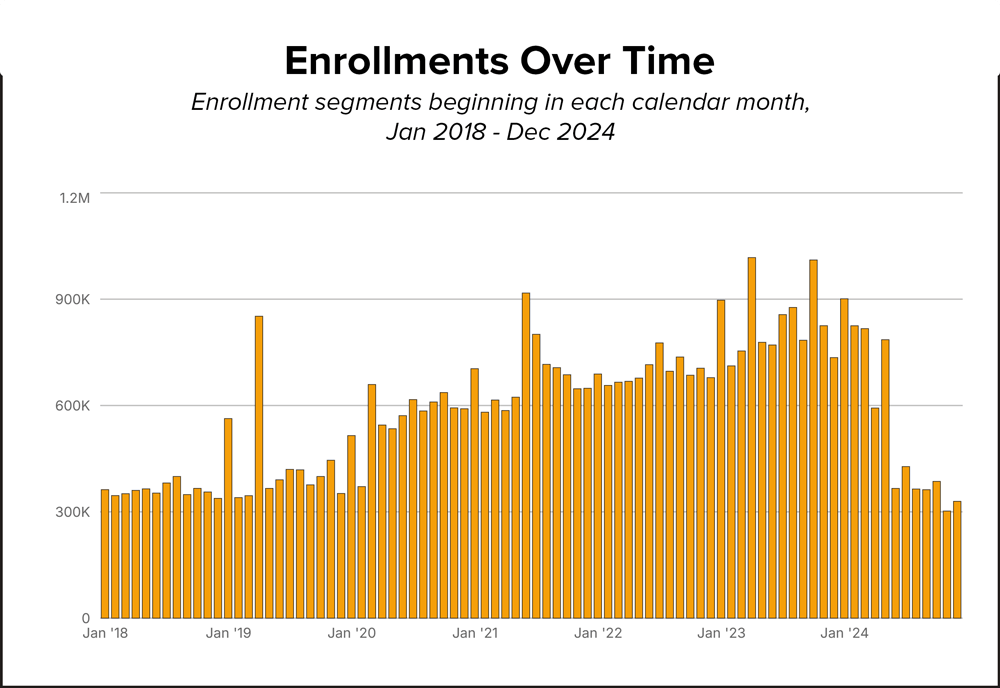
The dataset covers all 50 states, the District of Columbia, and U.S. territories, making it one of the most comprehensive public resources for analyzing Medicaid provider participation.
CMS Dataset at a Glance
| Dataset Attribute | Details |
| Source | CMS T-MSIS |
| Coverage Period | January 2018 – December 2024 |
| Geographic Coverage | All 50 States, District of Columbia, and U.S. Territories |
| Programs Included | Medicaid and CHIP |
| Granularity | Provider Enrollment Segment |
| Number of Public Fields | 10 |
| Latest Release | July 24, 2026 |
| 2024 Data Status | Preliminary |
Understanding Provider Enrollment Segments
One of the most important concepts in the dataset is the provider enrollment segment.
An enrollment segment represents a specific period during which a provider was enrolled in a state’s Medicaid or CHIP program.
A provider may have multiple enrollment segments because they:
- Renewed Medicaid enrollment
- Completed revalidation
- Changed enrollment status
- Participated in multiple Medicaid plans
- Practiced in multiple states
- Experienced temporary enrollment interruptions
Rather than combining all enrollment activity into one record, CMS preserves each enrollment period separately to provide a complete historical timeline.
This structure allows researchers to analyze enrollment trends while helping providers better understand how Medicaid participation changes over time.
Key Fields Included in the Dataset
The public dataset contains ten standardized fields that describe each enrollment segment.
| Field | Purpose |
| NPI | National Provider Identifier when a qualifying 10-character source identifier is available. |
| STATE_CD | USPS state or territory abbreviation. |
| ENRL_START_DT | Enrollment segment start date. |
| ENRL_END_DT | Enrollment segment end date. Blank generally indicates an open-ended enrollment segment. |
| ENRL_STATUS_CD | Raw Medicaid enrollment status code. |
| ENRL_STATUS_DESC | Description of the provider’s enrollment status. |
| ENRL_PLAN_CD | Medicaid or CHIP enrollment plan code. |
| ENRL_PLAN_DESC | Description of the enrollment plan. |
| PRVDR_TYPE | Provider entity type code. |
| PRVDR_TYPE_DESC | Description of the provider type. |
Although the dataset includes the NPI when available, CMS clearly states that NPI is not the unique identifier for each record. Multiple enrollment segments may exist for the same provider.
Why Medicaid Provider Enrollment Matters
Many reimbursement challenges begin long before a claim reaches the payer.
Enrollment issues frequently result in:
- Claim denials
- Delayed reimbursement
- Manual claim rework
- Increased accounts receivable
- Compliance risks
- Provider payment interruptions
Providers often focus on coding accuracy while overlooking enrollment maintenance. However, even correctly coded claims may be rejected if enrollment information does not match payer records.
Maintaining accurate enrollment information helps establish a stronger foundation for every stage of the revenue cycle.
Common Enrollment Changes That Affect Billing
Healthcare organizations should promptly update Medicaid enrollment whenever significant provider or practice changes occur.
Examples include:
- New practice locations
- Group affiliation changes
- Tax Identification Number updates
- National Provider Identifier (NPI) corrections
- Taxonomy changes
- Ownership transitions
- License renewals
- Provider additions or departures
Failing to report these updates can create unnecessary billing delays and reimbursement issues.
Medicaid Enrollment and Revenue Cycle Management
Provider enrollment is one of the earliest stages of the revenue cycle.
Before claims can be submitted successfully, providers must be properly enrolled with the appropriate Medicaid agencies and participating managed care organizations.
An effective enrollment strategy supports:
- Faster claim acceptance
- Fewer enrollment-related denials
- Reduced administrative workload
- Improved payment turnaround times
- Better compliance with payer requirements
Healthcare organizations that proactively manage enrollment often experience fewer preventable reimbursement disruptions.
Best Practices for Healthcare Providers
Providers can strengthen their enrollment processes by following several best practices.
1. Verify Enrollment Information Regularly
Review provider demographics, NPIs, taxonomy codes, practice locations, and payer enrollment records to ensure consistency across all systems.
2. Track Revalidation Requirements
Many Medicaid agencies require providers to periodically revalidate enrollment information. Missing deadlines may result in enrollment termination or temporary suspension.
3. Coordinate Credentialing and Billing
Enrollment changes should be communicated promptly between credentialing teams and billing departments to prevent claim submission errors.
4. Maintain Accurate Documentation
Keep provider licenses, certifications, ownership information, and organizational records current to support ongoing enrollment compliance.
5. Monitor State-Specific Requirements
Because Medicaid is administered at the state level, enrollment requirements vary across states. Multi-state providers should monitor each Medicaid program independently.
Important Limitations of the CMS Dataset
While the CMS dataset provides valuable insights, providers should understand its limitations.
| CMS Guidance | What It Means |
| Historical dataset | It reflects enrollment history, not real-time enrollment status. |
| NPI is not a unique key | Providers may appear multiple times. |
| Blank or placeholder NPIs | Some records may contain blank values or “0000000000.” |
| 2024 data are preliminary | Information may change as states finalize submissions. |
| State reporting varies | Cross-state comparisons should be interpreted carefully. |
| Placeholder dates may appear | Dates such as 1900-01-01 or 1970-01-01 may originate from source systems. |
These limitations reinforce the importance of verifying current enrollment status directly with state Medicaid agencies rather than relying solely on historical datasets.
How CloudRCM Helps Providers Stay Enrolled and Get Paid Faster

Keep your Medicaid enrollment active and improve cash flow with CloudRCM’s expert provider enrollment and revenue cycle management services. We handle credentialing, recredentialing, CAQH updates, payer enrollment, billing, denial management, and A/R follow-up, helping healthcare providers reduce administrative challenges, avoid reimbursement delays, and receive payments faster. Partner with CloudRCM to streamline your enrollment process and maximize revenue.
Conclusion
The CMS Medicaid Provider Enrollment Segments dataset reinforces that provider enrollment is an ongoing responsibility, not a one-time process. Keeping enrollment records accurate, meeting revalidation requirements, and proactively managing provider information helps reduce claim denials, protect reimbursement, and maintain compliance. Partnering with an experienced RCM company ensures your practice stays enrolled, gets paid faster, and supports long-term financial success.